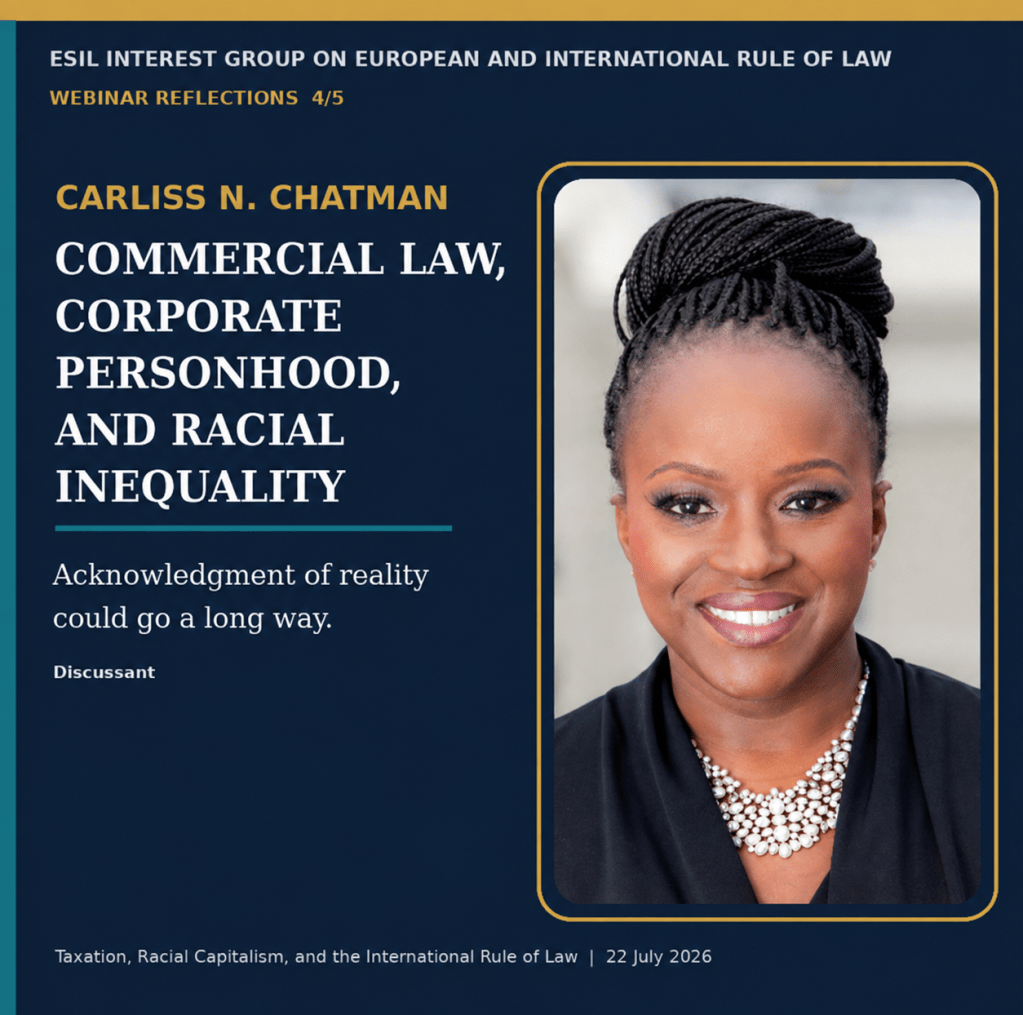

Carliss N. Chatman: Commercial Law, Corporate Personhood, and Racial Inequality– Reflections on the Inaugural Webinar – ESIL Interest Group on European and International Rule of Law Webinar Series · Webinar 1 · Reflection 4/5
As discussant in the inaugural ESIL Interest Group webinar, Carliss N. Chatman brought the perspectives of corporate and commercial law into the conversation between Anthony C. Infanti’s The Human Toll: Taxation and Slavery in Colonial America and Steven A. Dean’s Racial Capitalism and International Tax Law: The Story of Global Jim Crow.
Professor Chatman began with legal education. She explained that she uses both books in her course on Entrepreneurship, Race, and Inequality, together with Dorothy A. Brown’s scholarship. These works encourage students to examine the racial, gendered, and identity-based consequences of tax policy that conventional doctrinal teaching frequently leaves unexplored. Professor Chatman’s classroom examples illustrated a premise I had established in the discussion guide that I prepared as chair and moderator and circulated to all the speakers before the webinar: legal rules should not automatically be treated as neutral merely because they are expressed in technical or formally general terms. The broader question I had proposed was how legal categories and institutions operate as forms of epistemic governance and gatekeeping—determining which consequences become visible, which forms of knowledge are treated as authoritative, whose claims receive recognition, and which inequalities remain obscured.
Turning to Professor Infanti’s work, Professor Chatman reflected on the legal inversion embodied in slaveholder-compensation schemes. When an enslaved person was executed or killed under color of law, the legal system recognized an economic loss suffered by the owner while refusing to recognize the enslaved person’s humanity, suffering, or loss of life. Violence against a human being was translated into an injury to property for which the owner could receive public compensation.
Professor Chatman connected this history to her own scholarship on teaching slavery in commercial law. Slavery was not external to the development of American commercial institutions. It shaped legal understandings of property, exchange, credit, contractual ordering, and economic value that continue to influence the organization and teaching of modern commercial doctrine. Her intervention therefore emphasized the importance of confronting this history within subjects that are still frequently presented as technical, private, and racially neutral.
Professor Chatman also introduced corporate personhood as an important dimension of the conversation. Corporate personhood enables organized capital to own property, enter contracts, initiate litigation, exercise legally protected forms of speech, operate across borders, and separate institutional control from individual responsibility. Her analysis invited closer attention to the legal privileges, capacities, and protections attached to the corporate form, as well as to the different forms of recognition historically accorded to corporations, property owners, workers, and racialized communities.
In her final response, Professor Chatman identified acknowledgment as an essential first step. In corporate and commercial law, she observed, it can remain controversial simply to recognize that legal and economic outcomes differ according to race or that markets are not neutral. Yet without acknowledging those realities, it is impossible to diagnose the structures that produce inequality or to begin considering meaningful forms of repair.
As I explained in the discussion guide that I prepared as chair and moderator and circulated to all the speakers before the webinar—and reiterated following Professor Chatman’s intervention—remaining within separate disciplinary silos can prevent us from seeing the larger institutional picture. Tax, corporate, commercial, administrative, constitutional, comparative, and international law should not be treated as isolated intellectual worlds when their rules operate together to distribute authority, resources, vulnerability, responsibility, and recognition.
I situated this problem of disciplinary fragmentation within my work on epistemic governance. Legal institutions do not merely receive facts, categories, and expertise produced elsewhere. They participate in determining what counts as relevant knowledge, who is entitled to speak with authority, which experiences enter the legal record, which questions are accepted as legitimate subjects of legal analysis, and which persons or claims are discounted, excluded, or rendered invisible.
From this perspective, the conventional division between public and private law becomes increasingly difficult to sustain. Constitutional rights and public-law protections cannot be considered separately from the private-law institutions that structure participation in economic life. Together, these fields influence whose labor produces wealth, whose accumulated wealth receives legal protection, whose losses are recognized and compensated, who bears public burdens, and whose claims are rendered visible or excluded.
A central premise of the framework I developed for the webinar was that the two books reveal different historical and institutional expressions of a related legal ordering. Professor Infanti reconstructed a colonial fiscal system that recognized the slaveholder’s proprietary loss while excluding the enslaved person’s humanity. Professor Dean showed how international tax rules and institutions later protected mobile capital while restricting the fiscal sovereignty and developmental capacity of postcolonial states. Professor Chatman’s commercial-law perspective helped us consider how property, contract, and the corporate form participate in this wider organization of power and responsibility.
The broader institutional-design and rule-of-law questions around which I organized the webinar followed from this framework. Because law participates in creating markets, corporations, fiscal categories, economic incentives, and structures of recognition, these arrangements are neither natural nor inevitable. They can be examined, contested, and reconstructed. Repair therefore cannot be assigned exclusively to taxation, constitutional law, corporate law, or any other isolated field. It requires an approach to institutional design that connects taxation, private ordering, public responsibility, corporate accountability, economic citizenship, historical memory, and material redistribution.
Professor Chatman’s call to acknowledge reality provides the necessary point of departure. My concluding reflection was that acknowledgment must lead beyond diagnosis toward institutional reconstruction. A rule of law capable of responding to racial capitalism must do more than apply formally neutral rules consistently. It must also examine how legal institutions distribute power and resources, whose interests they recognize, which histories they preserve, and whether their design makes justice and meaningful repair possible.
Because readers may not have seen those earlier posts, the principal bibliography is reproduced below.
Selected Bibliography
Books in Dialogue
Dean, Steven A. (2025). Racial Capitalism and International Tax Law: The Story of Global Jim Crow. Oxford: Oxford University Press – Examines how international tax law has historically contributed to racialized structures of economic power and inequality on a global scale.
Infanti, Anthony C. (2025). The Human Toll: Taxation and Slavery in Colonial America. New York: New York University Press – Explores the relationship between taxation, slavery, and state-building in colonial America, highlighting the human costs embedded in fiscal and legal institutions.
Related Scholarship by Steven A. Dean
Racialized International Tax Law in Research Handbook on Critical Tax Studies (forthcoming Edinburgh University Press, Yvette Lind and Dominic de Cogan, eds.)
Fear of a Black Planet: Africa’s Decolonisation and the Transformation of the International Tax Regime in Taxing People: The Next 100 Years (Cambridge University Press 2026, Tsilly Dagan and Ruth Mason, eds.)
Filing While Black: The Casual Racism of the Tax Law, 2022 Utah Law Review 801, available at https://papers.ssrn.com/sol3/papers.cfm?abstract_id=4081456
Inclusive International Tax Policymaking: FATCA, the U.S. Congressional Black Caucus, and the OECD Blacklist, Revue Européenne et Internationale de Droit Fiscal(2021) (Reprinted in Tax Notes International)
Ten Truths about Tax Havens: Inclusion and the ‘Liberia’ Problem, 70 Emory Law Journal1657 (2021) (with Attiya Waris), available at https://papers.ssrn.com/sol3/papers.cfm?abstract_id=3822421
Dean’s SSRN Author Page https://papers.ssrn.com/sol3/cf_dev/AbsByAuth.cfm?per_id=440250
Related Scholarship by Anthony Infanti
Our Selfish Tax Laws: Toward Tax Reform That Mirrors Our Better Selves (The MIT Press 2018).
Critical Tax Theory: An Introduction (Cambridge University Press, Anthony C. Infanti & Bridget J. Crawford eds., 2009). The Introduction is available at https://papers.ssrn.com/sol3/papers.cfm?abstract_id=1333799
Internation Equity and Human Development, in Tax, Law and Development (Edward Elgar Publishing, Miranda Stewart & Yariv Brauner eds., 2013).
Tax Equity, 55 Buff. L. Rev. 1191 (2008), available at https://digitalcommons.law.buffalo.edu/buffalolawreview/vol55/iss4/5/
Tax and Time: On the Use and Misuse of Legal Imagination (NYU Press 2022), available at https://papers.ssrn.com/sol3/papers.cfm?abstract_id=4006652
Tax Reform Discourse, 32 Va. Tax Rev. 205 (2012), available at https://papers.ssrn.com/sol3/papers.cfm?abstract_id=2034869
Critical Tax Theory: Insights from the US and Opportunities for All, 51 Austl. Tax Rev. 81 (2022) (with Bridget J. Crawford), available at https://papers.ssrn.com/sol3/papers.cfm?abstract_id=4236410
Infanti’s SSRN Author Page
Related Scholarship by Carliss N. Chatman
(2023). “Teaching Slavery in Commercial Law.” 28 Michigan Journal of Race & Law 1–38. SMU Dedman School of Law Legal Studies Research Paper No. 611. Available at SSRN: https://papers.ssrn.com/sol3/papers.cfm?abstract_id=3926671 – Examines how slavery and its enduring legacies can be more meaningfully integrated into the teaching and understanding of commercial law.
(2026). “The Contract and the Cure: Building a Private Infrastructure for Reparations.” In Slavery’s Long Tentacles: Entanglements in Historical and Modern Forms of Slavery (Cambridge University Press, forthcoming). https://ssrn.com/abstract=6140369 – Explores the role of private law, contracts, and institutional design in advancing reparative justice for the enduring harms of slavery.
(October 24, 2024). “1981”, 82 Wash. & Lee L. Rev. 1655 (2026), SMU Dedman School of Law Legal Studies Research Paper No. 666, Available at SSRN: https://ssrn.com/abstract=4998718 – Analyzes the continuing significance of 42 U.S.C. § 1981 and its role in addressing racial discrimination, equality, and access to economic opportunity.
(2018). “The Corporate Personhood Two-Step.” 18 Nevada Law Journal 811–862. Posted July 17, 2017; revised August 11, 2023. Chatman, Carliss, The Corporate Personhood Two-Step (June 25, 2017). 18 Nev. L. J. 811 (2018), Available at SSRN: https://ssrn.com/abstract=2992275 – Investigates how legal doctrines of corporate personhood shape corporate power, accountability, and the allocation of rights within modern governance systems.
Chatman’s SSRN Author Page https://papers.ssrn.com/sol3/cf_dev/AbsByAuth.cfm?per_id=2419097
Related Scholarship by Paolo D. Farah
(2026). Epistemic Governance. Available at SSRN: https://papers.ssrn.com/sol3/papers.cfm?abstract_id=6487038 – Develops a framework for understanding how knowledge, authority, expertise, and competing narratives shape governance structures, institutional legitimacy, and global ordering.
(2025) China’s Path to Modernization and Legal Pluralism: Transplants and the Belt and Road Initiative, Asian Journal of Law and Society, Cambridge University Press https://papers.ssrn.com/sol3/papers.cfm?abstract_id=5215873 – Examines how competing legal traditions, governance models, and development paradigms contribute to evolving forms of legal pluralism and the reconfiguration of global order.
(2024). “Energy Justice, Just Transition and International Environmental Law.” In ASIL Proceedings (Just Energy Transition: Legal Challenges Associated with Coal Phase Out), Cambridge University Press. Available at SSRN: https://papers.ssrn.com/sol3/papers.cfm?abstract_id=5055884 – Explores how legal and governance frameworks shape the distribution of benefits and burdens during energy transitions, highlighting questions of historical responsibility, distributive justice, institutional legitimacy, and the role of law in addressing structural inequalities associated with climate and energy transformation.
Farah’s SSRN Author Page https://papers.ssrn.com/sol3/cf_dev/AbsByAuth.cfm?per_id=629289
Paolo Farah, Paolo Davide Farah
Suggested visual caption
Webinar Reflections 4/5: Carliss N. Chatman—Commercial Law, Corporate Power, and the Recognition of Racial Inequality