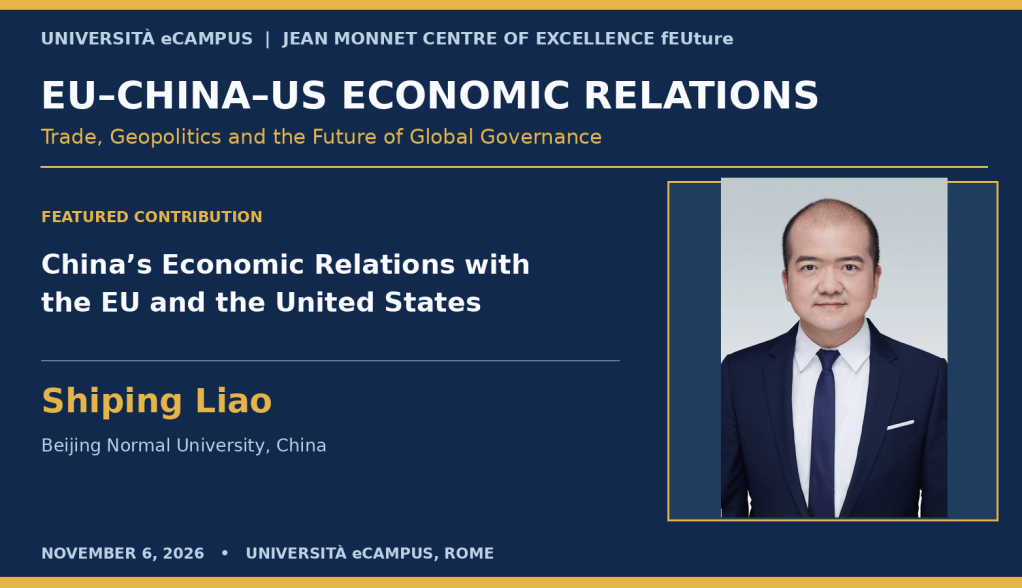


Shiping Liao — EU–China Trade Relations: Labour Standards, Technology-Enabled Compliance, and Regulatory Cooperation – Workshop on EU–China–US Economic Relations: Trade, Geopolitics and the Future of Global Governance | Part 3
Shiping Liao: Can technological innovation help bridge differences between European and Chinese approaches to labour standards and international trade?
This question was central to the contribution of Professor Shiping Liao of Beijing Normal University at our November 6 workshop.
Shiping examined the relationship between labour protection, market access, and EU–China trade relations, highlighting how regulatory requirements may be understood differently in Brussels and Beijing.
In the European context, labour standards are closely connected to social protection and fair competition. From a Chinese perspective, trade-linked labour requirements may also be perceived as external regulatory pressure.
Rather than treating these differences as an inevitable source of confrontation, Shiping explored a possible avenue for cooperation.
Drawing on examples of technology-assisted environmental monitoring in China, he proposed examining whether similar systems could improve the reliability of labour-compliance information and support Chinese enterprises seeking to meet European regulatory requirements.
His contribution also addressed Taiwan’s importance in semiconductor manufacturing, mainland China’s technological development, and the use of export restrictions and critical materials as instruments of economic leverage.
These issues generated an especially productive exchange.
Building on his proposal, I raised a question from my research on epistemic governance: technological monitoring can improve traceability, but who controls the information, verifies its accuracy, and ensures that affected workers have meaningful remedies?
A digital compliance system is not necessarily an accountable compliance system.
This exchange illustrates why international economic law increasingly needs to engage with technology governance, evidence, labour rights, and institutional accountability.
It was particularly meaningful to reconnect with Shiping, whom I have known since our early years of research on China and WTO law more than two decades ago.
Thank you, Shiping, for a stimulating contribution and for opening new possibilities for comparative research and dialogue.
 Full workshop report: [INSERT REPORT LINK]
#EUChinaRelations #WTOLaw #LabourRights #TradeLaw #TechnologyGovernance #EpistemicGovernance #Semiconductors