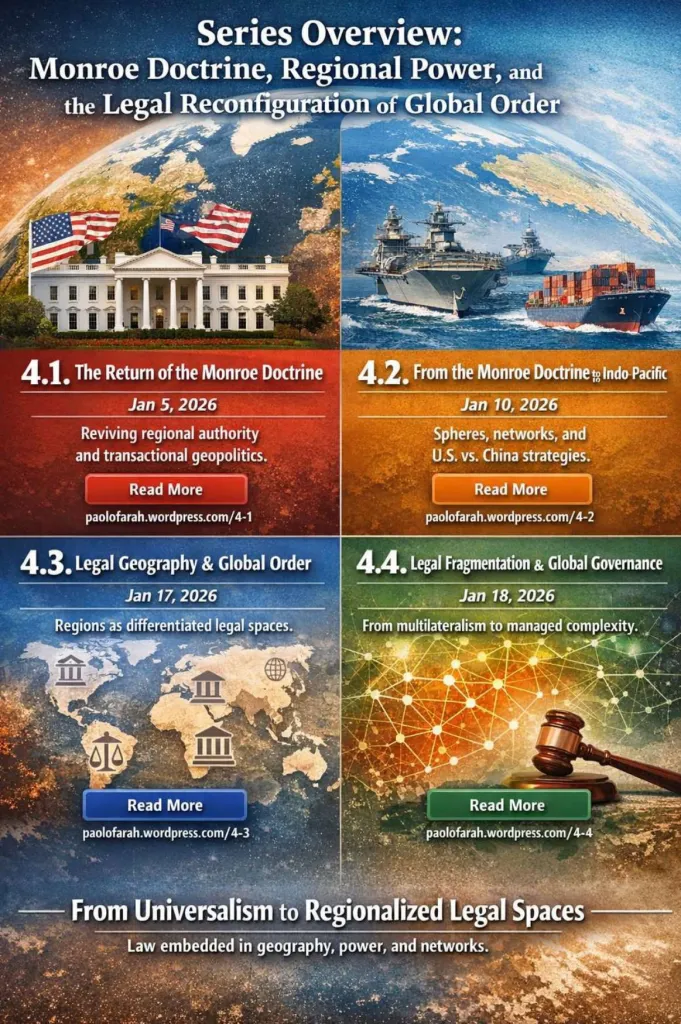
This concluding post brings together the core insights of the series and clarifies what is truly at stake in the transformation of global order.
Across Parts 4.1-4.4, a structural pattern emerged. What began with the return of Monroe-style regional logic expanded into an examination of networked power in the Indo-Pacific, the transformation of legal geography, and the strategic fragmentation of global governance.
Taken together, these developments reveal a deeper shift.
We are no longer operating within a fully universalist legal order. Instead, international law is increasingly embedded within regional power architectures. Geography, infrastructure, standards, and institutional design now shape how authority is exercised and how access is structured.
The Monroe Doctrine, in this context, should not be understood as a revived 19th-century policy. It represents a recurring structural logic: powerful states seek to organize space through privileged regional authority.
The Indo-Pacific Strategy and China’s Belt and Road Initiative exemplify this logic. Influence is exercised through:
- Supply-chain integration
- Infrastructure corridors
- Legal agreements and standards
- Network-based institutional coordination
The outcome is not the collapse of international law, but its reconfiguration.
Global governance is moving toward structured pluralism — a world of overlapping regimes, differentiated legal spaces, and region-specific legitimacy. Law no longer floats above power politics. It operates within it.
This transformation does not necessarily mean instability. But it does mean that coherence must now be managed rather than assumed.
The series ultimately argues that we are witnessing a legal reorganization of global order — where geography, power, and networks redefine how rules function across regions.
Read the full overview here: