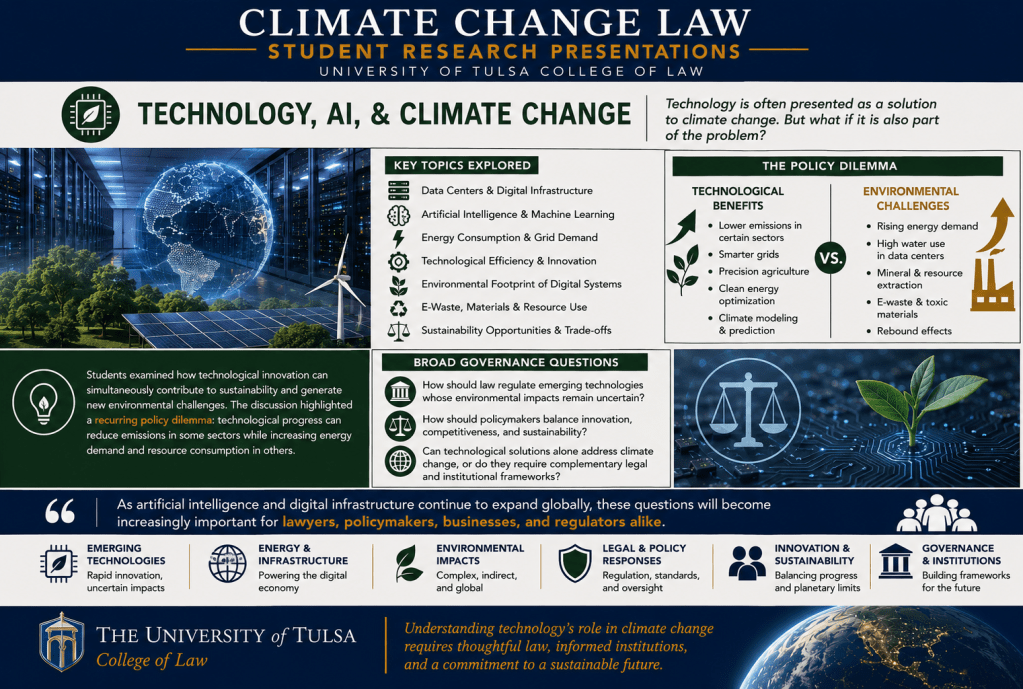

Technology, AI, and Climate Change
Technology is often presented as a solution to climate change. But what if it is also part of the problem?
One thought-provoking presentations in my Climate Change Law course at the University of Tulsa College of Law explored the complex relationship between technology, artificial intelligence, and climate change.
Students examined how technological innovation can simultaneously contribute to sustainability and generate new environmental challenges. Topics included data centers, artificial intelligence, digital infrastructure, energy consumption, technological efficiency, and the often-overlooked environmental footprint of digital systems.
The discussion highlighted a recurring policy dilemma: technological progress can reduce emissions in some sectors while increasing energy demand and resource consumption in others.
The presentation also raised broader governance questions:
How should law regulate emerging technologies whose environmental impacts remain uncertain?
How should policymakers balance innovation, competitiveness, and sustainability?
Can technological solutions alone address climate change, or do they require complementary legal and institutional frameworks?
As artificial intelligence and digital infrastructure continue to expand globally, these questions will become increasingly important for lawyers, policymakers, businesses, and regulators alike.
One of the most rewarding aspects of teaching is discovering which questions students consider most important when given the opportunity to explore complex legal challenges on their own.
Over the course of this semester in my Climate Change Law course at the University of Tulsa College of Law, twenty students worked in teams of five to develop two rounds of collaborative research presentations on topics of their own choosing.
The course itself was structured around weekly doctrinal modules examining how climate change intersects with different areas of law, including international law, torts, contracts, property, civil procedure, constitutional law, administrative law, legislation, federal courts, corporate governance, energy law, environmental justice, and technology governance.
Students were given substantial freedom to identify the questions they found most compelling, develop their own legal frameworks, and examine how climate change interacts with broader challenges of governance, institutional design, justice, and accountability. This approach allowed them to connect climate change to the legal questions they found most compelling while grounding their analysis in specific legal doctrines, institutions, and governance structures and to think critically about how law operates in addressing complex and evolving societal problems.
Another particularly rewarding aspect of the course was the collaborative process through which many of these projects evolved. Students were encouraged to develop their own research questions while receiving individualized feedback on topic selection, research design, structure, and presentation strategy. Through this iterative exchange, many refined their initial ideas, sharpened their analytical focus, strengthened their legal arguments, and connected their topics more effectively to broader debates in climate change law. The final presentations therefore reflected not only the students’ creativity and initiative, but also a process of co-production of knowledge in which dialogue, mentoring, and critical engagement helped transform preliminary interests into more sophisticated and rigorous research projects.
#ArtificialIntelligence #TechnologyLaw #ClimateChangeLaw #Sustainability #EnergyTransition #EnvironmentalLaw #LegalEducation #UniversityOfTulsa
Paolo Davide Farah, Paolo Farah