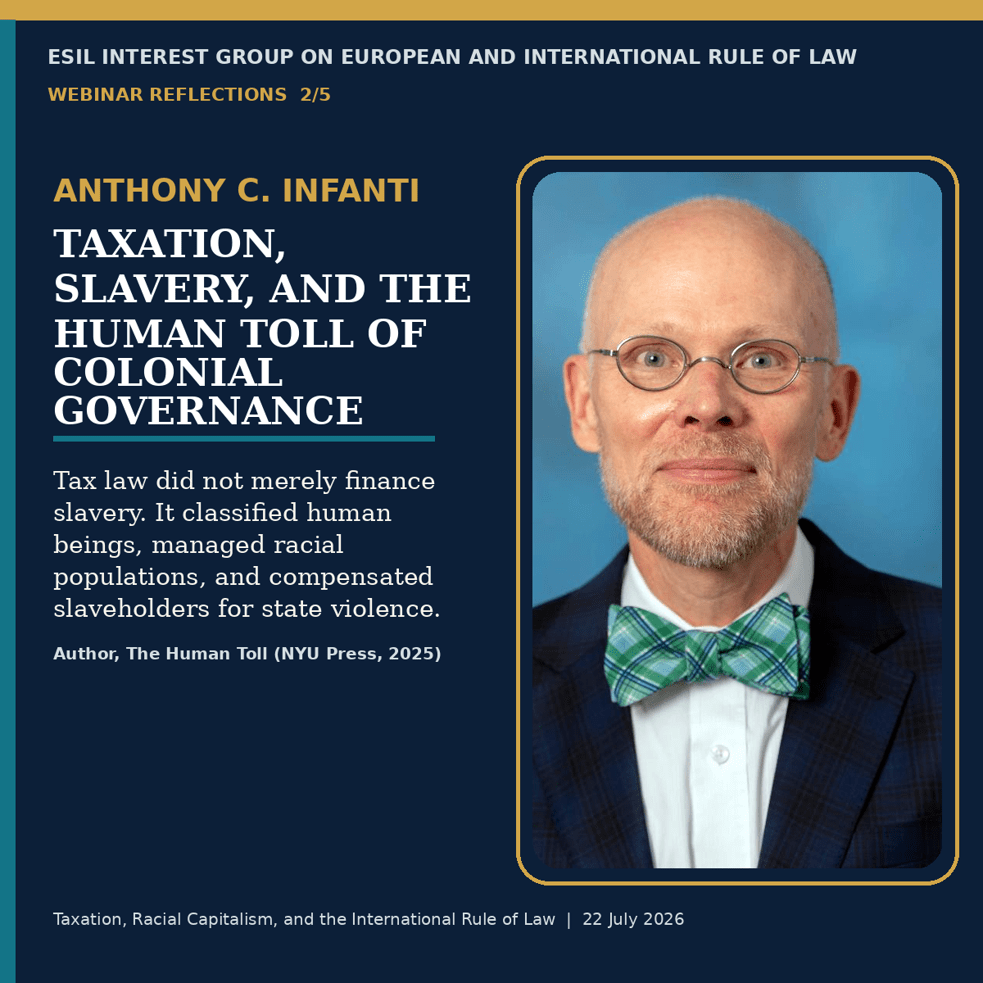

Anthony C. Infanti: Taxation, Slavery, and the Human Toll of Colonial Governance – Reflections on the Inaugural Webinar – ESIL Interest Group on European and International Rule of Law Webinar Series · Webinar 1 · Reflection 2/5
Anthony C. Infanti’s contribution to the inaugural ESIL Interest Group webinar fundamentally challenged the assumption that tax law stands apart from the legal machinery of slavery.
Presenting his 2025 book, The Human Toll: Taxation and Slavery in Colonial America, Professor Infanti explained that the project began with a question about payments made to slaveholders when enslaved persons were executed. What initially appeared to be a narrow historical practice opened onto a much broader institutional history: taxation was a routine and multifaceted component of colonial slavery, yet it had received remarkably little attention in histories of law and slavery.
The first dimension was classification. Enslaved persons were taxed upon importation through legislation that also taxed commodities such as sugar and alcohol. After arrival, poll taxes, property taxes, and estate taxes continued to encode their legal status. In several colonies, the development of slave codes accompanied a shift from taxing enslaved persons as people toward taxing them as property. Professor Infanti’s analysis demonstrated that tax law did not merely respond to classifications established elsewhere.
In my response, I connected his historical account to a broader institutional point: through the repeated application of fiscal categories, law helped normalize and reproduce the transformation of human beings into taxable property.
The second dimension was racial population management. In South Carolina, fiscal measures were used to alter the racial composition of the colony and preserve White control. Import taxes increased at moments of fear concerning resistance and rebellion. Colonial lawmakers also differentiated among enslaved persons according to origin, often taxing people arriving from other colonies or the Caribbean more heavily than those transported directly from Africa because the former were considered more familiar with the system and potentially more capable of resistance. Tax rates translated racialized judgments about danger and “tractability” into ordinary fiscal administration.
The third dimension was public compensation for slaveholders. When an enslaved person was executed or killed under color of law, the state transformed the death into a compensable economic loss to the owner. Professor Infanti traced how South Carolina moved from general revenues to targeted levies on slaveholders, then to broader property taxes and eventually a colony-wide fiscal system tightly linked to approved claims. Each financing method communicated a judgment about whether slavery and its enforcement were a private cost of slaveholding or a collective public benefit.
His archival method was equally important. Slave courts frequently kept no records, executions occurred quickly, and some archival collections were later destroyed. Tax schedules survived because governments needed to document payments, but they usually preserved the slaveholder’s name rather than the enslaved person’s. By reading tax laws together with legislative history, pardon requests, petitions, newspapers, and other sources, Professor Infanti reconstructed names, accusations, resistance, and fragments of lives that the official archive had pushed to the margins.
Professor Infanti’s archival reconstruction also provided the basis for a broader connection I emphasized during the discussion: legal records preserve what institutions consider valuable and authoritative. The slaveholder’s property claim generated fiscal documentation, while the identity, experiences, and humanity of the enslaved person were frequently excluded from the official record. I therefore suggested that the archive should itself be understood as part of the institutional and epistemic architecture of racial capitalism.
In the final round, Professor Infanti contrasted the expansive fiscal imagination used to construct and sustain slavery with the restrictive doctrines that now constrain reparations. Colonial lawmakers experimented freely with taxes, incentives, and compensation, while contemporary efforts to repair those harms are narrowed by constitutional doctrines and commitments to colorblindness.
Building on his answer, I posed a broader question concerning institutional design and the rule of law: can law recover an equally ambitious imagination for repair—this time directed toward those whose lives, labor, wealth, dignity, and legal recognition were denied?
Because readers may not have seen those earlier posts, the principal bibliography is reproduced below.
Selected Bibliography
Books in Dialogue
Dean, Steven A. (2025). Racial Capitalism and International Tax Law: The Story of Global Jim Crow. Oxford: Oxford University Press – Examines how international tax law has historically contributed to racialized structures of economic power and inequality on a global scale.
Infanti, Anthony C. (2025). The Human Toll: Taxation and Slavery in Colonial America. New York: New York University Press – Explores the relationship between taxation, slavery, and state-building in colonial America, highlighting the human costs embedded in fiscal and legal institutions.
Related Scholarship by Steven A. Dean
Racialized International Tax Law in Research Handbook on Critical Tax Studies (forthcoming Edinburgh University Press, Yvette Lind and Dominic de Cogan, eds.)
Fear of a Black Planet: Africa’s Decolonisation and the Transformation of the International Tax Regime in Taxing People: The Next 100 Years (Cambridge University Press 2026, Tsilly Dagan and Ruth Mason, eds.)
Filing While Black: The Casual Racism of the Tax Law, 2022 Utah Law Review 801, available at https://papers.ssrn.com/sol3/papers.cfm?abstract_id=4081456
Inclusive International Tax Policymaking: FATCA, the U.S. Congressional Black Caucus, and the OECD Blacklist, Revue Européenne et Internationale de Droit Fiscal(2021) (Reprinted in Tax Notes International)
Ten Truths about Tax Havens: Inclusion and the ‘Liberia’ Problem, 70 Emory Law Journal1657 (2021) (with Attiya Waris), available at https://papers.ssrn.com/sol3/papers.cfm?abstract_id=3822421
Dean’s SSRN Author Page https://papers.ssrn.com/sol3/cf_dev/AbsByAuth.cfm?per_id=440250
Related Scholarship by Anthony Infanti
Our Selfish Tax Laws: Toward Tax Reform That Mirrors Our Better Selves (The MIT Press 2018).
Critical Tax Theory: An Introduction (Cambridge University Press, Anthony C. Infanti & Bridget J. Crawford eds., 2009). The Introduction is available at https://papers.ssrn.com/sol3/papers.cfm?abstract_id=1333799
Internation Equity and Human Development, in Tax, Law and Development (Edward Elgar Publishing, Miranda Stewart & Yariv Brauner eds., 2013).
Tax Equity, 55 Buff. L. Rev. 1191 (2008), available at https://digitalcommons.law.buffalo.edu/buffalolawreview/vol55/iss4/5/
Tax and Time: On the Use and Misuse of Legal Imagination (NYU Press 2022), available at https://papers.ssrn.com/sol3/papers.cfm?abstract_id=4006652
Tax Reform Discourse, 32 Va. Tax Rev. 205 (2012), available at https://papers.ssrn.com/sol3/papers.cfm?abstract_id=2034869
Critical Tax Theory: Insights from the US and Opportunities for All, 51 Austl. Tax Rev. 81 (2022) (with Bridget J. Crawford), available at https://papers.ssrn.com/sol3/papers.cfm?abstract_id=4236410
Infanti’s SSRN Author Page
Related Scholarship by Carliss N. Chatman
(2023). “Teaching Slavery in Commercial Law.” 28 Michigan Journal of Race & Law 1–38. SMU Dedman School of Law Legal Studies Research Paper No. 611. Available at SSRN: https://papers.ssrn.com/sol3/papers.cfm?abstract_id=3926671 – Examines how slavery and its enduring legacies can be more meaningfully integrated into the teaching and understanding of commercial law.
(2026). “The Contract and the Cure: Building a Private Infrastructure for Reparations.” In Slavery’s Long Tentacles: Entanglements in Historical and Modern Forms of Slavery (Cambridge University Press, forthcoming). https://ssrn.com/abstract=6140369 – Explores the role of private law, contracts, and institutional design in advancing reparative justice for the enduring harms of slavery.
(October 24, 2024). “1981”, 82 Wash. & Lee L. Rev. 1655 (2026), SMU Dedman School of Law Legal Studies Research Paper No. 666, Available at SSRN: https://ssrn.com/abstract=4998718 – Analyzes the continuing significance of 42 U.S.C. § 1981 and its role in addressing racial discrimination, equality, and access to economic opportunity.
(2018). “The Corporate Personhood Two-Step.” 18 Nevada Law Journal 811–862. Posted July 17, 2017; revised August 11, 2023. Chatman, Carliss, The Corporate Personhood Two-Step (June 25, 2017). 18 Nev. L. J. 811 (2018), Available at SSRN: https://ssrn.com/abstract=2992275 – Investigates how legal doctrines of corporate personhood shape corporate power, accountability, and the allocation of rights within modern governance systems.
Chatman’s SSRN Author Page https://papers.ssrn.com/sol3/cf_dev/AbsByAuth.cfm?per_id=2419097
Related Scholarship by Paolo D. Farah
(2026). Epistemic Governance. Available at SSRN: https://papers.ssrn.com/sol3/papers.cfm?abstract_id=6487038 – Develops a framework for understanding how knowledge, authority, expertise, and competing narratives shape governance structures, institutional legitimacy, and global ordering.
(2025) China’s Path to Modernization and Legal Pluralism: Transplants and the Belt and Road Initiative, Asian Journal of Law and Society, Cambridge University Press https://papers.ssrn.com/sol3/papers.cfm?abstract_id=5215873 – Examines how competing legal traditions, governance models, and development paradigms contribute to evolving forms of legal pluralism and the reconfiguration of global order.
(2024). “Energy Justice, Just Transition and International Environmental Law.” In ASIL Proceedings (Just Energy Transition: Legal Challenges Associated with Coal Phase Out), Cambridge University Press. Available at SSRN: https://papers.ssrn.com/sol3/papers.cfm?abstract_id=5055884 – Explores how legal and governance frameworks shape the distribution of benefits and burdens during energy transitions, highlighting questions of historical responsibility, distributive justice, institutional legitimacy, and the role of law in addressing structural inequalities associated with climate and energy transformation.
Farah’s SSRN Author Page https://papers.ssrn.com/sol3/cf_dev/AbsByAuth.cfm?per_id=629289
Paolo Farah, Paolo Davide Farah
Webinar Reflections 2/5: Anthony C. Infanti: Taxation, Slavery, and the Human Toll of Colonial Governance