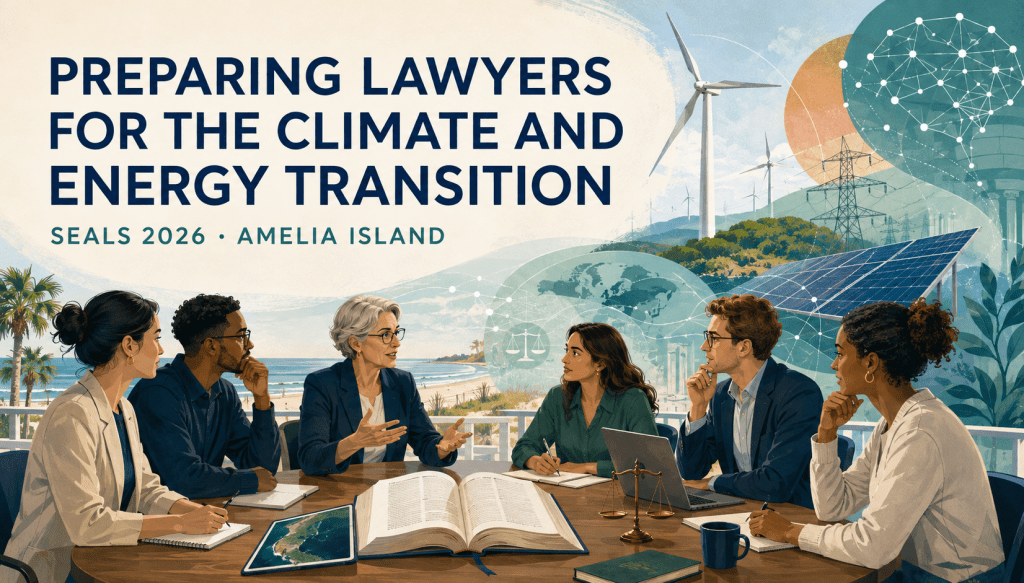
Preparing Lawyers for the Climate and Energy Transition: Experiential Pedagogy, Professional Skills, and Institutional Innovation – 2026 Southeastern Association of Law Schools (SEALS) Annual Conference
On Saturday, August 1, I organized and moderated the fourth and final interdisciplinary discussion group of my week at the 2026 Southeastern Association of Law Schools (SEALS) Annual Conference on Amelia Island:
“Preparing Lawyers for the Climate and Energy Transition: Experiential Pedagogy, Professional Skills, and Institutional Innovation.”
The discussion moved organically from questions about evidence, observation, memory, and investigation to experiential pedagogy, assessment, professional responsibility, artificial intelligence, academic integrity, and the institutional structures needed to prepare students for rapidly changing forms of legal practice.
In that respect, the session illustrated one of the greatest strengths of the SEALS discussion-group format. Rather than proceeding through a sequence of formal presentations, participants developed the conversation collectively, drawing on their experiences as teachers, scholars, lawyers, and institutional actors.
Beyond Doctrinal Knowledge
One of the central themes was that preparing lawyers for the climate and energy transition requires much more than adding environmental, climate, or energy doctrine to the curriculum.
Lawyers working in these fields must understand regulatory institutions, scientific evidence, technological systems, land and infrastructure, financial arrangements, administrative processes, community interests, and the relationships among public authorities, private actors, and civil society. They must also be able to investigate facts, communicate across disciplinary boundaries, assess uncertainty, and translate complex technical information into legal arguments and practical advice.
Participants emphasized that legal education frequently concentrates on negotiation, interviewing, counseling, and written analysis while devoting less sustained attention to investigation. The recurring instruction to “walk the land” captured the larger point: lawyers cannot always understand environmental and energy controversies from an office, a judicial opinion, or a casebook. They must sometimes examine the relevant physical setting, infrastructure, institutional practices, affected communities, and competing forms of expertise.
The climate and energy transition therefore requires a form of legal education that is simultaneously doctrinal, technical, institutional, and field-facing.
Experiential Pedagogy as a Method of Learning and Verification
The discussion explored several ways of developing these capacities through simulations, staged exercises, clinics, group projects, and role-based assignments.
In my own courses, for example, I have used simulations in which different groups act as a court, the opposing parties, government institutions, civil-society organizations, industry associations, or representatives of affected communities. Students must frame the problem, identify their institutional position, develop an argument, respond to other participants, and defend their conclusions through questioning.
I also discussed the iterative presentations adopted in my classes in which students first propose a topic, revise its framing after feedback, develop the project collaboratively, present it, and then answer questions about their choices and conclusions. This process makes experiential pedagogy more than an exercise in public speaking. It requires students to assume responsibility for the analysis they present.
That responsibility has become increasingly important in the age of generative AI. A simulation, practicum, or recorded presentation may appear to demonstrate learning, but it does not necessarily establish that each student understands or “owns” the work. Short oral examinations, individualized follow-up questions, staged submissions, and opportunities to defend a written or group project can help make the student’s reasoning visible.
These methods require additional faculty time. Nevertheless, I believe that even a brief five- or ten-minute conversation with each student may reveal far more about comprehension than a polished written product considered in isolation.
Rethinking Assessment in the Age of AI
A substantial part of the conversation focused on the growing difficulty of designing assessments that are both educationally meaningful and fair.
Take-home examinations, open-book assignments, recorded lectures, asynchronous courses, and collaborative projects all provide important pedagogical and accessibility benefits. At the same time, generative AI can now produce summaries, stock answers, research suggestions, citations, and polished prose. It may therefore become difficult to determine whether differences among student submissions reflect differences in knowledge, writing ability, access to technological assistance, or willingness to disregard course policies.
The possible responses are not simple. Closed-book examinations may protect certain forms of individual assessment but can also measure speed and memory rather than the professional capacities a course is intended to develop. Prohibiting computers may create difficulties involving accommodations and may not reflect the conditions under which most lawyers work. Elaborate AI policies can become difficult to administer and may quickly be overtaken by changes in technology.
The more productive question may be whether an assessment requires students to demonstrate that they understand, can apply, and can defend what they submit.
This does not eliminate the need for written work or carefully designed examinations. It suggests combining them with client-specific problems, oral follow-up, iterative drafting, simulations, source verification, and questions that require students to explain why a particular authority, factual assumption, or analytical choice matters.
AI Literacy as Professional Responsibility
The conversation also resisted treating AI as a binary choice between unrestricted adoption and complete prohibition.
Generative AI may assist with limited and carefully defined tasks: comparing drafts, identifying possible issues, reorganizing material, testing an explanation, or locating specialized language that can then be independently investigated. But participants also described fabricated authorities, inaccurate Bluebook citations, irrelevant cases, shallow generalizations, and apparently polished answers that collapsed when subjected to even modest questioning.
The core problem is therefore not simply whether a student or lawyer has used AI. It is whether the person using it can evaluate the output, verify every authority, identify its limitations, explain the reasoning, and accept responsibility for the final work.
This is already a professional-practice issue. Clients increasingly arrive with AI-generated documents, research, or proposed answers. They may also compare a lawyer’s advice with material generated through consumer AI systems. Future lawyers must be prepared to explain why an apparently plausible answer may be legally irrelevant, factually unsupported, institutionally unrealistic, or professionally dangerous.
Students should therefore learn to distinguish among different uses of AI—for research, summarization, drafting, revision, comparison, or experimentation—and to understand that each function presents different risks. They must also learn that fluency, confidence, and formatting are not substitutes for accuracy.
The Institutional Dimension
These questions cannot be left entirely to individual faculty members to resolve course by course.
The discussion raised broader concerns about the reliability of AI-detection systems, the possibility of false positives, the privacy implications of uploading student work into third-party platforms, the wording and enforcement of academic-integrity policies, procedural fairness in disciplinary proceedings, accommodations, faculty workload, and the risk of inconsistent expectations across courses.
Institutional innovation must therefore accompany pedagogical innovation. Law schools need coherent approaches that protect fairness and accessibility while giving faculty sufficient flexibility to design assessments appropriate to different subjects and learning objectives.
Five Propositions Emerging from the Conversation
The discussion suggested five broader propositions:
- Climate and energy competence is necessarily interdisciplinary. Lawyers must engage with science, technology, infrastructure, finance, institutions, and affected communities as well as legal doctrine.
- Experiential pedagogy should be central rather than supplementary. Simulations, clinics, field investigation, collaborative projects, and role-based exercises develop capacities that conventional examinations cannot fully measure.
- Assessment should make reasoning visible. Students should be required not only to produce an answer but also to explain, apply, verify, and defend it.
- Responsible AI use is becoming part of professional responsibility. Lawyers must understand both the utility and the limitations of the tools that they, their clients, courts, agencies, and opposing counsel may use.
- Institutional design matters. Effective innovation must account for accessibility, privacy, procedural fairness, academic integrity, faculty resources, and rapidly changing professional expectations.
Bringing the Four Discussion Groups Together
This final session also brought the larger arc of my SEALS week full circle.
The four discussion groups I organized examined digital transformation, corporate power and accountability, food and agriculture governance, and the preparation of lawyers for the climate and energy transition. Although their immediate subjects differed, each asked a version of the same underlying question: how can legal institutions develop the knowledge, capacity, accountability, and professional practices necessary to respond to technological, environmental, economic, and geopolitical change?
The final discussion added an essential dimension to that inquiry. Legal institutions cannot respond effectively to these transformations unless law schools prepare people capable of understanding and governing them.
I am deeply grateful to all the colleagues who contributed their experiences, questions, examples, disagreements, and ideas. The conversation reinforced the value of the SEALS discussion-group model and generated questions that I hope we will continue exploring through future workshops, webinars, teaching collaborations, and scholarly projects.
Paolo Davide Farah, Paolo Farah