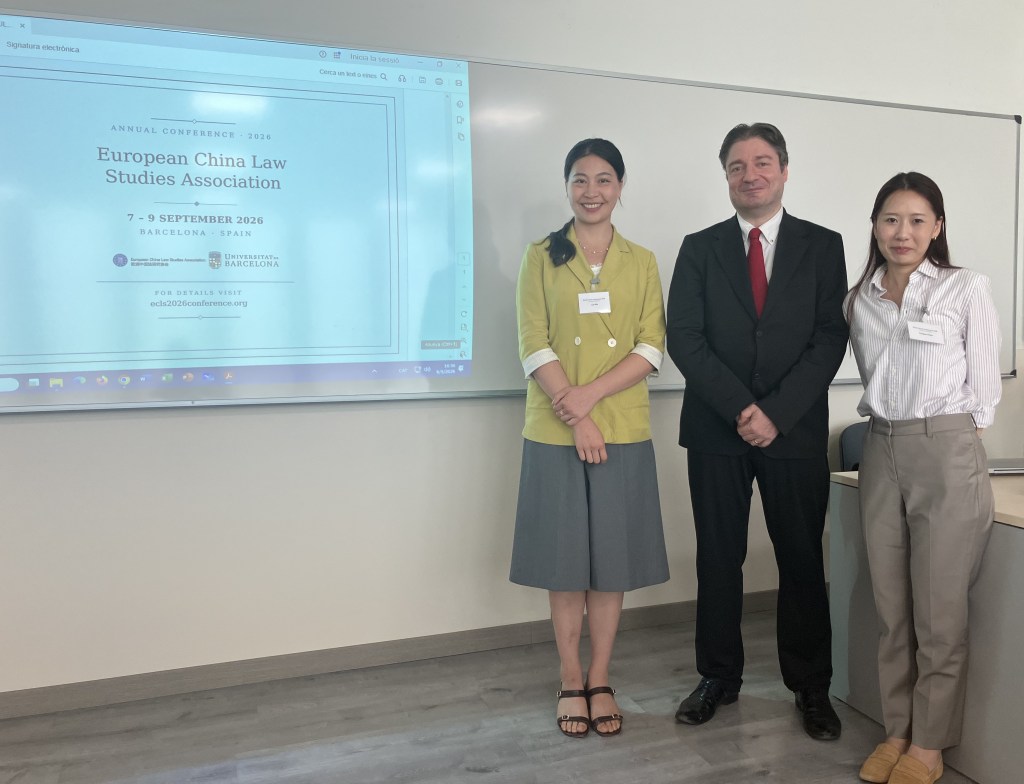
From Five Papers to One Conversation: Chairing Environmental Law and Sustainable Development at Europe-China Law Studies Association Annual Conference 2026 in Barcelona, Spain
It was a great pleasure to chair Panel 26, “Environmental Law and Sustainable Development,” at the European China Law Studies Association (ECLS) Annual Conference 2026, held from 7–9 September at the Faculty of Law of the University of Barcelona. The conference brought together scholars working across an exceptionally broad range of fields—from environmental and climate governance to artificial intelligence, courts and judicial practice, human rights, trade and investment, corporate and commercial law, data governance, constitutionalism, and China’s changing place in the international legal order.
In the full version of my reflections on WordPress, I discuss the five papers in considerably greater detail, the intellectual “red thread” connecting them, the format I proposed as chair, and some broader thoughts on how conference panels can create more meaningful scholarly dialogue: https://paolofarah.wordpress.com/2026/09/12/from-five-papers-to-one-conversation-chairing-environmental-law-and-sustainable-development-at-ecls-2026-in-barcelona/
Our panel brought together five contributions addressing quite different aspects of environmental law and sustainable development: Haiyi Yu on China’s Ecological and Environmental Code and the domestic implementation of international environmental obligations; Anna Maria Rizzo on the emergence of environmental law as an autonomous legal branch and its implications for biosecurity; Yaoyao Chen on the theoretical foundations of China’s ecological-environmental damage compensation system; Xiaxin Wang on Rights of Nature, representation and institutional enforcement; and Lan Ma on the mismatch between operational control and legal responsibility in maritime sustainability law.
Two of the five accepted speakers were ultimately unable to join us in Barcelona in person. I nevertheless wanted their scholarship to remain visible in the panel’s intellectual architecture. Their papers had been selected as part of the same conversation, and the connections among all five projects were too important simply to disappear because circumstances prevented physical participation.
Moving beyond the sequence of five separate presentations
The conference format allowed a maximum of approximately 15 minutes for each speaker. With five papers in a 95-minute panel, however, five conventional presentations would have consumed approximately 75 minutes, leaving relatively little space for genuine discussion.
I therefore proposed something different.
I invited the speakers to transform their conventional presentations into focused five-minute interventions, and I was particularly grateful for their openness and willingness to experiment with the format. Rather than attempting to compress an entire article into five minutes, I asked each speaker to identify four things: the principal problem addressed by the paper; its central claim or finding; the legal or institutional mechanism that mattered most; and one connection, tension, or question raised by another contribution to the panel.
The objective was to relocate much of that substantive engagement from a sequence of independent monologues into a horizontal scholarly conversation.
My original plan therefore reserved substantial time for direct exchanges among the speakers, followed by questions from the audience and a final round in which the different strands of the discussion could be brought back together.
For me, this is one of the most interesting functions a panel chair can perform. Chairing need not consist simply of introducing speakers and enforcing a clock. Sometimes the chair can help identify the intellectual question that the papers are collectively asking—even when the authors approached the conference from very different doctrinal, comparative, or methodological starting points.
Finding the red thread
What initially appeared to be five rather different projects in fact revealed a remarkably clear common question:
How do environmental norms move from legal recognition to institutional operation?
China’s 2026 Ecological and Environmental Code provided an especially important hinge for the conversation. But the broader question extended well beyond codification. The papers collectively asked how legal norms are translated into categories, institutions, responsible actors, representation, remedies, implementation mechanisms—and ultimately into environmental outcomes.
I saw the five contributions as a sequence of interconnected movements:
Haiyi Yu began at the macro level: international environmental obligations → domestic codification and implementation. Her work asks whether China’s new environmental codification can become an operational framework through which international obligations are translated into legislation, standards, institutional responsibilities and implementing mechanisms.
Anna Maria Rizzo then moved from codification → the reorganization of legal fields, using biosecurity to test what it actually means for environmental law to become a more autonomous and codified branch. Biosecurity does not belong neatly to environmental law alone: it intersects with health, agriculture, biotechnology, medicine and national security. The question therefore becomes whether codification resolves fragmentation—or simply relocates it.
Yaoyao Chen brought the conversation from legal architecture to ecological harm → injury, compensation and restoration. Her work asks what happens when damage is inflicted not simply upon an identifiable private rights-holder but upon the environment itself, and how Chinese law should conceptualize compensation, direct restoration and alternative restoration.
Xiaxin Wang shifted the focus toward environmental interests → representation and enforcement. Her contribution questions whether recognition of Rights of Nature—or even legal personhood—is sufficient if there are no institutions capable of continuously representing ecological interests, mobilizing resources, securing remedies and overseeing implementation. Her “institutional translation chain” was particularly helpful in connecting recognition of a norm with what must happen institutionally before that norm produces practical protection.
Finally, Lan Ma provided a highly contemporary technological and sectoral test: operational control → legal responsibility. In autonomous and increasingly decarbonized shipping, the actor formally responsible under law may no longer be the actor exercising the decisive operational control. Shipowners, remote operation centres, autonomous systems and technology providers may all affect environmentally significant decisions, while legal responsibility remains comparatively centralized.
Put together, the five projects moved from norms, to legal architecture, to harm, to representation, to responsibility.
And that produced the larger question around which I tried to organize the discussion:
When environmental law recognizes an objective, who must translate it into action? Who defines the relevant environmental interest? Who has authority—or a duty—to act? Who bears responsibility? Which remedies matter? And what institutional mechanisms determine whether law actually changes environmental outcomes?
That, to me, was the real red thread of the panel.
Formal legality and functional governance
Several distinctions became especially useful in structuring the discussion.
Codification is not the same thing as implementation. A coherent statutory architecture does not necessarily create institutional capacity or accountability.
Legal subjectivity is not the same thing as representation. Rights, legal personhood, standing, institutional mandates and remedies interact, but they are not interchangeable.
And formal responsibility is not necessarily the same thing as practical control—especially in technologically complex regulatory environments in which the person legally designated as responsible may no longer be making all of the decisions that generate environmental risk.
These distinctions allowed questions directed initially to one paper to become questions for another. Environmental codification could be tested against the biosecurity problem; ecological-damage compensation could be placed in dialogue with institutional representation of ecosystems; Rights of Nature could be compared with restoration-based mechanisms; and the problem of representation could in turn be connected with the distribution of control and responsibility in autonomous shipping.
This was precisely why I preferred a horizontal format. The purpose was not to force five distinct papers into an artificial unified theory. Their differences mattered. But those differences became more productive once the speakers were invited to respond directly to one another rather than simply delivering five self-contained presentations. That principle was also built explicitly into the discussion guide I prepared for the session.
A broader ECLS conversation
The panel was also part of a much richer three-day ECLS program. The Barcelona conference opened with remarks from Andreu Olesti, Dean of the University of Barcelona Faculty of Law; José Pintor Aguilar, General Director of Casa Asia; and Björn Ahl, President of ECLS, followed by a keynote address by Susan Trevaskes. The program then unfolded through parallel panels covering a remarkable spectrum of contemporary Chinese-law scholarship, with the conference concluding on 9 September with concluding remarks and the ECLS General Assembly.
I came away from Barcelona especially appreciative of the willingness of the speakers on my panel to experiment with a format that asked them to present less in order to discuss more.
For me, the experience reinforced something that applies well beyond environmental law: scholarly conferences are at their most useful when papers do not merely sit beside one another, but are deliberately placed in dialogue.
Sometimes the most productive question for a chair is therefore not simply, “What does each paper say?”
It is:
“What can these papers make us see when we read them together?”
Paolo Davide Farah, Paolo Farah