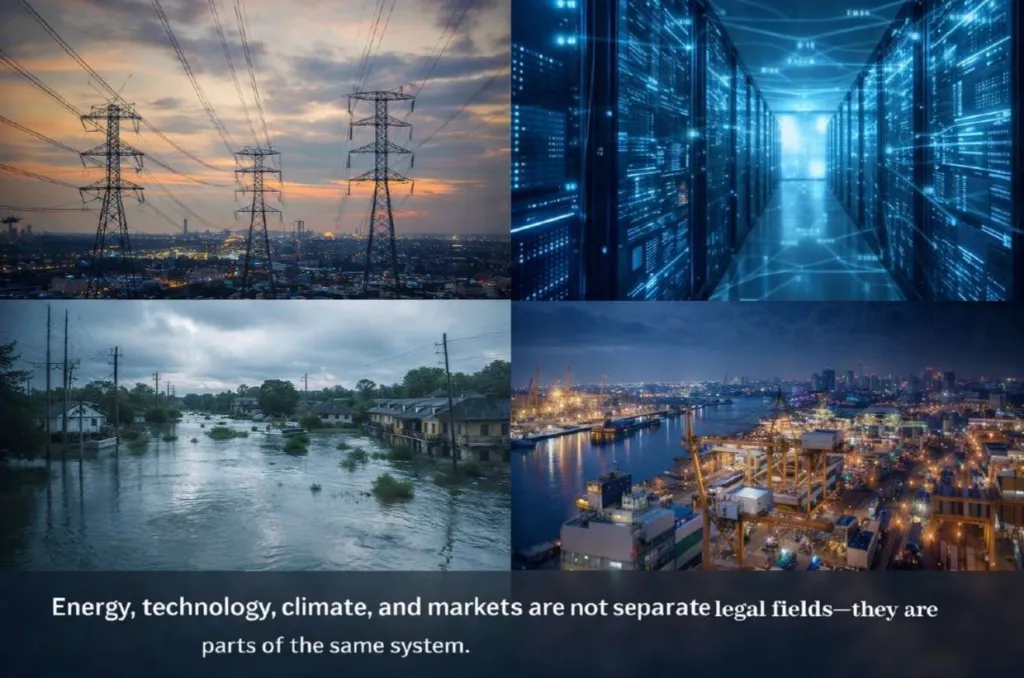
This teaching series examines how law operates not as a collection of isolated doctrines but as an integrated system that shapes infrastructure, governance, environmental resilience, and financial survival. Across four interconnected courses—Energy Policy, Technology Law, Climate Change Law, and Secured Transactions—the reflections explore how legal architecture designs complex systems, allocates authority, absorbs stress, and ultimately determines who bears risk when those systems are tested.
The series begins with Energy Policy, where infrastructure is examined as a legal construct rather than merely a technical network. Regulatory institutions, market structures, and distributive choices shape how energy transitions unfold. Law determines how projects are financed, how markets are structured, and how justice considerations are embedded within governance frameworks.
Original post:
It then turns to Technology Law, recognizing that digital systems increasingly mediate public authority. Algorithms, data infrastructures, and platform governance reshape accountability, transparency, and institutional legitimacy. Law must adapt to environments where authority is embedded within technological architecture rather than exercised solely through traditional administrative structures.
Original post:
The third reflection addresses Climate Change Law as a sustained institutional stress test. Climate disruption challenges doctrinal assumptions, stretches temporal frameworks, and forces governance systems to confront systemic risk. Legal institutions must reconcile long-term environmental pressures with procedural coherence and democratic accountability.
Original post:
Finally, the series examines Secured Transactions, revealing the quiet but decisive role of commercial law. Financing structures, collateral regimes, and priority rules determine resilience beneath the surface of visible policy debates. Before a crisis emerges, commercial doctrine has already structured the distribution of fragility and survival.
Original post:
Taken together, these reflections demonstrate that law does not simply respond to disruption. It constructs institutional order, stabilizes expectations, and pre-allocates resilience across interconnected systems. Energy, technology, climate, and markets are not separate regulatory domains—they are interdependent components of a single legal ecosystem operating under continuous pressure.
To explore the complete integrated reflection and understand how these domains function together as one legal system under stress, read the full series overview here: