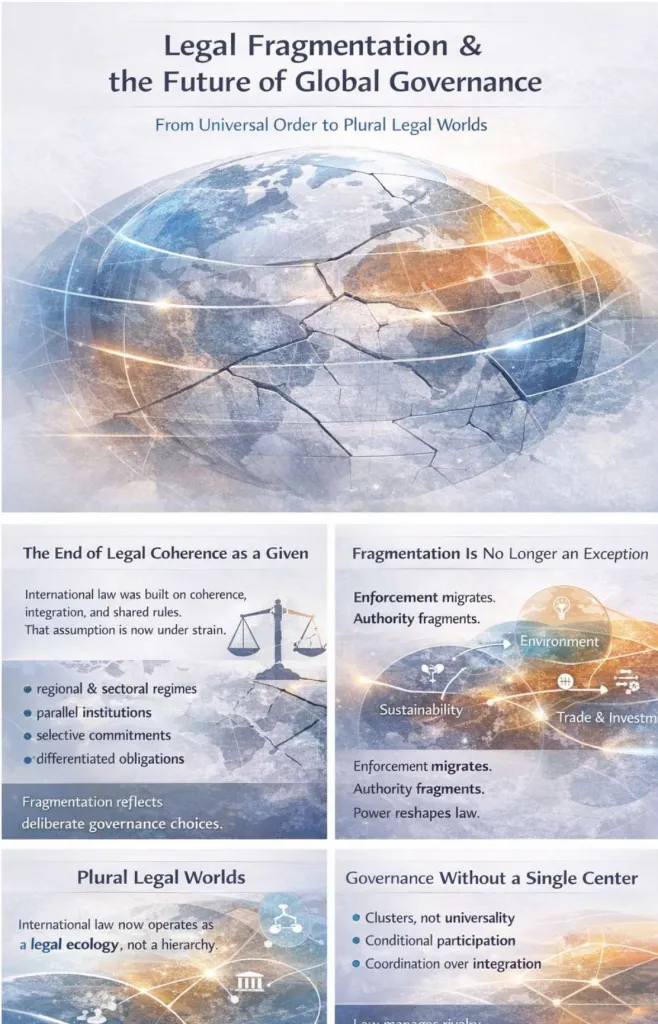
International law is no longer fragmented by accident. Fragmentation has become a structural feature of global governance.
For decades, the dominant narrative assumed a gradual movement toward universal multilateralism — a coherent legal order guided by shared norms and centralized institutions. That assumption is now under pressure.
Today, global governance operates through overlapping regimes, regional frameworks, strategic coalitions, and issue-specific institutions. Instead of a single, unified legal system, we observe a plural legal ecology shaped by competition, coordination, and strategic alignment.
Fragmentation now functions as a tool.
Regional power strategies, network governance, environmental urgency, and technological competition have transformed how law operates. States increasingly design legal arrangements that serve strategic objectives rather than universal coherence.
This transformation produces several structural changes:
- Institutions coordinate rather than command
- Commitments become conditional and context-driven
- Legitimacy varies across regions
- Legal regimes overlap instead of integrating
Global governance no longer transcends rivalry — it structures it.
The central risk in this environment is instrumentalization. When law becomes a mechanism of leverage rather than a constraint on power, its normative authority weakens. Yet the law does not disappear. It adapts. It becomes embedded in regional strategies, infrastructure systems, and governance networks.
The future of international order may therefore lie not in restoring universal coherence, but in managing structured pluralism — a world where fragmentation is organized rather than chaotic.
Read the full article here:
If you would like to see how the entire series connects — from the Monroe Doctrine to regional legal pluralism — continue to the concluding overview:
Read Part 4.5 here: