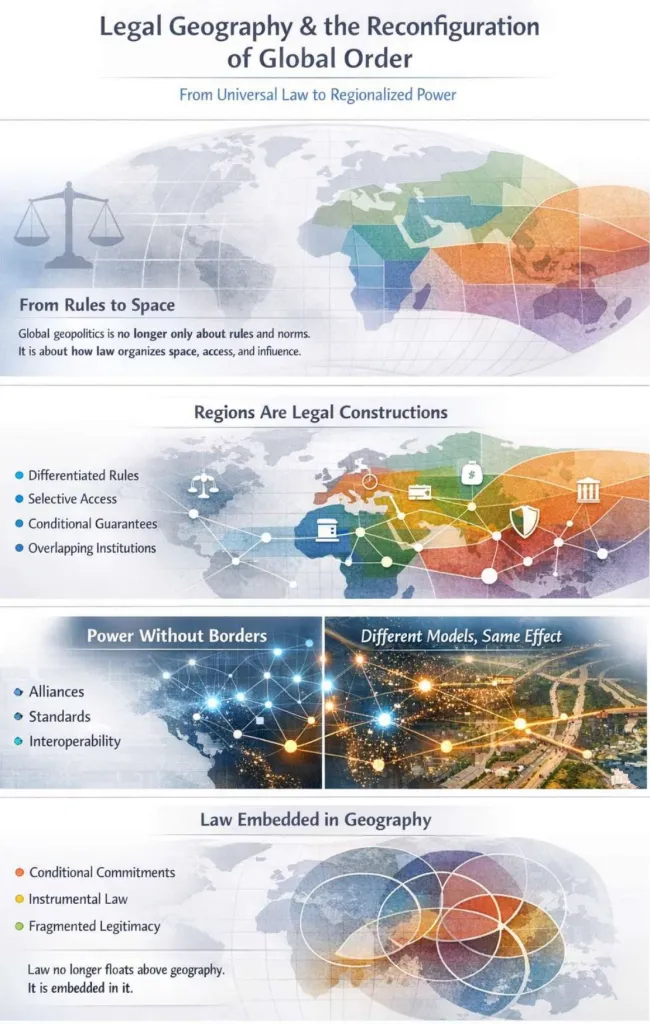
Global politics today is not only shifting in terms of power — it is shifting in terms of legal space.
The transformation underway is best understood through the concept of legal geography: how law organizes territory, connectivity, access, and authority. What was once imagined as a universal legal order is increasingly structured through differentiated regional spaces.
Regions now function as layered legal environments. Access to markets, security guarantees, infrastructure, and technology flows is no longer neutral or universally available. Instead, participation is shaped by standards, compliance systems, political alignment, and institutional design.
Power operates less through borders and more through mechanisms such as:
- Regulatory standards
- Supply-chain governance
- Contractual commitments
- Structured economic dependence
Both the United States and China pursue different strategies, yet the outcome converges: regionally differentiated legal orders embedded in geopolitical rivalry.
International law does not collapse in this process. Rather, it becomes plural and geographically contingent. Universal multilateralism gives way to structured pluralism — overlapping regimes operating across strategic regions.
The result is a reconfiguration of global order in which law no longer floats above power. It is anchored within geography, networks, and institutional architectures.
Understanding this shift is essential to grasp how contemporary governance is being reorganized.
Read the full article here:
If you would like to explore how this legal fragmentation reshapes global governance and institutional legitimacy, continue to the next part:
Read Part 4.4 here: