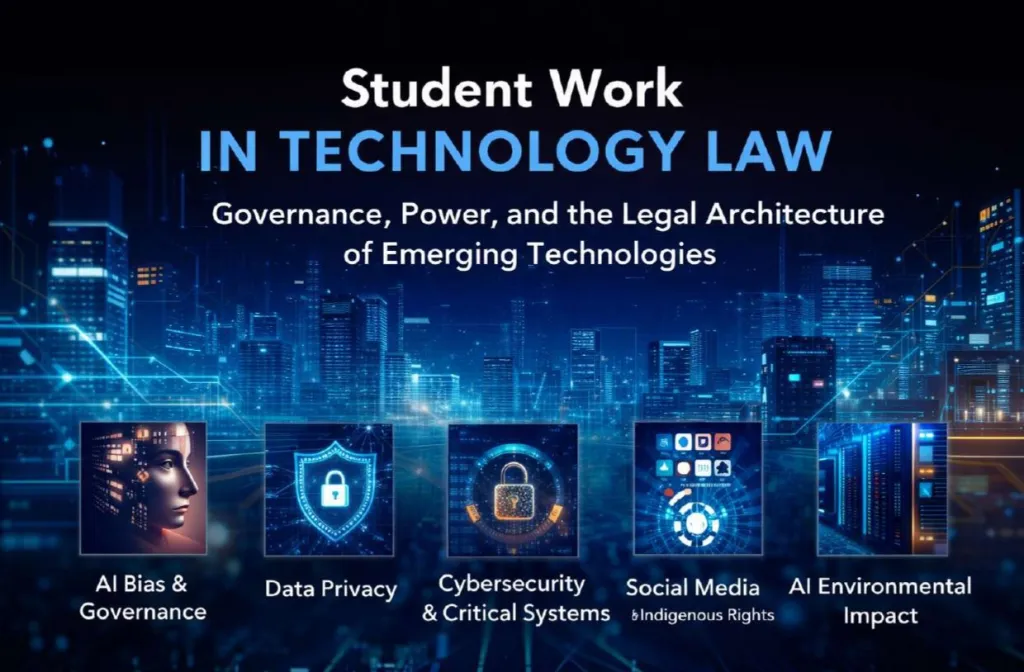
This reflection builds on the broader teaching series and focuses specifically on Technology Law as a framework for understanding institutional power in digital environments.
Original post:
Technology law is no longer confined to questions of innovation policy or data protection compliance. Digital systems now structure public administration, energy governance, financial markets, and even climate monitoring. As a result, the law must engage not only with technological change but also with the redistribution of authority embedded in technological architecture.
The course approaches technology law as institutional design under uncertainty. Algorithms allocate resources, platforms influence speech and participation, and automated systems mediate regulatory processes. In these environments, accountability is no longer straightforward. Legal frameworks must adapt to systems where decision-making is partially opaque, privately controlled, and rapidly evolving.
A central theme explored in the classroom is the transformation of governance itself. When authority becomes operationalized through code, traditional doctrines of oversight, liability, and legitimacy are tested. Students examine how regulatory institutions respond—through administrative adaptation, statutory reform, and evolving liability models—while attempting to preserve transparency and public trust.
Rather than treating technology law as a niche discipline, this reflection situates it within a broader ecosystem that includes energy infrastructure, environmental stress, and financial structuring. Digital systems increasingly connect and mediate these domains, making technology governance foundational rather than peripheral.
Understanding technology law in this way reveals its structural importance. It is not merely about regulating innovation; it is about sustaining institutional coherence in an era of increasingly digitized governance.
To see how sustained environmental pressure further challenges legal systems and institutional capacity, continue with the next reflection in this series: