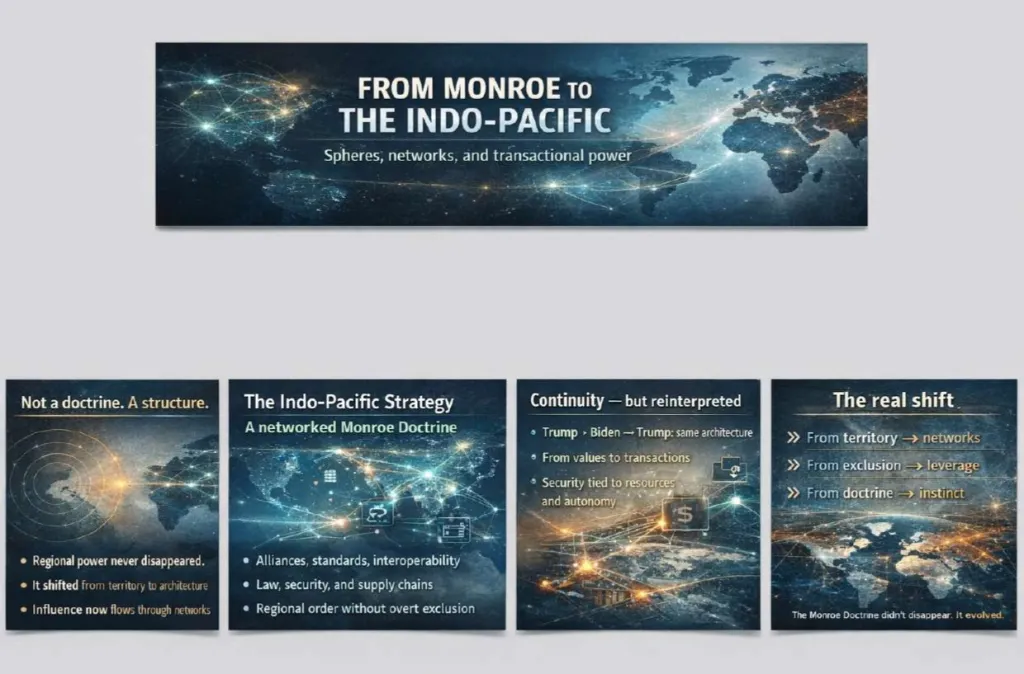
The contemporary return of Monroe-style thinking is not territorial — it is architectural.
If the 19th-century Monroe Doctrine was about excluding rival empires from the Western Hemisphere, today’s regional strategies operate through design: building networks, shaping standards, and structuring dependence.
The Indo-Pacific Strategy reflects this evolution. Rather than declaring exclusive control, the United States consolidates influence through alliance systems, technological interoperability, regulatory coordination, and supply-chain integration. Power becomes embedded in systems that organize connectivity across the region.
At the same time, China’s Belt and Road Initiative follows a structurally similar path. Infrastructure corridors, long-term financing, bilateral legal frameworks, and energy cooperation projects create durable patterns of influence. Connectivity itself becomes the mechanism of authority.
Neither Washington nor Beijing openly speaks of “spheres of influence.” Yet both construct zones where rules, standards, and economic flows are shaped by their strategic priorities.
This shift marks a transformation in global order:
- Territory matters less than networks
- Sovereignty becomes intertwined with infrastructure
- Legal authority is embedded in institutional design
- Regional power is exercised through structured interdependence
The Indo-Pacific is therefore not just a geographic space. It is a model of how regional power is reconfigured in the 21st century — through law, standards, supply chains, and coordinated governance rather than direct domination.
Modern competition is not only about who controls land. It is about who designs the system within which others operate.
Read the full article here:
If you would like to explore how these dynamics transform the legal meaning of space and reshape global order, continue to the next part:
Read Part 4.3 here: