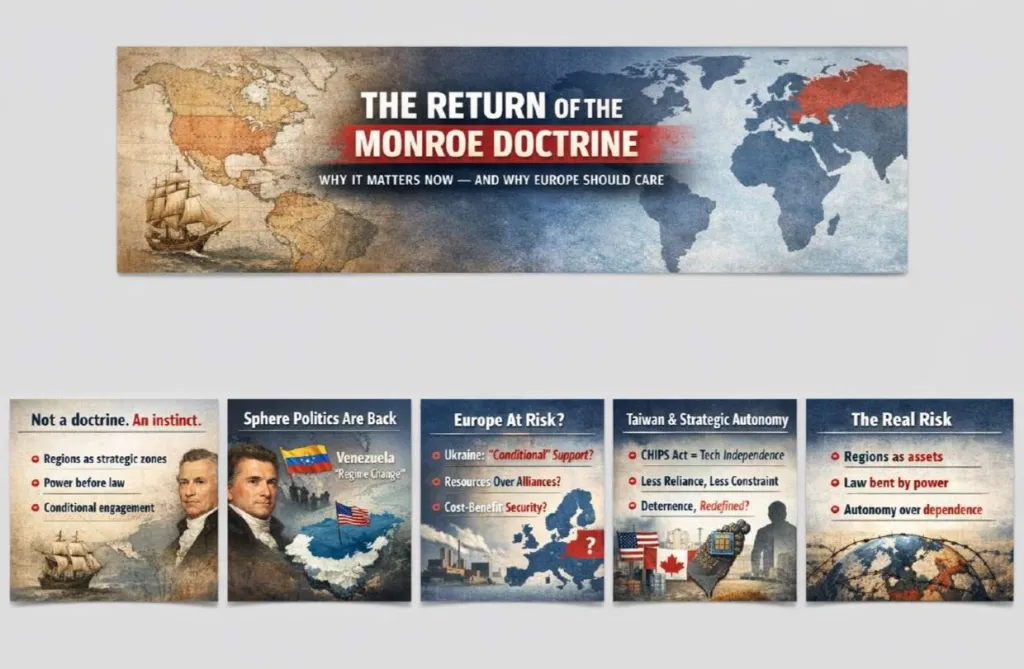
The Monroe Doctrine is often treated as a relic of 19th-century diplomacy. Yet its core strategic instinct — that geography and power justify privileged regional authority — appears to be re-emerging in contemporary geopolitics.
Today, the doctrine does not return as formal policy. Instead, it resurfaces as structure. The logic is visible in how regional space is framed and managed through power calculations rather than universal legal principles.
Recent developments reflect this shift. Venezuela has been discussed as a politically manageable sphere. Greenland has been treated as a strategic asset of security value. Even Canada has been rhetorically subjected to trade leverage narratives. These examples illustrate a renewed emphasis on regional primacy — where proximity and dominance shape political expectations.
The implications extend far beyond the Americas.
For Europe, the deeper concern is the transformation of alliance politics. If engagement becomes strictly transactional, commitments may evolve from principled guarantees into conditional arrangements. The cases of Ukraine, Taiwan, and semiconductor supply chains demonstrate how security and economic partnerships increasingly risk being evaluated through cost-benefit logic.
In this emerging framework:
- Regions function as strategic zones rather than legal communities
- Alliances become contingent and interest-driven
- Law adapts to power realities instead of constraining them
The Monroe Doctrine, therefore, has not returned as a historical doctrine. It has returned as a governing instinct embedded within modern geopolitical strategy.
Read the full article here:
If you are interested in exploring how this logic evolves in the Indo-Pacific context and shapes competing regional strategies, continue to the next part:
Read Part 4.2 here: