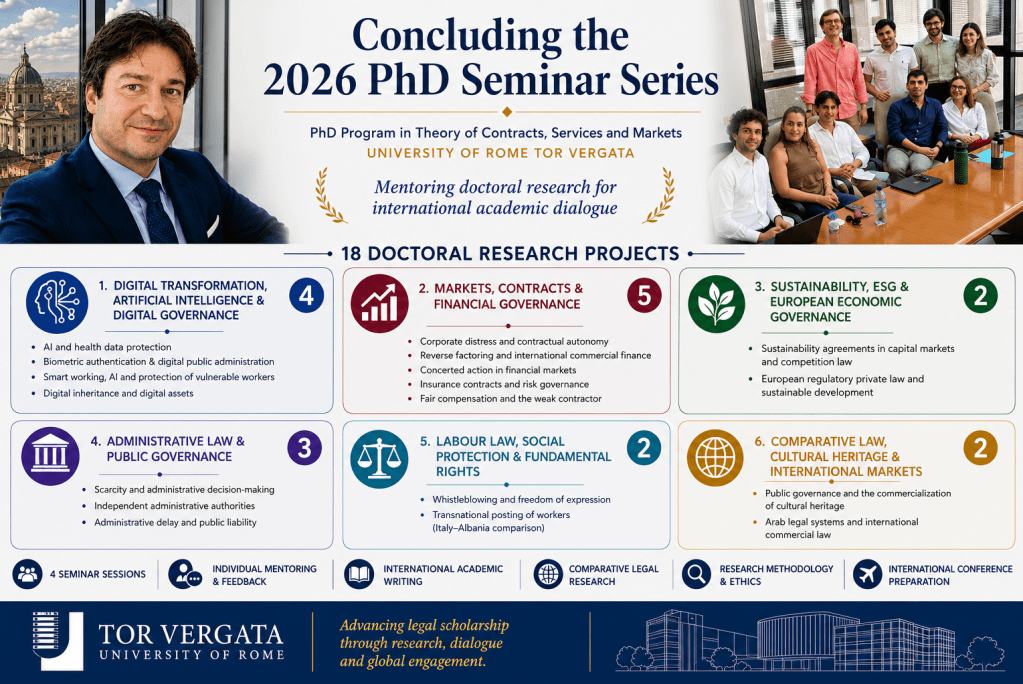

From Doctoral Research to International Scholarship: Concluding the 2026 PhD Seminar Series at the University of Rome Tor Vergata
Today I had the pleasure of concluding the final session of the 2026 PhD Seminar Series within the PhD Program in Theory of Contracts, Services and Markets at the University of Rome Tor Vergata.
For those interested, I have shared a more detailed reflection on my WordPress blog: https://paolofarah.wordpress.com/2026/06/26/from-doctoral-research-to-international-scholarship-concluding-the-2026-phd-seminar-series-at-the-university-of-rome-tor-vergata/
Over the past two months, the seminar has evolved into much more than a traditional course on academic writing or presentation techniques. Through four seminar sessions and numerous individual mentoring meetings, we worked together on a common objective: helping doctoral researchers transform part of their dissertation into a paper suitable for presentation in international academic contexts.
Although the seminar formally addressed research methodology, academic writing, and presentation techniques, our discussions rapidly moved beyond these themes. Rather than focusing simply on how to prepare effective PowerPoint presentations, we explored how doctoral research can be framed as a contribution to broader international scholarly conversations. Together we discussed how to formulate stronger research questions, refine conceptual frameworks, develop comparative and interdisciplinary perspectives, and communicate complex legal ideas clearly and persuasively to audiences beyond national boundaries.
For each doctoral researcher, the process combined individualized written feedback, one-to-one mentoring meetings, and the discussion of draft PowerPoint presentations. The objective was never to replace or overlap with the essential role played by each student’s supervisor, co-supervisor, and the PhD College in guiding the dissertation. Instead, the seminar sought to complement that work by encouraging students to identify one specific aspect of their broader doctoral research that could evolve into an autonomous conference paper or future journal article suitable for international academic audiences.
One of the most rewarding aspects of this experience was observing how projects originating from very different legal disciplines gradually converged around many of the most significant challenges currently transforming legal scholarship. While each dissertation remains firmly rooted within its own field, the presentations revealed remarkable common threads concerning technological change, sustainability, economic governance, globalization, constitutional values, market regulation, and the evolving relationship between public and private law.
By the conclusion of the seminar, the doctoral projects naturally clustered around several broad research areas.
 Artificial Intelligence, Digital Governance & Digital Transformation
Several projects explored the legal implications of emerging technologies and digital transformation. Research addressed artificial intelligence and health data protection, biometric authentication within digital public administration, smart working and algorithmic management, and the evolving legal meaning of digital inheritance and digital assets.
Collectively, these projects demonstrate how technological innovation increasingly challenges traditional legal categories while requiring new regulatory frameworks capable of balancing innovation, privacy, accountability, fundamental rights, accessibility, and democratic governance.
 Corporate, Commercial & Financial Law
A second group of projects examined contemporary transformations within private law, commercial law, corporate governance, and financial regulation.
Research addressed contractual autonomy during corporate financial distress, reverse factoring and international commercial finance, concerted action within takeover regulation, the legal nature of insurance contracts and risk governance, and the protection of weaker professional contractors through the Fair Compensation Law.
These projects illustrate how modern commercial law increasingly operates at the intersection of private autonomy, financial markets, economic regulation, and broader public-interest objectives.
 Sustainability, ESG & Competition Law
Another particularly dynamic area focused on sustainability governance and the transformation of European economic regulation.
Projects examined sustainability agreements in capital markets, ESG governance, sustainable finance, competition law, and the evolution of European Regulatory Private Law through the principle of sustainable development.
These themes reflect one of the defining transformations currently taking place within legal scholarship: the growing interaction between environmental sustainability, market regulation, corporate governance, and global public policy.
 Administrative Law & Public Governance
Several doctoral researchers investigated the changing role of public institutions in allocating resources and exercising regulatory authority.
Research addressed administrative decision-making under conditions of scarcity, the allocation of powers among independent administrative authorities, and administrative liability for delay.
Together, these projects explored how contemporary public governance increasingly requires balancing constitutional principles, efficiency, market regulation, accountability, transparency, and competing public and private interests.
 Labour Law & Fundamental Rights
The seminar also included projects examining labour law through constitutional, comparative, and European perspectives.
Research explored whistleblowing and freedom of expression within employment relationships, together with comparative approaches to the transnational posting of workers in European labour law.
These projects illustrate the increasingly close interaction between labour law, constitutional guarantees, human rights, and transnational legal governance.
 Comparative Law, Cultural Heritage & International Commercial Law
A final group of projects highlighted the continuing importance of comparative legal research.
Research examined the commercialization and public governance of cultural heritage, legal pluralism within Arab legal systems and its relationship with international commercial law, and broader questions concerning comparative legal development and legal harmonization.
These projects remind us that comparative law remains one of the most valuable methodologies for understanding legal diversity while identifying common principles capable of facilitating international dialogue.
The Breadth of Contemporary Legal Research
Taken together, the projects covered an impressive spectrum of contemporary legal scholarship, including:
- Artificial Intelligence, Digital Governance, and Data Protection;
- Biometric Authentication and Digital Public Administration;
- Smart Working, Artificial Intelligence, and the Future of Labour;
- Digital Inheritance and Digital Assets;
- Corporate Distress and Contractual Autonomy;
- Reverse Factoring and International Commercial Finance;
- Insurance Law and Risk Governance;
- Fair Compensation and the Protection of Weaker Contracting Parties;
- Competition Law, Sustainable Finance, and ESG Governance;
- European Regulatory Private Law;
- Administrative Decision-Making and Scarcity;
- Independent Administrative Authorities;
- Administrative Liability;
- Whistleblowing, Freedom of Expression, and Labour Law;
- Comparative Labour Law and the Transnational Posting of Workers;
- Cultural Heritage Governance and Commercialization;
- Legal Pluralism in the Arab World and International Commercial Law;
- Financial Market Regulation and Concerted Action.
Although these projects addressed very different legal questions, they shared a common methodological ambition: moving beyond purely domestic legal analysis to engage broader comparative, European, and international debates.
Many students progressively refined their research through an iterative process of discussion, written feedback, individual meetings, and successive revisions. In many cases, broad dissertation topics gradually evolved into focused research questions; conceptual frameworks became clearer; comparative perspectives were strengthened; and presentations increasingly reflected the structure expected within international conferences and academic publications.
This process of academic dialogue and co-production was never intended to alter the substantive direction of each doctoral dissertation, but rather to help students recognize how their existing research could be communicated more effectively to wider scholarly communities. For many participants, this represented a first opportunity to think about their work not only as a doctoral thesis, but also as a potential contribution to ongoing international academic debates.
I would like to express my sincere gratitude to University of Tor Vergata and all the doctoral researchers for their enthusiasm, thoughtful discussions, openness to dialogue, and commitment to developing their research within an increasingly international academic environment.
I very much look forward to following the continued evolution of these projects in the years ahead, and I hope that many of them will soon find their way into international conferences, collaborative research initiatives, and publications in leading academic journals.
Mentoring emerging scholars is always one of the most rewarding aspects of academic life. Watching doctoral researchers progressively refine their ideas, challenge their assumptions, and gain confidence in presenting their work to an international audience reminds us that legal scholarship advances not only through individual research, but also through sustained dialogue, intellectual exchange, and the collective pursuit of knowledge.
For those interested, I have shared a more detailed reflection on my WordPress blog: https://paolofarah.wordpress.com/2026/06/26/from-doctoral-research-to-international-scholarship-concluding-the-2026-phd-seminar-series-at-the-university-of-rome-tor-vergata/
Paolo Davide Farah, Paolo Farah
