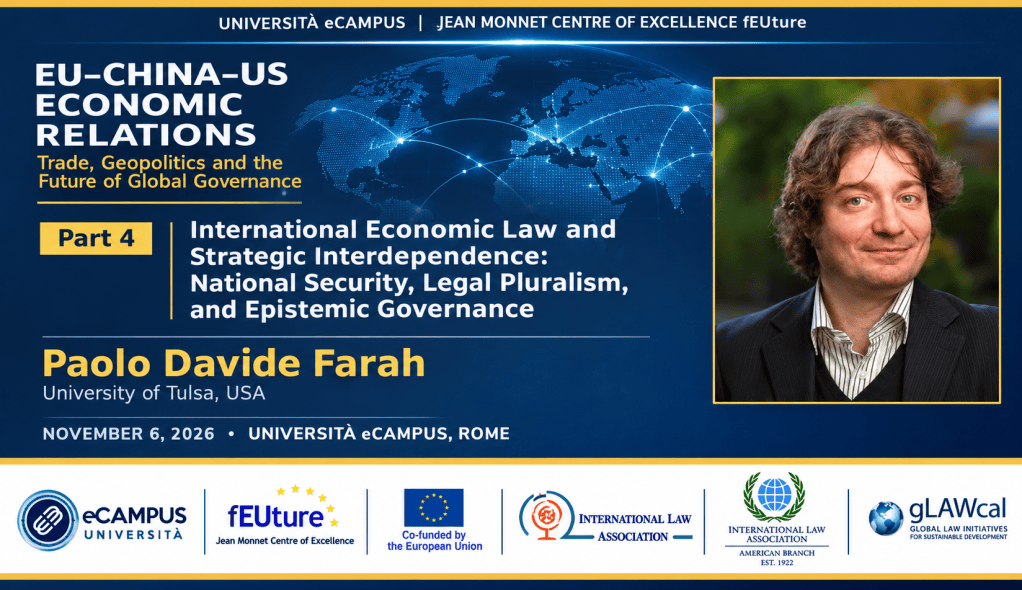


Paolo Davide Farah — International Economic Law and Strategic Interdependence: National Security, Legal Pluralism, and Epistemic Governance – Workshop on EU–China–US Economic Relations: Trade, Geopolitics and the Future of Global Governance | Part 4
The Full post is available at : https://paolofarah.wordpress.com/2026/11/22/paolo-davide-farah-international-economic-law-and-strategic-interdependence-national-security-legal-pluralism-and-epistemic-governance-workshop-on-eu-china-us-economic-r/
Paolo Davide Farah: From the CHIPS Act to epistemic governance – Is globalization disappearing, or are we witnessing the transformation of the legal and institutional structures that govern it?
This was the central question I developed during the November 6 workshop on EU–China–US Economic Relations: Trade, Geopolitics and the Future of Global Governance, which I co-organized with Professor Roberto Castaldi at Università eCampus.
I proposed distinguishing political and legal fragmentation from the actual disconnection of economic networks.
The United States, China, and the European Union remain deeply interconnected, even as they increasingly deploy tariffs, subsidies, investment restrictions, export controls, and technological regulations in pursuit of economic security.
From an international economic law perspective, a fundamental concern is the expanding use of national security justifications. When virtually every strategic sector becomes an exception to ordinary trade disciplines, what remains of the constraining force of WTO rules?
Our discussion of Taiwan, the US CHIPS and Science Act, and semiconductor supply chains provided a particularly revealing example.
I distinguished policies designed to strengthen domestic resilience from measures intended to restrict another country’s technological development. Both may be presented through the language of security, but they raise different legal and institutional questions.
For Europe, strategic autonomy cannot realistically mean complete technological self-sufficiency. It requires diversification, technological capabilities, reliable partnerships, and the ability to make independent decisions.
I also connected these issues to my research on China, the Belt and Road Initiative, and legal pluralism, examining how competing and overlapping regulatory arrangements are reshaping the international economic order.
Finally, drawing on my work on epistemic governance, I argued that technological competition concerns not only products and infrastructure but also the production of regulatory knowledge.
Who controls the datasets? Who establishes the standards? Who verifies corporate compliance? Can affected individuals challenge automated findings?
These questions matter for AI regulation, environmental reporting, labour monitoring, ESG disclosures, and corporate accountability.
The future of international economic law will depend not only on who exercises economic power, but also on who defines the rules, produces the evidence, and controls the mechanisms of accountability.
These questions are also central to the work of the ILA Study Group and ABILA Committee that I chair, and to our continuing research activities through gLAWcal.
 Full workshop report: https://paolofarah.wordpress.com/2026/11/19/workshop-report-universita-ecampus-rome-and-online-november-6-2026-eu-china-us-economic-relations-trade-geopolitics-and-the-future-of-global-governance/
#InternationalEconomicLaw #WTO #CHIPSAct #Taiwan #ArtificialIntelligence #EpistemicGovernance #LegalPluralism #GlobalGovernance