SEALS2026 – Law, Governance, and Institutional Change in a Transforming World
The 2026 Annual Meeting of the Southeastern Association of Law Schools (SEALS) provides an exceptional opportunity to bring together scholars from across legal disciplines to engage in sustained and interdisciplinary conversations on some of the most significant challenges facing law and legal institutions today. I am grateful to everyone who has agreed to participate in these discussion groups—as organizers, discussants, and participants—and I look forward to the thoughtful exchanges that have long made the SEALS discussion group format such a valuable forum for intellectual engagement.
Although each discussion group addresses a distinct area of law, they are connected by a common concern: how legal institutions can respond to rapid technological, environmental, economic, and geopolitical transformations while preserving the rule of law, democratic accountability, human rights, and sustainable development. Together, these discussions explore the evolving relationship between law, governance, markets, and society, bringing together perspectives from public and private law, international and comparative law, business law, environmental law, technology law, and legal education.
This year’s discussion groups examine four complementary themes: digital transformation and the governance of emerging technologies; corporate accountability and sustainability across global value chains; the legal challenges of transforming food and agricultural systems; and the preparation of lawyers for the climate and energy transition through innovative approaches to legal education. While each session stands on its own, the four discussions collectively reflect the increasingly interdisciplinary character of contemporary legal scholarship and the need for dialogue across traditional doctrinal boundaries.
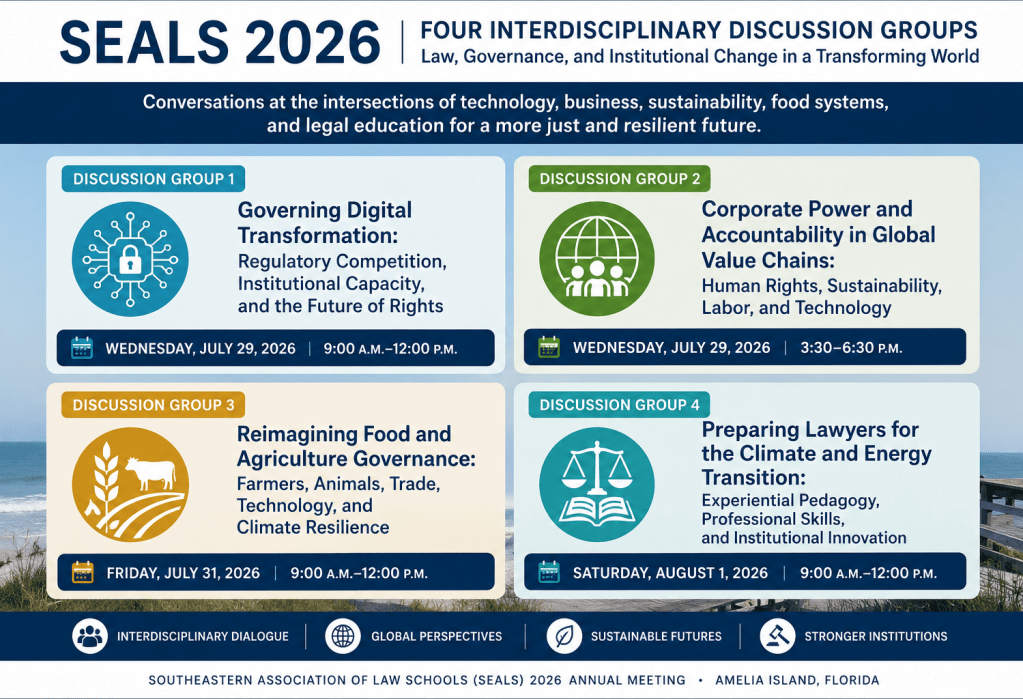
Below you will find the schedule of the discussion groups, together with their titles and descriptions. I hope these sessions will foster engaging conversations, generate new collaborations, and contribute to ongoing debates about the role of law in addressing the complex challenges of our time.
Discussion Group 1
Governing Digital Transformation: Regulatory Competition, Institutional Capacity, and the Future of Rights
Wednesday, July 29, 2026
9:00 a.m.–12:00 p.m.Discussion Group 2
Corporate Power and Accountability in Global Value Chains: Human Rights, Sustainability, Labor, and Technology
Wednesday, July 29, 2026
3:30–6:30 p.m.Discussion Group 3
Reimagining Food and Agriculture Governance: Farmers, Animals, Trade, Technology, and Climate Resilience
Friday, July 31, 2026
9:00 a.m.–12:00 p.m.Discussion Group 4
Preparing Lawyers for the Climate and Energy Transition: Experiential Pedagogy, Professional Skills, and Institutional Innovation
Saturday, August 1, 2026
9:00 a.m.–12:00 p.m.
DISCUSSION GROUP 1
Governing Digital Transformation: Regulatory Competition, Institutional Capacity, and the Future of Rights
Wednesday, July 29, 2026
9:00 a.m.–12:00 p.m.
Artificial intelligence, automated decision-making, data-intensive business models, cybersecurity threats, digital platforms, and blockchain technologies are transforming not only substantive law but also the institutions responsible for creating and enforcing it.
This discussion group examines how international, regional, and domestic legal systems are responding to digital transformation and whether competing regulatory approaches are producing convergence, fragmentation, or new forms of regulatory competition. Particular attention will be given to institutional capacity, cross-border enforcement, public and private standard-setting, and the participation of jurisdictions outside the traditional centers of technological regulation.
Participants will also consider how emerging technologies are reshaping intellectual property, corporate governance, competition, employment, administrative decision-making, business transactions, and individual rights. The discussion will explore how legal systems can support socially beneficial innovation while maintaining accountability, transparency, security, and meaningful human oversight.
Possible Discussion Questions
1. What is the most important recent legal or institutional development in emerging-technology governance?
2. Are the principal regulatory models for artificial intelligence and digital technologies moving toward convergence, or are they becoming increasingly fragmented?
3. Which institutions—legislatures, administrative agencies, courts, international organizations, technical bodies, or private companies—are best positioned to govern rapidly evolving technologies?
4. How should legal systems address automated decisions that are difficult to explain, contest, or attribute to a particular human decision-maker?
5. Can innovation-oriented regulation adequately protect privacy, equality, intellectual property, cybersecurity, and other public interests, or are stronger precautionary approaches necessary?
6. How are artificial intelligence and data-driven technologies changing corporate governance, professional responsibility, business transactions, and the allocation of legal liability?
7. What perspectives from the Global South and emerging economies are missing from dominant debates about technology governance?
8. Should international law pursue interoperable minimum standards, mutual recognition among national systems, or more comprehensive global regulation?
DISCUSSION GROUP 2
Corporate Power and Accountability in Global Value Chains: Human Rights, Sustainability, Labor, and Technology
Wednesday, July 29, 2026
3:30–6:30 p.m.
The regulation of multinational corporations is entering a period of significant institutional and political uncertainty. This discussion group examines how domestic, regional, international, and transnational legal regimes are redefining corporate responsibility across global value chains.
Moving beyond the adoption of due-diligence and reporting requirements, the group will focus on implementation, enforcement, remedies, corporate governance, labor conditions, and the distribution of compliance costs among lead firms, subsidiaries, suppliers, workers, and affected communities.
Participants will consider evolving sustainability due-diligence regimes, the legacy and continuing relevance of the Alien Tort Statute, the U.N. Guiding Principles on Business and Human Rights, ESG reporting, materiality standards, rating agencies, greenwashing, and technology-assisted supply-chain monitoring.
The discussion will ask whether current approaches produce meaningful accountability or primarily create new forms of procedural compliance without effective remedies.
Possible Discussion Questions
1. Has the contemporary business and human rights debate moved from norm creation to meaningful implementation, or does a substantial enforcement gap remain?
2. Which forms of corporate due diligence are most likely to improve conditions for workers, communities, and rights holders rather than merely generate additional reporting?
3. How should responsibility be allocated among parent corporations, subsidiaries, contractors, suppliers, investors, financial institutions, and digital platforms?
4. What remedies should be available when corporate conduct causes environmental, labor, or human rights harms across multiple jurisdictions?
5. How can legal systems prevent companies from transferring compliance costs and risks to smaller suppliers, workers, and producers in developing countries?
6. What role should materiality assessments, ESG ratings, auditors, certification bodies, and sustainability consultants play, and how should these actors themselves be held accountable?
7. Can artificial intelligence, blockchain, satellite monitoring, and other technologies improve supply-chain transparency, or might they produce new forms of surveillance and exclusion?
8. Are existing distinctions among voluntary standards, mandatory due diligence, disclosure requirements, and civil liability still useful, or is a more integrated regulatory model needed?
9. How should corporate sustainability regulation respond to political resistance, regulatory retrenchment, and competing conceptions of corporate purpose?
DISCUSSION GROUP 3
Reimagining Food and Agriculture Governance: Farmers, Animals, Trade, Technology, and Climate Resilience
Friday, July 31, 2026
9:00 a.m.–12:00 p.m.
Food and agricultural systems are being reshaped by climate change, biodiversity loss, technological innovation, geopolitical instability, and growing concern over the distribution of power throughout global food chains.
This discussion group examines how law can govern the agricultural transition while protecting farmers, workers, animals, consumers, Indigenous peoples, and vulnerable communities. Participants will explore the interaction among farmers’ rights, animal welfare, international trade, food sovereignty, food security, intellectual property, agricultural technology, land use, and environmental sustainability.
Particular attention will be given to the effects of artificial intelligence, biotechnology, digital agriculture, data ownership, and corporate concentration on small-scale producers and rural communities.
The group will consider whether existing domestic and international institutions can reconcile productivity and innovation with ecological resilience, distributive justice, cultural diversity, and democratic control over food systems.
Possible Discussion Questions
1. What should be the principal objective of agricultural law and policy: productivity, food security, food sovereignty, ecological sustainability, rural development, or some combination of these goals?
2. How can legal systems protect small-scale farmers and agricultural workers during transitions toward more technologically intensive and climate-resilient production?
3. Are current international trade rules compatible with food sovereignty, animal welfare, biodiversity protection, and domestic measures supporting sustainable agriculture?
4. How should law regulate ownership and control of agricultural data, seeds, genetic resources, traditional knowledge, and artificial-intelligence systems used in farming?
5. Do technological innovations such as precision agriculture, biotechnology, alternative proteins, and automated farming democratize agricultural production or increase corporate concentration?
6. How should animal welfare and animal rights be incorporated into agricultural, environmental, trade, and food-safety regulation?
7. What forms of legal recognition should be given to Indigenous knowledge, traditional agricultural practices, and community-based food systems?
8. How should the costs of climate adaptation and ecological transition be distributed among governments, agribusinesses, consumers, farmers, and international institutions?
9. What institutional reforms would be necessary to coordinate food, trade, climate, biodiversity, health, and development policies more effectively?
DISCUSSION GROUP 4
Preparing Lawyers for the Climate and Energy Transition: Experiential Pedagogy, Professional Skills, and Institutional Innovation
Saturday, August 1, 2026
9:00 a.m.–12:00 p.m.
The climate and energy transition is changing the knowledge, professional competencies, and ethical judgment expected of lawyers.
This discussion group examines how environmental, energy, climate, and sustainability law courses can move beyond conventional doctrinal instruction while preserving analytical rigor. Participants will consider simulations, clinics, fieldwork, community partnerships, policy laboratories, transactional exercises, and interdisciplinary projects, as well as collaborations with governments, businesses, nongovernmental organizations, scientists, and affected communities.
The group will also explore how the NextGen Bar Exam, artificial intelligence, online and hybrid education, and changing patterns of legal practice should influence course design and assessment.
Particular attention will be given to collaboration among doctrinal, clinical, legal-writing, and skills faculty and to ensuring that experiential education serves communities rather than treating them merely as instructional resources. Participants will be invited to share concrete exercises, assessment methods, and models that can be adapted across institutions.
Possible Discussion Questions
1. Which professional skills should students acquire in environmental, energy, climate, and sustainability law courses that are not adequately developed through traditional doctrinal teaching?
2. Which experiential methods—clinics, simulations, negotiations, drafting projects, fieldwork, community engagement, or policy laboratories—have proved most effective?
3. How can experiential components be incorporated into large doctrinal courses without sacrificing substantive coverage or creating unmanageable faculty workloads?
4. How should the NextGen Bar Exam influence the teaching and assessment of environmental, administrative, energy, and regulatory law?
5. What forms of collaboration among doctrinal, clinical, legal-writing, and interdisciplinary faculty are realistically sustainable?
6. How can faculty work ethically with communities, governmental institutions, businesses, and nongovernmental organizations without turning external partners into mere teaching materials?
7. What role should artificial intelligence play in legal research, regulatory analysis, drafting, simulations, and student assessment?
8. How should faculty evaluate collaborative projects when students perform different roles and produce different forms of work?
9. Which experiential exercises can be used successfully in online, hybrid, or internationally diverse classrooms?
10. What institutional support, funding, or curricular reform is necessary to make experiential education a durable component of environmental and sustainability law programs?
Paolo Farah, Paolo Davide Farah