Twenty Students, Twenty Perspectives on Climate Change Law
One of the most rewarding aspects of teaching is discovering which questions students consider most important when given the opportunity to explore complex legal challenges independently.
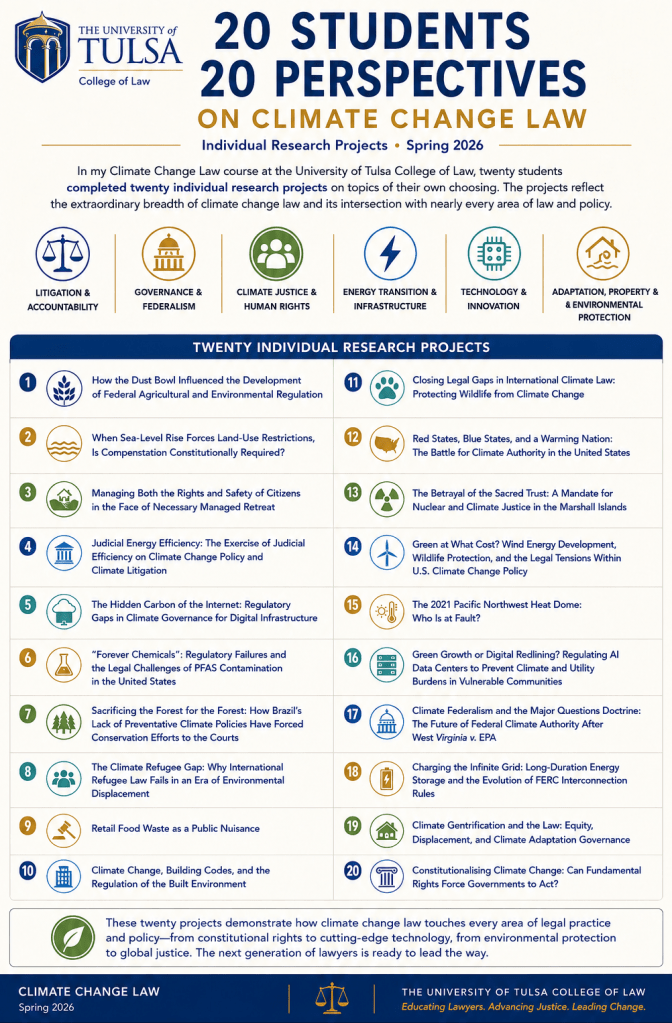
In my Climate Change Law course at the University of Tulsa College of Law, twenty students completed twenty individual research projects and policy briefs on topics of their own choosing. These projects complemented the two rounds of collaborative group presentations completed earlier in the semester, allowing students to move from team-based exploration of climate law topics to independent research and policy analysis.
Throughout the semester, students examined how climate change intersects with a wide range of legal fields, including international law, constitutional law, administrative law, property law, torts, civil procedure, federal courts, energy law, environmental justice, corporate governance, and technology governance. Building on these doctrinal foundations, students selected specific climate-related legal problems and analyzed them through particular legal, institutional, and governance lenses.
A particularly rewarding aspect of these projects was the opportunity to work closely with students as they refined their ideas throughout the semester. Through individualized feedback on topic selection, analytical framing, research design, structure, and presentation strategy, many projects evolved substantially from their original proposals, becoming more focused, more legally grounded, and more responsive to broader debates in climate change law and governance.
Among the topics students explored were:
• The Dust Bowl and the development of federal agricultural and environmental regulation
• Sea-level rise, land-use restrictions, and constitutional compensation
• Managed retreat and the balance between public safety and private rights
• Judicial responses to climate litigation and climate policy
• The hidden carbon footprint of the Internet and digital infrastructure
• PFAS contamination and regulatory failures
• Amazon deforestation litigation and climate accountability in Brazil
• Climate refugees and the limitations of international refugee law
• Public nuisance and retail food waste
• Building codes and climate adaptation in the built environment
• Wildlife protection and gaps in international climate law
• Climate federalism and the battle for climate authority in the United States
• Nuclear and climate justice in the Marshall Islands
• Wind energy development and wildlife conservation
• Liability for the Pacific Northwest Heat Dome
• AI data centers, environmental justice, and digital infrastructure
• The Major Questions Doctrine and the future of federal climate authority
• Long-duration energy storage and FERC interconnection rules
• Climate gentrification, equity, and adaptation governance
Taken together, these projects illustrate how climate change law increasingly intersects with constitutional law, administrative law, international law, energy regulation, technology governance, environmental justice, property rights, human rights, and questions of institutional design.
What impressed me most was not simply the breadth of the topics, but the willingness of students to engage with difficult questions that often have no easy answers. Across very different subject areas, many projects returned to common concerns about responsibility, accountability, governance, risk allocation, and the role of law in responding to a changing climate.
Twenty students. Twenty projects. Twenty perspectives on one of the defining legal challenges of our time.
Paolo Davide Farah, Paolo Farah