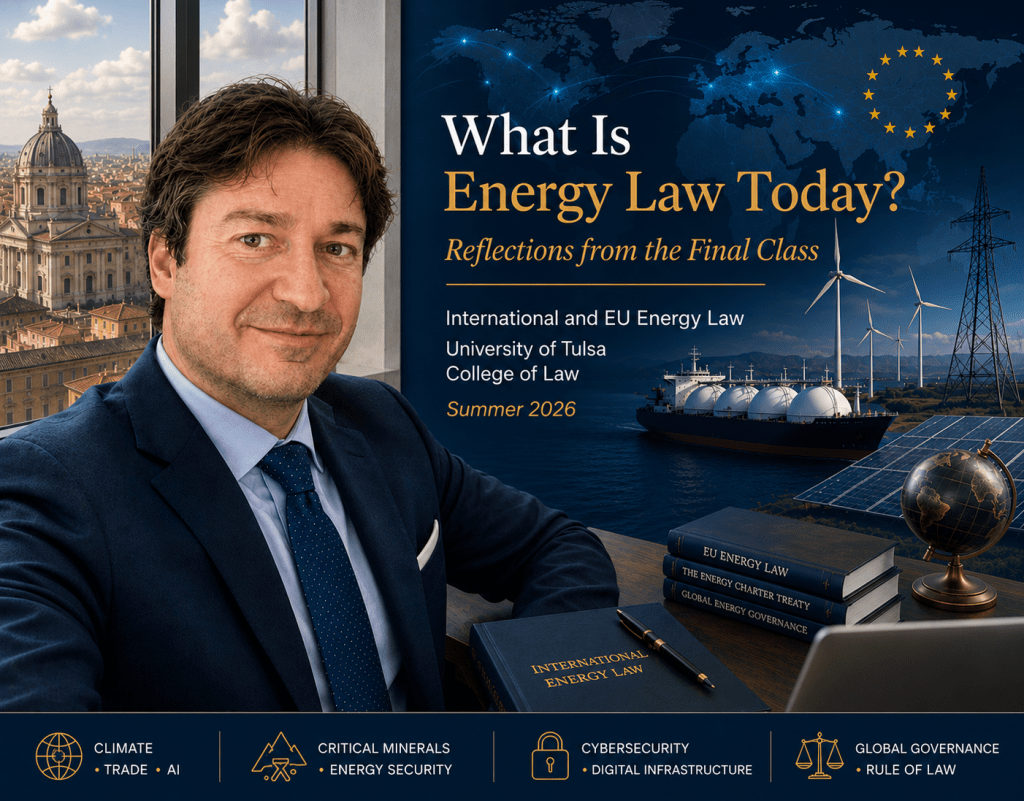

What Is Energy Law Today? Reflections from the Final Class of My International and EU Energy Law Course
The full post is available at https://paolofarah.wordpress.com/2026/06/25/what-is-energy-law-today-reflections-from-the-final-class-of-my-international-and-eu-energy-law-course/
One of the questions I posed to my students during the final session of my International and EU Energy Law course at the University of Tulsa College of Law was deceptively simple:
What is energy law today?
Thirty years ago, the answer might have focused primarily on oil and gas, pipelines, OPEC, energy markets, prices, and security of supply.
Today, that answer is no longer sufficient.
Throughout this summer semester, we explored how energy law increasingly intersects with climate change, international trade, artificial intelligence, cybersecurity, digital infrastructure, human rights, ESG, strategic autonomy, critical minerals, industrial policy, competition law, and geopolitics. Rather than treating these subjects as separate fields, we examined how they have become deeply interconnected.
During our concluding discussion, I suggested that energy law has undergone several fundamental transformations.
We have moved:
• from energy markets to energy systems;
• from market governance to strategic governance;
• from primarily national regulation to multi-level governance involving domestic, regional, international, and private actors;
• from regulating physical infrastructure to governing increasingly digital infrastructures, where artificial intelligence, smart grids, cybersecurity, and data governance have become essential components of modern energy systems;
• and perhaps most importantly, from regulating relatively stable technologies to governing uncertainty itself.
One of the most rewarding aspects of the final class was seeing students connect these broader transformations to the topics they had explored in their own research presentations. Their discussions ranged from strategic autonomy and critical minerals to cybersecurity, hydrogen governance, nuclear energy, digitalization, infrastructure governance, and emerging technologies. Together, these projects illustrated how contemporary energy law extends far beyond the regulation of fuels or electricity markets.
Our conversation concluded with a broader reflection on the future.
What will energy lawyers actually do in twenty years?
Increasingly, they will not simply negotiate energy contracts or advise on regulatory compliance. They will also work on artificial intelligence, critical infrastructure protection, cybersecurity, climate litigation, strategic investment, international trade, national security, corporate governance, and geopolitical competition.
In other words, the energy lawyer of the future will also be, to varying degrees, an international lawyer, a technology lawyer, an environmental lawyer, a trade lawyer, a national security lawyer, and a corporate lawyer.
Perhaps the most interesting question we discussed was not which technology will dominate the future, hydrogen, advanced nuclear reactors, artificial intelligence, carbon capture, or something not yet discovered, but whether our legal institutions are capable of governing increasingly interconnected and uncertain systems.
Climate change cannot be separated from critical minerals.
Critical minerals cannot be separated from geopolitics.
Geopolitics cannot be separated from trade and investment.
Artificial intelligence cannot be separated from electricity demand.
Cybersecurity cannot be separated from national security.
None of these challenges can be addressed in isolation.
That is why I suggested to the class that the greatest challenge facing energy law over the coming decades may not be any single technology or policy. Instead, it may be governance itself: designing legal institutions capable of managing multiple, interconnected risks while preserving the rule of law, democratic legitimacy, sustainability, and international cooperation.
I concluded by thanking the students for an outstanding semester. Their thoughtful participation, collaborative presentations, and willingness to engage with complex legal and policy questions made this intensive summer course especially rewarding.
As educators, we often hope that students remember more than individual doctrines or regulations. If there is one idea I hope they carry forward, it is this:
Energy law is no longer simply the law governing oil, gas, or electricity. It has become one of the principal legal architectures through which societies organize technological innovation, economic development, climate policy, national security, and global governance.
The full post is available at https://paolofarah.wordpress.com/2026/06/25/what-is-energy-law-today-reflections-from-the-final-class-of-my-international-and-eu-energy-law-course/
Paolo Davide Farah, Paolo Farah