

From Taxation to Epistemic Governance: Knowledge, Power, and the Reconfiguration of Global Order
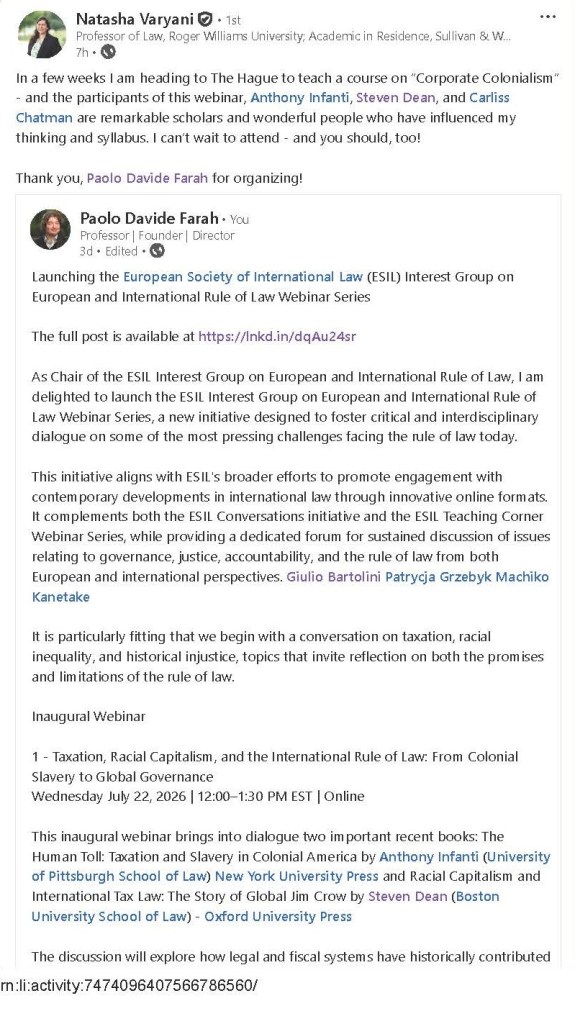
I was delighted to see that our forthcoming inaugural webinar of the European Society of International Law (ESIL) Interest Group on the European and International Rule of Law has already sparked interest and connections with ongoing teaching and research initiatives beyond the event itself.
The conversation among Anthony Infanti, Steven Dean, Carliss Chatman, and myself explores how questions of taxation, racial capitalism, and historical injustice illuminate issues concerning governance, power, legal ordering, institutional design, and the ways in which legal and institutional frameworks shape social and economic relations. The themes raised by these important works invite reflection not only on fiscal systems and historical inequality, but also on the role of law in structuring authority, allocating resources, and responding to persistent forms of injustice in contemporary society. https://paolofarah.wordpress.com/2026/06/17/this-esil-interest-group-on-international-and-european-rule-of-law-conversations/
These questions are central to what I have recently described as epistemic governance: who produces knowledge, whose perspectives are recognized as authoritative, how governance frameworks are constructed and legitimized, and how competing visions of law, development, justice, and social order interact in an increasingly interconnected world. More on this theme here: https://papers.ssrn.com/sol3/papers.cfm?abstract_id=6487038 The Webinar full bibliography is available at https://lnkd.in/dqAu24sr
In many respects, this inaugural webinar reflects the vision of the ESIL Webinar Series. Future conversations will address topics ranging from intellectual property, international economic law, and environmental governance to emerging technologies, legal pluralism, and the role of emerging powers. All will engage with a common set of questions concerning global governance, authority, knowledge, and the ongoing reconfiguration of legal and political order.
These themes also inform the work of the newly established International Law Association (ILA) Study Group on International Law, Global Challenges, and the Impact of Emerging Powers on Global Governance: https://paolofarah.wordpress.com/2026/06/13/from-dialogue-to-action-chairing-the-new-ila-study-group-on-international-law-global-challenges-and-the-impact-of-emerging-powers-on-global-governance/
I look forward to continuing these conversations through this webinar and future events in the series.
#InternationalLaw #GlobalGovernance #EpistemicGovernance #RuleOfLaw #ESIL #ILA #LegalPluralism #InternationalEconomicLaw #ComparativeLaw #GlobalOrder
The inaugural webinar, “Taxation, Racial Capitalism, and the International Rule of Law: From Colonial Slavery to Global Governance,” will take place on Wednesday July 22, 2026, from 12:00–1:30 PM EST. Participation is free and open to all. Registration is available at:
https://docs.google.com/forms/d/e/1FAIpQLSenhxQcN6nndaMpfluOGg0YZCyhriqNIrzdFqfgrISpInOkHQ/viewform?usp=dialog
Selected Bibliography
Books in Dialogue
Dean, Steven A. (2025). Racial Capitalism and International Tax Law: The Story of Global Jim Crow. Oxford: Oxford University Press – Examines how international tax law has historically contributed to racialized structures of economic power and inequality on a global scale.
Infanti, Anthony C. (2025). The Human Toll: Taxation and Slavery in Colonial America. New York: New York University Press – Explores the relationship between taxation, slavery, and state-building in colonial America, highlighting the human costs embedded in fiscal and legal institutions.
Related Scholarship by Carliss N. Chatman
(2023). “Teaching Slavery in Commercial Law.” 28 Michigan Journal of Race & Law 1–38. SMU Dedman School of Law Legal Studies Research Paper No. 611. Available at SSRN: https://papers.ssrn.com/sol3/papers.cfm?abstract_id=3926671 – Examines how slavery and its enduring legacies can be more meaningfully integrated into the teaching and understanding of commercial law.
(2026). “The Contract and the Cure: Building a Private Infrastructure for Reparations.” In Slavery’s Long Tentacles: Entanglements in Historical and Modern Forms of Slavery (Cambridge University Press, forthcoming). https://ssrn.com/abstract=6140369 – Explores the role of private law, contracts, and institutional design in advancing reparative justice for the enduring harms of slavery.
(October 24, 2024). “1981”, 82 Wash. & Lee L. Rev. 1655 (2026), SMU Dedman School of Law Legal Studies Research Paper No. 666, Available at SSRN: https://ssrn.com/abstract=4998718 – Analyzes the continuing significance of 42 U.S.C. § 1981 and its role in addressing racial discrimination, equality, and access to economic opportunity.
(2018). “The Corporate Personhood Two-Step.” 18 Nevada Law Journal 811–862. Posted July 17, 2017; revised August 11, 2023. Chatman, Carliss, The Corporate Personhood Two-Step (June 25, 2017). 18 Nev. L. J. 811 (2018), Available at SSRN: https://ssrn.com/abstract=2992275 – Investigates how legal doctrines of corporate personhood shape corporate power, accountability, and the allocation of rights within modern governance systems.
Chatman’s SSRN Author Page https://papers.ssrn.com/sol3/cf_dev/AbsByAuth.cfm?per_id=2419097
Related Scholarship by Paolo D. Farah
(2026). Epistemic Governance. Available at SSRN: https://papers.ssrn.com/sol3/papers.cfm?abstract_id=6487038 – Develops a framework for understanding how knowledge, authority, expertise, and competing narratives shape governance structures, institutional legitimacy, and global ordering.
(2025) China’s Path to Modernization and Legal Pluralism: Transplants and the Belt and Road Initiative, Asian Journal of Law and Society, Cambridge University Press https://papers.ssrn.com/sol3/papers.cfm?abstract_id=5215873 – Examines how competing legal traditions, governance models, and development paradigms contribute to evolving forms of legal pluralism and the reconfiguration of global order.
Farah’s SSRN Author Page https://papers.ssrn.com/sol3/cf_dev/AbsByAuth.cfm?per_id=629289
Paolo Davide Farah, Paolo Farah