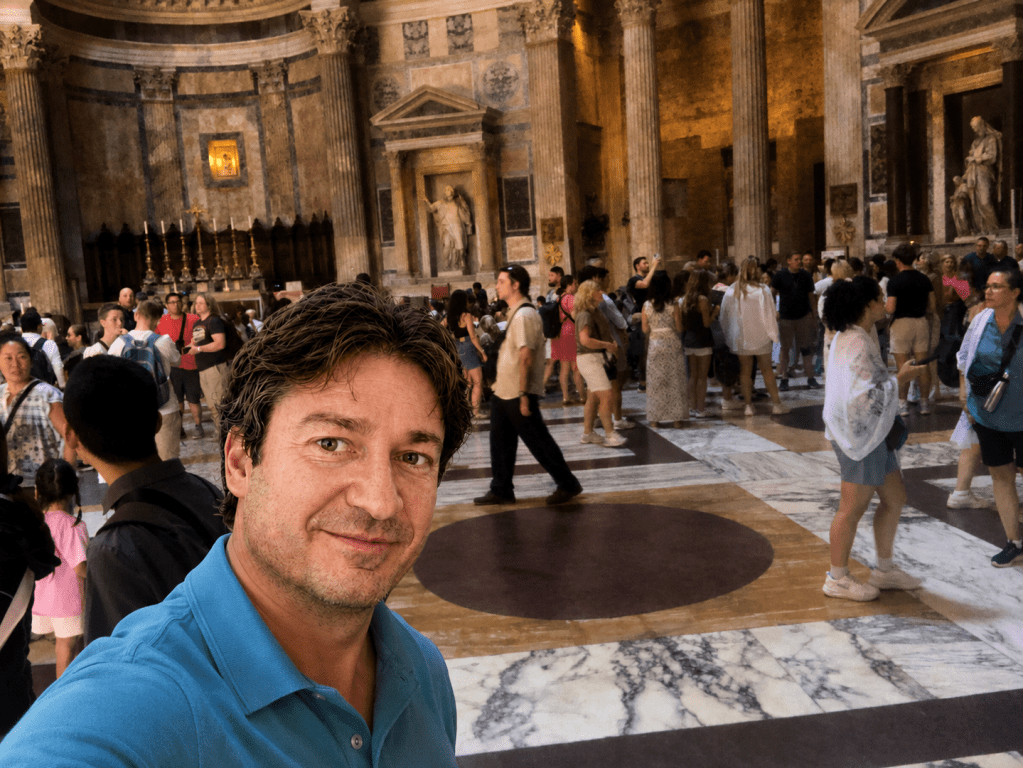


The Pantheon and the Endurance of Civilizations: Reflections on Governance, Knowledge, and Global Order
Standing beneath the dome of the Pantheon, one cannot help but reflect on the extraordinary longevity of institutions, ideas, and civilizations.
For those interested, the complete reflection is available on my WordPress blog: https://paolofarah.wordpress.com/2026/06/28/the-pantheon-and-the-endurance-of-civilizations-reflections-on-governance-knowledge-and-global-order/
Built nearly two thousand years ago, the Pantheon has survived the rise and fall of empires, religious transformations, political revolutions, wars, technological change, and shifting political orders. It has served successively as a Roman temple, a Christian church, and a site of national memory, illustrating how institutions acquire new meanings across different historical, political, and cultural contexts while preserving elements of their historical identity.
In today’s world, marked by geopolitical tensions, armed conflicts, energy transitions, climate challenges, technological disruption, and the reconfiguration of the international order, the Pantheon offers a powerful lesson. Durable governance is not merely about power, resources, or military strength. It is also about adaptability, legitimacy, memory, and the ability to integrate change while preserving core values.
The monument reminds us that cultural heritage is not simply about preserving the past. It is about understanding how societies continuously reinterpret their institutions, identities, and collective memory while navigating profound political, religious, technological, and social transformations. It is a living repository of knowledge, experience, and collective learning. In many ways, it reflects a broader challenge facing contemporary societies: how to preserve, reinterpret, and transmit knowledge across generations while navigating an ever-changing world.
In an age increasingly shaped by artificial intelligence, digital infrastructures, energy competition, critical minerals, and emerging technologies, the governance of knowledge may become as important as the governance of territory, markets, or natural resources. Empires disappear, political systems evolve, and technologies change, yet some forms of knowledge endure because they become embedded in institutions, culture, and collective memory.
Looking through the Pantheon’s oculus toward the sky, one might ask:
What allows certain institutions, norms, and civilizations to endure while others fade away? And how can we build governance frameworks capable not only of managing today’s challenges, but of transmitting wisdom, resilience, and legitimacy to future generations?
These questions lie at the heart of contemporary debates on global governance, the rule of law, sustainability, and what I have elsewhere described as epistemic governance—the governance of knowledge itself.
(2026). Epistemic Governance. Available at SSRN: https://papers.ssrn.com/sol3/papers.cfm?abstract_id=6487038 – Develops a framework for understanding how knowledge, authority, expertise, and competing narratives shape governance structures, institutional legitimacy, and global ordering
For those interested, I have shared a longer reflection on my WordPress blog exploring the connections between the Pantheon, cultural heritage, global governance, and what I describe as epistemic governance: https://paolofarah.wordpress.com/2026/06/28/the-pantheon-and-the-endurance-of-civilizations-reflections-on-governance-knowledge-and-global-order/
#Pantheon #Rome #CulturalHeritage #GlobalGovernance #EpistemicGovernance #InternationalLaw #RuleOfLaw #Geopolitics #Sustainability #ArtificialIntelligence #ClimateChange #EnergyTransition #LegalHistory
Paolo Davide Farah, Paolo Farah
Suggested Bibliography
- Epistemic Governance, available on SSRN: https://papers.ssrn.com/sol3/papers.cfm?abstract_id=6487038
- Conflict between Intellectual Property Rights and Human Rights: A Case Study on Intangible Cultural Heritage
94 Oregon Law Review 125 (2015) - When John Locke Meets Lao Tzu: The Relationship between Intellectual Property, Biodiversity and Indigenous Knowledge and the Implications for Food Security
33 Duke Environmental Law & Policy Forum 297 (2024)