
From Energy Markets to Global Energy Governance: Student Perspectives on the Future of International and EU Energy Law
One of the most rewarding aspects of teaching is watching students apply legal concepts to emerging global challenges and develop their own analytical frameworks.
The full post is available at: https://paolofarah.wordpress.com/2026/06/27/from-energy-markets-to-global-energy-governance-student-perspectives-on-the-future-of-international-and-eu-energy-law/
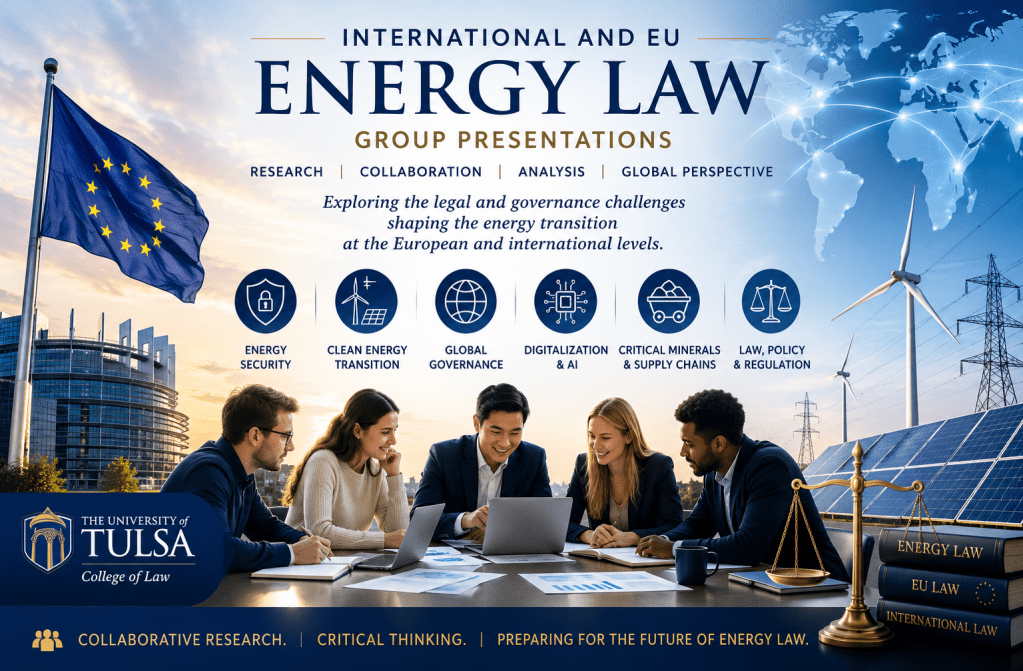
Over the course of my International and EU Energy Law class at the University of Tulsa College of Law, students worked collaboratively in groups to prepare two rounds of research presentations examining some of the most significant legal and governance challenges facing the energy transition.
An important feature of the course was its iterative approach to collaborative research. Rather than preparing presentations independently from the outset, each group first submitted a detailed proposal, received individualized feedback, revised and refined its research question, and, where necessary, adjusted its topic to avoid overlap with other groups. This iterative process encouraged students to sharpen their analytical frameworks, develop stronger legal arguments, and engage more critically with complex questions of international and EU energy governance before delivering their final presentations.
The course itself was organized around the evolution of energy law, from traditional regulation of energy markets toward broader questions of international governance, strategic autonomy, digitalization, infrastructure, geopolitics, sustainability, and technological transformation.
Building upon the legal frameworks examined throughout the semester, students selected their own research topics and explored questions including:
• Energy security after Russia’s invasion of Ukraine and the transformation of EU energy governance;
• The International Energy Agency and energy resilience during geopolitical crises;
• Competition law, state aid, and government intervention in energy markets;
• Strategic autonomy, critical minerals, and new global supply-chain dependencies;
• Cybersecurity governance for critical energy infrastructure;
• Risk governance, hydrogen, nuclear energy, and emerging energy technologies.
Although each group focused on a different subject, together their presentations illustrated a broader transformation taking place within contemporary energy law.
Energy law is no longer confined to regulating oil, gas, or electricity markets. It increasingly intersects with international trade, industrial policy, digital infrastructure, cybersecurity, artificial intelligence, environmental governance, critical minerals, strategic investment, national security, and global governance.
One of the most encouraging aspects of the presentations was seeing students move beyond describing legal frameworks to asking broader governance questions about resilience, uncertainty, institutional design, public-private coordination, and the evolving role of law in managing the energy transition.
These collaborative presentations represent only one component of the course. Students are now developing their individual research presentations and policy briefs, where they will build upon these discussions while pursuing their own independent research questions in International and EU energy law.
I look forward to seeing how their individual projects further contribute to these important and rapidly evolving debates.
Related reflections from this course:
7.19. What Is Energy Law Today? Reflections from the Final Class of My International and EU Energy Law Course: https://paolofarah.wordpress.com/2026/06/25/what-is-energy-law-today-reflections-from-the-final-class-of-my-international-and-eu-energy-law-course/
7.9. International and EU Energy Law: Global Governance, Strategic Autonomy, and Energy Transformation: https://paolofarah.wordpress.com/2026/05/18/international-and-eu-energy-law-global-governance-strategic-autonomy-and-energy-transformation/
Paolo Davide Farah, Paolo Farah