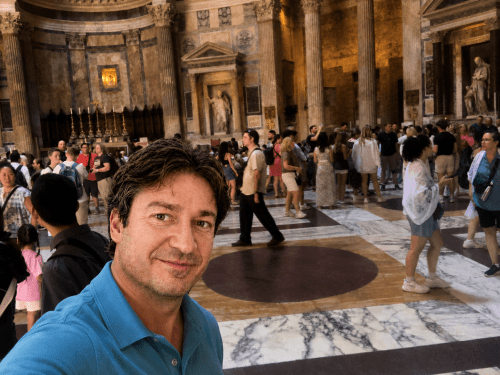


From Ancient Rome to Contemporary Constitutional Debates: Religion, Governance, and the Public Sphere
Standing beneath the dome of the Pantheon, one is reminded that the relationship between religion, political authority, and public institutions has never been static. Few monuments illustrate this more clearly than the Pantheon itself.
For those interested, the complete reflection is available on my WordPress blog: https://paolofarah.wordpress.com/2026/06/29/from-ancient-rome-to-contemporary-constitutional-debates-religion-governance-and-the-public-sphere
Constructed in the second century CE as a Roman temple, later consecrated as a Christian church, and eventually becoming a site of national memory through the burial of Italy’s kings, the Pantheon has continuously adapted to changing constitutional, political, and social realities. Its remarkable continuity lies not in institutional permanence but in its capacity to acquire new meanings across successive historical eras.
This history offers an important perspective for understanding contemporary constitutional debates. Recent discussions in the United States concerning the relationship between religion and the state—including proposals to rethink the traditional understanding of church-state separation—are often presented as uniquely American controversies. They are not.
Across constitutional democracies, societies have long grappled with a common question: how should political communities balance religious liberty, institutional neutrality, democratic pluralism, and constitutional legitimacy?
Different constitutional traditions have produced different answers. France has developed the principle of laïcité; Germany has embraced a cooperative model between the state and religious communities; Italy recognizes the autonomy of religious denominations while preserving the secular character of the Republic; and the United States continues to interpret the Establishment and Free Exercise Clauses through an evolving body of constitutional jurisprudence.
These differences remind us that there is no single constitutional formula governing the relationship between religion and the public sphere. Constitutional systems evolve within distinct historical, cultural, and political contexts.
The Pantheon offers an instructive lesson. Its history should not be understood as supporting any particular constitutional arrangement. Rather, it illustrates a broader phenomenon: enduring institutions survive because societies continually reinterpret them while preserving elements of their historical identity.
This insight extends beyond religion. It speaks to constitutional resilience itself. Institutions endure not because they remain unchanged, but because they successfully adapt to changing political realities while maintaining legitimacy, continuity, and public trust.
In an era marked by democratic polarization, geopolitical competition, technological transformation, and renewed debates over constitutional identity, perhaps the more enduring question is not whether religion should occupy more or less space within the public sphere, but how constitutional democracies can preserve pluralism, protect fundamental freedoms, and maintain institutional legitimacy amid profound social change.
The Pantheon has witnessed nearly two thousand years of constitutional transformation. Its greatest lesson may be that resilience is achieved neither through rigid permanence nor constant rupture, but through the capacity of institutions to evolve while preserving the values that give them enduring legitimacy.
For those interested, the complete reflection is available on my WordPress blog: https://paolofarah.wordpress.com/2026/06/29/from-ancient-rome-to-contemporary-constitutional-debates-religion-governance-and-the-public-sphere
Paolo Davide Farah, Paolo Farah
Suggested Bibliography
- Epistemic Governance, available on SSRN: https://papers.ssrn.com/sol3/papers.cfm?abstract_id=6487038
- Conflict between Intellectual Property Rights and Human Rights: A Case Study on Intangible Cultural Heritage
94 Oregon Law Review 125 (2015) - When John Locke Meets Lao Tzu: The Relationship between Intellectual Property, Biodiversity and Indigenous Knowledge and the Implications for Food Security
33 Duke Environmental Law & Policy Forum 297 (2024)