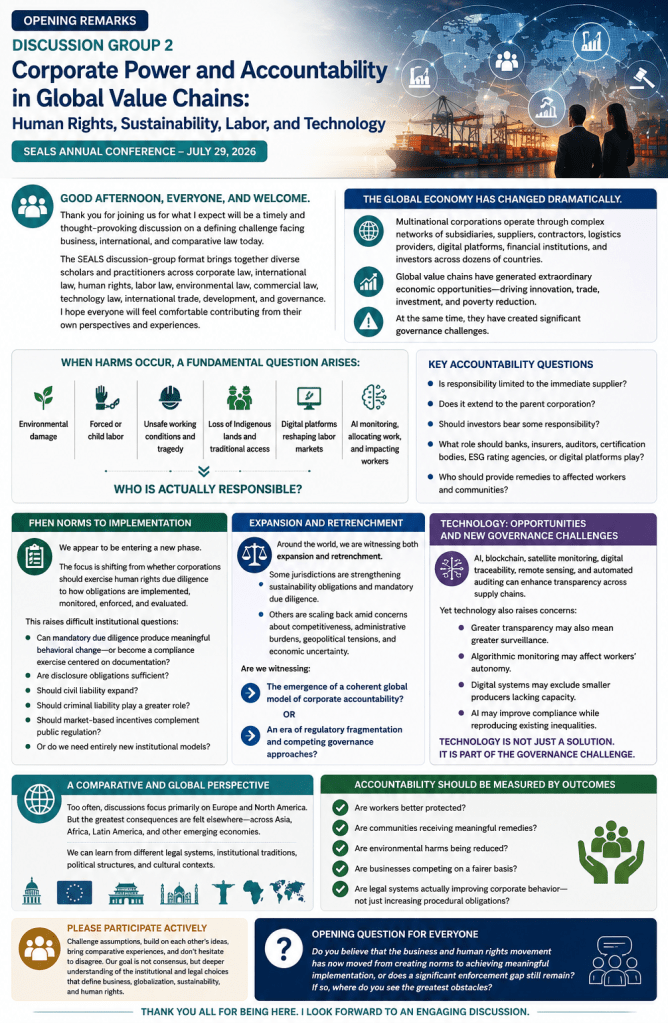
Opening Remarks
Discussion Group 2
Corporate Power and Accountability in Global Value Chains: Human Rights, Sustainability, Labor, and Technology – 2026 Southeastern Association of Law Schools (SEALS) Annual Conference – July 29, 2026
Good afternoon, everyone, and welcome.
Thank you all for joining us for what I expect will be a timely and thought-provoking discussion on one of the defining challenges facing business, international, and comparative law today: the evolving relationship between corporate power, global value chains, and legal accountability.
It is a pleasure to welcome such a distinguished and interdisciplinary group of participants. One of the greatest strengths of the SEALS discussion-group format is precisely that it allows us to move beyond disciplinary boundaries. Today’s conversation touches on corporate law, international law, human rights, labor law, environmental law, commercial law, technology law, international trade, development, and governance. I hope everyone will feel comfortable contributing from their own perspectives and experiences.
The organization of the global economy has changed dramatically over the past several decades.
Today’s multinational corporations rarely manufacture products entirely within one jurisdiction. Instead, production is distributed across complex networks of subsidiaries, suppliers, contractors, logistics providers, digital platforms, financial institutions, and investors that span dozens of countries.
These global value chains have generated extraordinary economic opportunities. They have contributed to innovation, trade, investment, and poverty reduction in many parts of the world.
At the same time, they have also created significant governance challenges.
When environmental damage occurs…
When forced labor or child labor is discovered…
When unsafe working conditions lead to tragedy…
When Indigenous communities lose access to traditional lands…
When digital platforms reshape labor markets…
Or when artificial intelligence begins allocating work and monitoring workers…
A fundamental legal question immediately arises:
Who is actually responsible?
Is responsibility limited to the immediate supplier?
Does it extend to the parent corporation?
Should investors bear some responsibility?
What role should banks, insurers, auditors, certification bodies, ESG rating agencies, or digital platforms play?
And perhaps even more importantly:
Who should provide remedies to affected workers and communities?
For many years, much of the business and human rights debate focused on developing norms.
Today, however, we appear to be entering a different phase.
The conversation is increasingly shifting from whether corporations should exercise human rights due diligence to how these obligations should actually be implemented, monitored, enforced, and evaluated.
That shift raises difficult institutional questions.
Can mandatory due diligence produce meaningful behavioral change?
Or does it risk becoming another compliance exercise centered primarily on documentation rather than outcomes?
Are disclosure obligations sufficient?
Should civil liability expand?
Should criminal liability play a greater role?
Should market-based incentives complement public regulation?
Or do we need entirely new institutional models?
These questions have become even more complicated in light of recent political developments.
Around the world, we are witnessing both expansion and retrenchment.
Some jurisdictions continue moving toward stronger sustainability obligations and mandatory due diligence.
Others are reconsidering or scaling back regulatory initiatives amid concerns about competitiveness, administrative burdens, geopolitical tensions, and economic uncertainty.
This raises another important question for today’s discussion:
Are we witnessing the emergence of a coherent global model of corporate accountability, or are we entering an era of regulatory fragmentation and competing governance approaches?
Technology further complicates this picture.
Artificial intelligence, blockchain, satellite monitoring, digital traceability systems, remote sensing, and automated auditing promise greater transparency across supply chains than ever before.
Yet technology also raises new concerns.
Greater transparency may also mean greater surveillance.
Algorithmic monitoring may affect workers’ autonomy.
Digital certification systems may exclude smaller producers that lack technological or financial capacity.
Artificial intelligence may improve compliance while simultaneously reproducing existing inequalities.
Technology is therefore not simply a solution.
It is itself becoming part of the governance challenge.
I also hope that today’s discussion will maintain a genuinely comparative and global perspective.
Too often, discussions about corporate accountability focus primarily on Europe and North America.
Yet many of the greatest consequences of global value-chain regulation are experienced elsewhere—in Asia, Africa, Latin America, and other emerging economies, where suppliers, workers, local businesses, and communities often bear the greatest compliance costs while possessing the fewest institutional resources.
This reminds us that accountability should not be measured solely by whether companies file better reports or produce more sophisticated compliance documentation.
Ultimately, accountability should be measured by outcomes.
Are workers better protected?
Are communities receiving meaningful remedies?
Are environmental harms being reduced?
Are businesses competing on a fairer basis?
And are legal systems actually improving corporate behavior rather than simply increasing procedural obligations?
Those, I believe, are the questions that should guide today’s conversation.
As always, I encourage everyone to participate actively. Please challenge assumptions, build on one another’s ideas, bring comparative experiences from different jurisdictions, and don’t hesitate to disagree. The purpose of this session is not to reach complete agreement but to explore the difficult legal and institutional choices that increasingly define the relationship between business, globalization, sustainability, and human rights.
With that, let me begin with our opening question:
Do you believe that the business and human rights movement has now moved from creating norms to achieving meaningful implementation, or does a significant enforcement gap still remain? If so, where do you see the greatest obstacles?
Thank you all for being here, and I look forward to what I am sure will be an engaging discussion.
Paolo Davide Farah, Paolo Farah