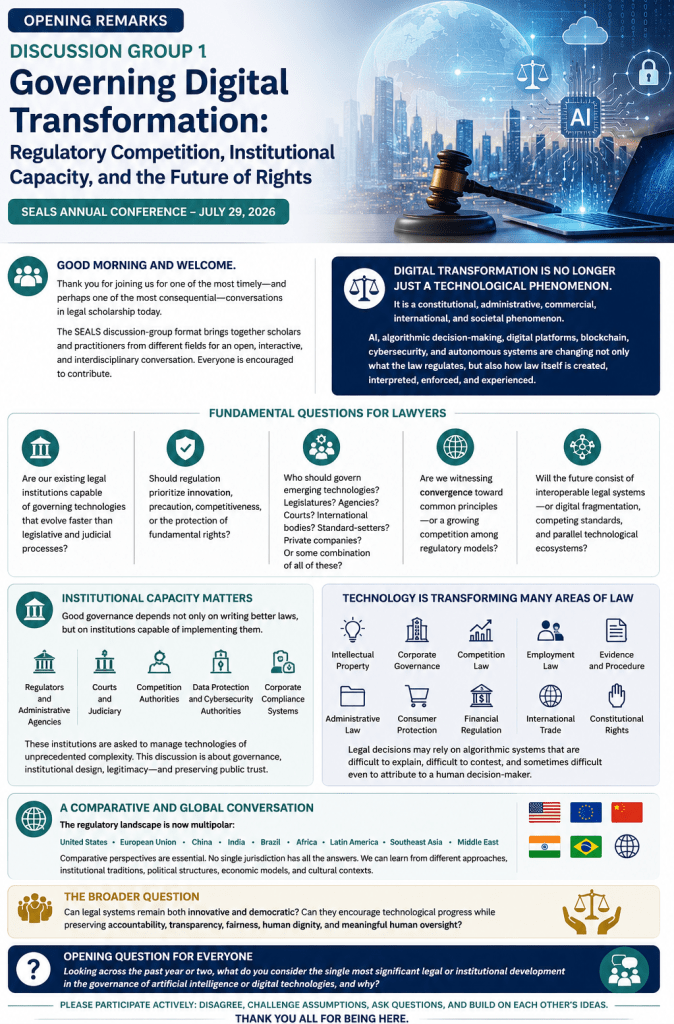
Opening Remarks
Discussion Group 1
Governing Digital Transformation: Regulatory Competition, Institutional Capacity, and the Future of Rights
2026 Southeastern Association of Law Schools (SEALS) Annual Conference – July 29, 2026
Good morning, everyone, and welcome.
Thank you all for joining us.
I am delighted to welcome such an outstanding group of scholars, practitioners, and colleagues from different legal fields. One of the distinctive strengths of the SEALS discussion-group format is that it brings together people with different expertise, methodologies, and perspectives. Rather than formal presentations, our goal is to have an open, interactive, and interdisciplinary conversation in which everyone is encouraged to contribute.
Digital transformation is no longer simply a technological phenomenon. It has become a constitutional, administrative, commercial, international, and societal phenomenon. Artificial intelligence, algorithmic decision-making, digital platforms, blockchain technologies, cybersecurity, and increasingly autonomous systems are changing not only what the law regulates, but also how law itself is created, interpreted, enforced, and experienced.
For lawyers, this raises a series of fundamental questions.
Are our existing legal institutions capable of governing technologies that evolve faster than legislative and judicial processes?
Should regulation prioritize innovation, precaution, competitiveness, or the protection of fundamental rights?
Who should actually govern emerging technologies? National legislatures? Administrative agencies? Courts? International organizations? Technical standard-setting bodies? Private companies? Or some combination of all of these?
These questions are becoming even more complex because digital governance is increasingly global.
For many years, discussions about technology regulation were largely framed around the United States and the European Union. Today, however, the landscape has become far more multipolar. China has developed sophisticated regulatory models with global implications. India is emerging as a major digital regulatory actor. Brazil has become increasingly influential in data protection and platform governance. Countries across Africa, Latin America, Southeast Asia, and the Middle East are developing innovative regulatory approaches that deserve far greater scholarly attention.
One of the questions I hope we will explore today is whether we are witnessing convergence toward common principles—or instead a growing competition among regulatory models.
Will the future consist of interoperable legal systems?
Or are we moving toward digital fragmentation, competing standards, and parallel technological ecosystems?
Another issue that deserves careful attention concerns institutional capacity.
We often focus on writing better laws, but good governance depends equally on the institutions responsible for implementing them. Administrative agencies, courts, regulators, competition authorities, cybersecurity institutions, data protection authorities, and even corporate compliance systems are all being asked to manage technologies whose technical complexity is unprecedented.
This discussion therefore is not only about regulation.
It is also about governance.
It is about institutional design.
It is about legitimacy.
And ultimately, it is about preserving public trust.
Technology also forces us to rethink many traditional areas of law.
Artificial intelligence is affecting intellectual property, corporate governance, competition law, employment law, evidence, civil procedure, administrative law, consumer protection, financial regulation, international trade, and even constitutional rights.
Increasingly, legal decisions themselves may rely upon algorithmic systems that are difficult to explain, difficult to contest, and sometimes difficult even to attribute to a human decision-maker.
That challenges many of the assumptions on which modern legal systems have traditionally been built.
Perhaps the broader question underlying today’s discussion is this:
Can legal systems remain both innovative and democratic?
Can they encourage technological progress while preserving accountability, transparency, fairness, human dignity, and meaningful human oversight?
These are not merely technical questions.
They are questions about the future relationship between law, technology, markets, governments, and society itself.
My hope is that today’s discussion will also be comparative and genuinely international.
Comparative law is becoming increasingly important precisely because no single jurisdiction has all the answers. We can learn a great deal by examining how different legal systems respond to common technological challenges while remaining attentive to differences in institutional traditions, political structures, economic development, and cultural context.
Finally, I would like to encourage everyone to participate actively.
Please feel free to disagree, challenge assumptions, ask questions, and build upon each other’s ideas. The purpose of this session is not to reach consensus, but rather to deepen our understanding of the legal, institutional, and normative choices that digital transformation requires.
With that in mind, let me begin with a simple opening question for everyone:
Looking across the past year or two, what do you consider the single most significant legal or institutional development in the governance of artificial intelligence or digital technologies, and why?
I look forward to hearing your perspectives, and thank you all again for being here.
Paolo Davide Farah, Paolo Farah