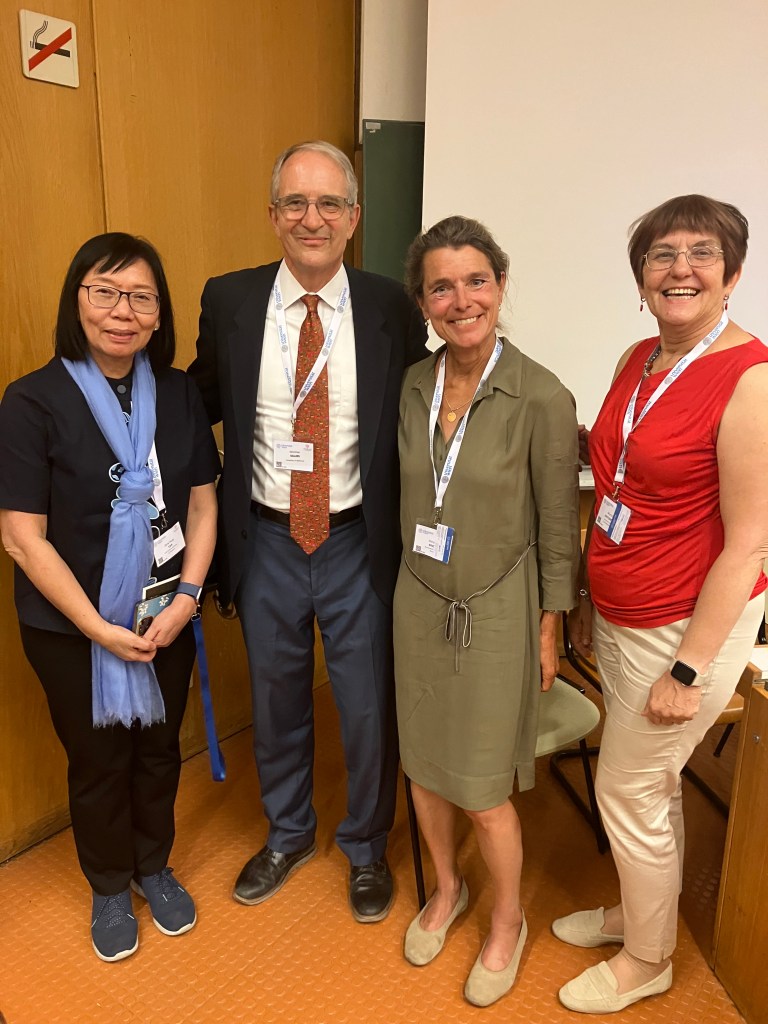

The International Rule of Law and International Relations in a Changing World – Reflections from the ILA Vienna Conference, Day 4
What does the international rule of law mean in a world characterized by increasingly different conceptions of law, governance, sovereignty and international order?
This was the central question underlying another particularly rich session on Day 4 of the 82nd Biennial Conference of the International Law Association (ILA) in Vienna: the meeting of the new ILA Study Group on the Rule of Law and International Relations.
The Study Group is undertaking an ambitious inquiry into the nature, value and purpose of the international rule of law, beginning with the question of whether the ILA should ultimately establish a full Committee on the subject.
The discussion outlined three closely connected dimensions of the project.
The first is conceptual and theoretical: what exactly do we mean when we invoke the rule of law at the international level, and can fundamental principles be identified across different legal and constitutional traditions?
The second concerns institutions and implementation: even if principles can be identified, what institutions and structures are capable of translating them into practice?
The third concerns the relationship between the international and domestic legal orders, including how international law is received and implemented through domestic institutions.
The discussion quickly demonstrated why the first of these questions is already extraordinarily complex.
Different constitutional systems have developed different understandings of the rule of law. Different languages and legal traditions employ concepts that overlap without necessarily being identical. And different regions approach sovereignty, governmental authority, individual rights and the limits of public power through distinct historical and institutional experiences.
This raises a fundamental challenge: how can international law seek universal principles without treating one particular legal tradition as universal?
The discussion therefore turned naturally toward comparative and regional perspectives. Rather than regarding differences among regions simply as obstacles to universality, comparative analysis can help identify both genuine divergences and underlying principles that may be shared despite different vocabularies and institutional forms.
The conversation also addressed the relationship between the international and domestic rule of law. The two cannot easily be separated: international legal commitments are frequently implemented through domestic institutions, while developments within states can strengthen—or erode—the broader international legal order. International and regional organizations may themselves play an important role in supporting the rule of law within national legal systems.
One of the most thought-provoking dimensions of the discussion concerned the implications of different understandings of international order associated with major and emerging powers. The session considered, among other examples, Chinese and Russian approaches emphasizing principles such as sovereignty and non-intervention and the difficult question of how these conceptions relate to understandings of the international rule of law that place human rights among its foundational elements.
For me, this dimension was particularly interesting because it intersects closely with questions raised by the changing distribution of global power: Can international law accommodate greater normative and institutional pluralism while preserving meaningful common principles? How should different regional, cultural and political conceptions participate in defining those principles? And where is the boundary between legitimate pluralism and the erosion of the rule of law itself?
These questions also resonate strongly with the work we are beginning in the newly established ILA Study Group on International Law, Global Challenges, and the Impact of Emerging Powers on Global Governance, which I have the privilege of chairing. Although the mandates of the two Study Groups are distinct, the potential intellectual intersections are significant—particularly concerning emerging powers, competing conceptions of international order, regional perspectives, global governance, international institutions and the relationship between universality and pluralism.
One of the great advantages of undertaking these conversations within the International Law Association is precisely its global structure. The discussion emphasized the importance of drawing perspectives from different regions, generations and intellectual traditions rather than constructing an international conception of the rule of law from a geographically limited conversation.
At a moment when both domestic and international institutions face significant pressures, asking what the international rule of law actually requires is not merely a theoretical exercise.
It is increasingly a question about the foundations, legitimacy and future of the international legal order itself.
Paolo Davide Farah, Paolo Farah