Regional Organizations, Multipolarity and Productive Legal Pluralism — Reflections from the ILA Vienna Conference – Day 3 – 2nd Part
Another particularly stimulating discussion today at the 82nd Biennial Conference of the International Law Association in Vienna, during Plenary Panel IV, “Regional Organizations in a Multipolar World: Shaping Global Governance.”
The panel examined a question that is becoming increasingly central to international law: as geopolitical power becomes more dispersed and regional institutions assume greater roles, how should we understand the relationship between regionalism and global governance?
The discussion moved across very different regional experiences—from the Caribbean and Latin America to Africa, Europe and the Asia-Pacific—and explored regional organizations not simply as alternatives to universal institutions, but as increasingly important nodes within a more complex architecture of global governance. Particularly interesting were the exchanges concerning different degrees of institutionalization, the idea of “liquid regionalism,” overlapping regional organizations, the relationship between regional and universal institutions, and the capacity of regional arrangements to respond to global challenges such as climate change.
The second part of the discussion turned specifically to regional adjudication and its potential contribution to the development of international law. The experiences of the Caribbean Court of Justice, the Inter-American Court of Human Rights, the European systems and emerging dispute-settlement arrangements in other regions raised a question that connects closely with some of the issues I hope to explore through the newly established ILA Study Group on International Law, Global Challenges, and the Impact of Emerging Powers on Global Governance.
In my intervention, I suggested that we already know from the European and Inter-American systems that regional adjudication can mediate between international norms and local realities. The more difficult question concerns what happens to that function as the international legal order itself becomes increasingly multipolar and multilevel—not only geopolitically, but also geographically and institutionally.
I therefore asked:
Should we expect different regions to develop different judicial understandings of common global challenges? And, if so, should international law regard this development primarily as fragmentation—or potentially as a productive form of legal pluralism through which regional and local perspectives can reshape global governance? Under what conditions can such differentiation be beneficial rather than harmful?
I added that international lawyers have traditionally devoted considerable attention to the risks associated with the fragmentation of international law. I suggested that differentiation among regional institutions need not invariably be understood negatively. Under some conditions, what appears as fragmentation may instead create space for experimentation, contextualization and the emergence of legal approaches that subsequently influence the broader international legal order.
That leads, for me, to an important further question: what are the conditions under which regional differentiation becomes productive rather than harmful?
The panel itself offered several possible directions. More institutionalized regional systems may be capable of maintaining cooperation despite political or ideological differences; regional adjudicatory bodies can translate broader international norms into particular social and institutional contexts; and regional approaches can sometimes travel in the opposite direction, contributing to the progressive development of international law itself. At the same time, the discussion rightly emphasized the risks of institutional overlap, competing approaches, backlash against regional courts, and regional solutions that may make universal agreement more difficult.
This is precisely where the relationship among multipolarity, multilevel governance, legal pluralism and global challenges becomes particularly interesting.
A multipolar international order need not simply mean that power is redistributed among states. It may also mean that the production, interpretation and development of international legal norms increasingly occur through multiple regional, national and local sites, with ideas moving not only from the global level downward, but also from local and regional institutions upward into global governance.
For me, this was one of the most valuable dimensions of an already extremely rich plenary discussion—and one that connects directly with the broader questions we will be exploring through the new ILA Study Group.
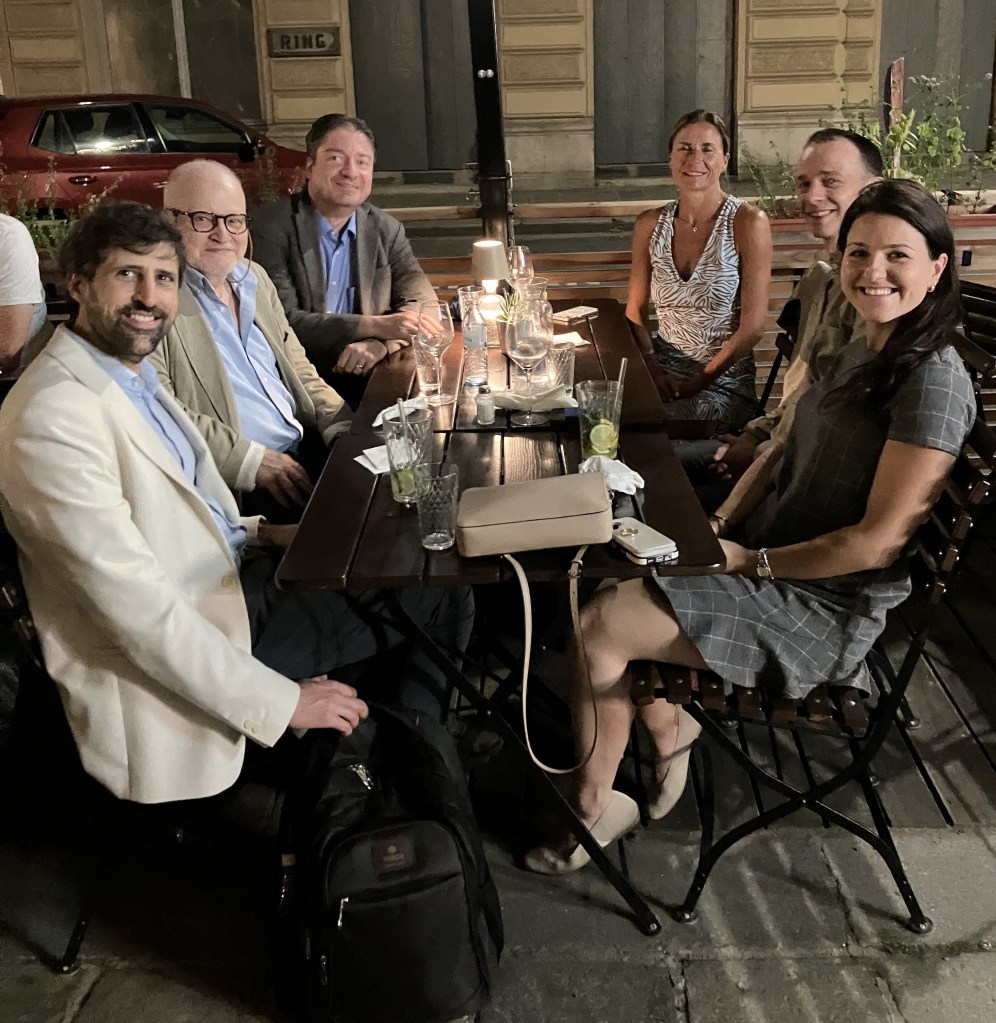
Day 3 ended on an especially pleasant note, with an informal dinner with some fellow members of the ILA Committee on the Rights of Nature, ahead of our closed working session tomorrow. A wonderful opportunity to continue the conversations in a more informal setting and to enjoy the collegial dimension of the ILA Conference before another full day of discussions in Vienna.
82nd ILA Biennial Conference · Vienna 2026
Contours of International Law: Encounters and Evolutions
Plenary Panel IV — Regional Organizations in a Multipolar World: Shaping Global Governance