

Rights of Nature and the ILA Across Borders: From Committee Work to the Italian Embassy and the American Branch – Vienna Conference, Day 4 – 1st Part
Day 4 of the 82nd Biennial Conference of the International Law Association (ILA) in Vienna brought together substantive work on the future development of the Rights of Nature, alongside valuable opportunities for exchange with colleagues from both the Italian and American branches of the ILA.
As an appointed member of the ILA Committee on the Rights of Nature, I participated in the Committee’s closed working session, which provided an opportunity to take stock of the Initial Report and, even more importantly, to look ahead to the next stages of the Committee’s work.
The discussion highlighted how moving from the mapping of existing developments to the formulation of ILA Principles on the Rights of Nature raises a series of fundamental questions. What precisely do we mean by “rights of nature”? Is a common or encompassing definition necessary before principles can be formulated? What kinds of rights can or should be attributed to nature, and on what philosophical and legal foundations?
Particularly important was the discussion of the different intellectual and legal pathways through which Rights of Nature have developed. These include Indigenous peoples’ worldviews and legal traditions, but also broader ecocentric and pluricentric approaches that challenge exclusively anthropocentric understandings of the relationship between humans and the natural world. The challenge is not simply to choose among these perspectives, but to understand where they intersect and whether they can provide common foundations for principles capable of operating across different legal systems and traditions.
This also raises difficult questions concerning the relationship between Rights of Nature and human rights: whether and how nature can be recognized as a legal subject; how the interests or rights of ecosystems, rivers, forests and other natural entities are represented through human institutions; and how an ecocentric legal framework interacts with concepts such as human dignity.
Another important dimension of our discussion concerned the difference between legal recognition and effective implementation. Constitutional provisions, legislation or judicial recognition of Rights of Nature cannot, by themselves, establish that nature is effectively protected. The experience of jurisdictions that have formally recognized such rights makes it essential to examine what actually happens in practice and to avoid confusing ambitious legal texts with successful implementation.
These questions will become increasingly important as the Committee moves from its Initial Report toward subsequent work on the relationship between Rights of Nature and other fields of international law and, ultimately, toward the contemplated development of ILA principles.
We also discussed how to make this work genuinely global and continuous between ILA biennial conferences: geographical representation, participation from different regions, opportunities for intermediate meetings and online exchanges, and ways of bringing together members whose physical distance can otherwise make sustained collaboration difficult. I was particularly pleased to contribute to this discussion, including on possibilities for greater geographical participation and cooperation across ILA branches.
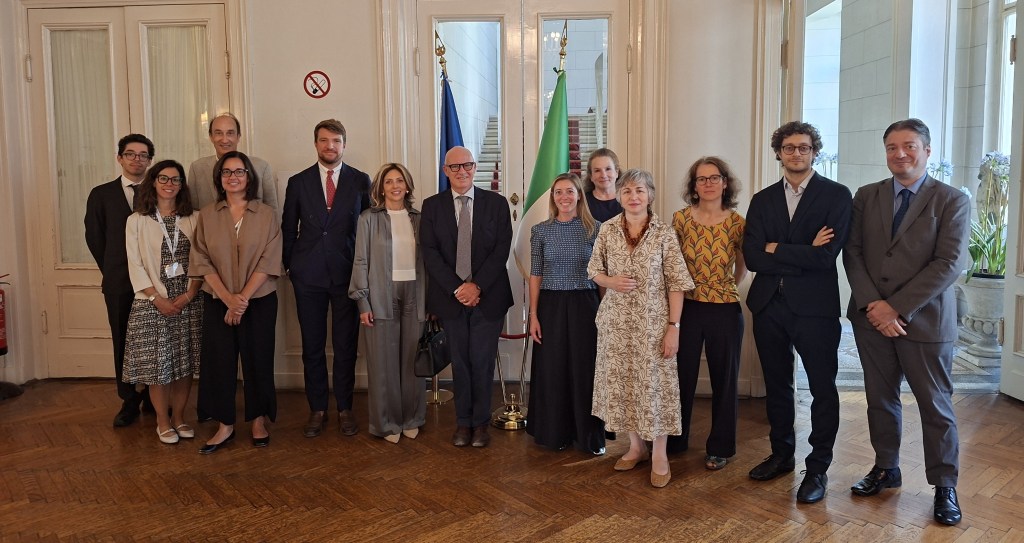
The institutional conversations continued beyond the Committee room. It was a pleasure to join colleagues from the Italian Branch of the IIA at the Italian Embassy in Vienna. Many thanks to the Italian Embassy in Vienna, and in particular to Ambassador Giovanni Pugliese for his invitation and Counsellor Francesco Perale, for his warm hospitality and for welcoming the Italian Branch of the ILA on this special occasion.
Later in the evening it was great to spend time with colleagues from the American Branch of the International Law Association (ABILA) over dinner.
For someone connected with both branches, these encounters were a particularly fitting complement to the day’s substantive work. They are also a reminder of one of the distinctive strengths of the ILA: international law develops not only through reports, principles and formal sessions, but also through sustained intellectual communities that connect scholars and practitioners across countries, regions, branches and legal traditions.
I look forward to contributing to the next stages of the Committee’s work and to the continuing international conversation about what recognizing the Rights of Nature can—and should—mean for international law.
Related Research, Presentations and Events/Symposia/Conferences:
1) When John Locke Meets Lao Tzu: The Relationship between Intellectual Property, Biodiversity and Indigenous Knowledge and the Implications for Food Security, 33 Duke Envtl. L. & Pol’y F. 297 (2024), available at: https://papers.ssrn.com/sol3/papers.cfm?abstract_id=4832284
2) Conflict between Intellectual Property Rights and Human Rights: A Case Study on Intangible Cultural Heritage, 94 Or. L. Rev. 125 (2015), available at: https://papers.ssrn.com/sol3/papers.cfm?abstract_id=2705698
3) Desirability of Commodification of Intangible Cultural Heritage: The Unsatisfying Role of IPRs, 11 Transnat’l Dispute Mgmt. 2, 2014, available at: https://papers.ssrn.com/sol3/papers.cfm?abstract_id=2472339
4) Organizer, Moderator (Chair), and Discussant, Indigenous Legal Orders, Legal Pluralism, and the Coloniality of Method Across Comparative Law, International Law, Intellectual Property, and Trade Governance, Webinar organized on behalf of the American Branch of the International Law Association, June 1, 2026. Flyer ABILA Webinar June 1, 2026 – Webinar Available on YouTube https://www.youtube.com/watch?v=sLeZZabxDxI

5) Organizer and Chair for the Tribal Energy, Environmental Justice, and Climate Change Symposium, March 25, 2026, University of Tulsa College of Law, Tulsa, Oklahoma – Flyer – Symposium Tribal Energy Law, Environmental Justice – March 25, 2026

6) Paolo Davide Farah, Presenter, “Business, Human Rights, and the Environment: Indigenous Perspectives and the 2024 WIPO Treaty”, for the International Conference “Towards A Global Ecological-Economic Legal Framework” jointly organized by École Normale Supérieure (ENS-PSL), Université PSL (Paris Sciences & Lettres) in Paris, France and organized in collaboration with the European Society of International Law (ESIL), the ESIL Interest Groups on EU and International Rule of Law, International Environmental Law, International Economic Law and gLAWcal – Global Law Initiatives for Sustainable Development (UK) held at École Normale Supérieure (ENS-PSL), Paris, France, June 6-7, 2025
7) Paolo Davide Farah, Presenter, “Bridging Gaps in Global Intellectual Property: Challenges and Prospects of the WIPO Treaty on Genetic Resources and Traditional Knowledge”, Paper Presented at the American Society of International Law, International Economic Law Interest Group, Biennial Conference on International Economic Law, held at the University of Michigan Law School, May 16, 2025
You can explore my complete SSRN Author Page here:
SSRN Author Page: https://papers.ssrn.com/sol3/cf_dev/AbsByAuth.cfm?per_id=629289
You may also find additional publications, news, research projects, and academic activities throughout this blog and website –
https://paolofarah.wordpress.com
Paolo Farah, Paolo Davide Farah