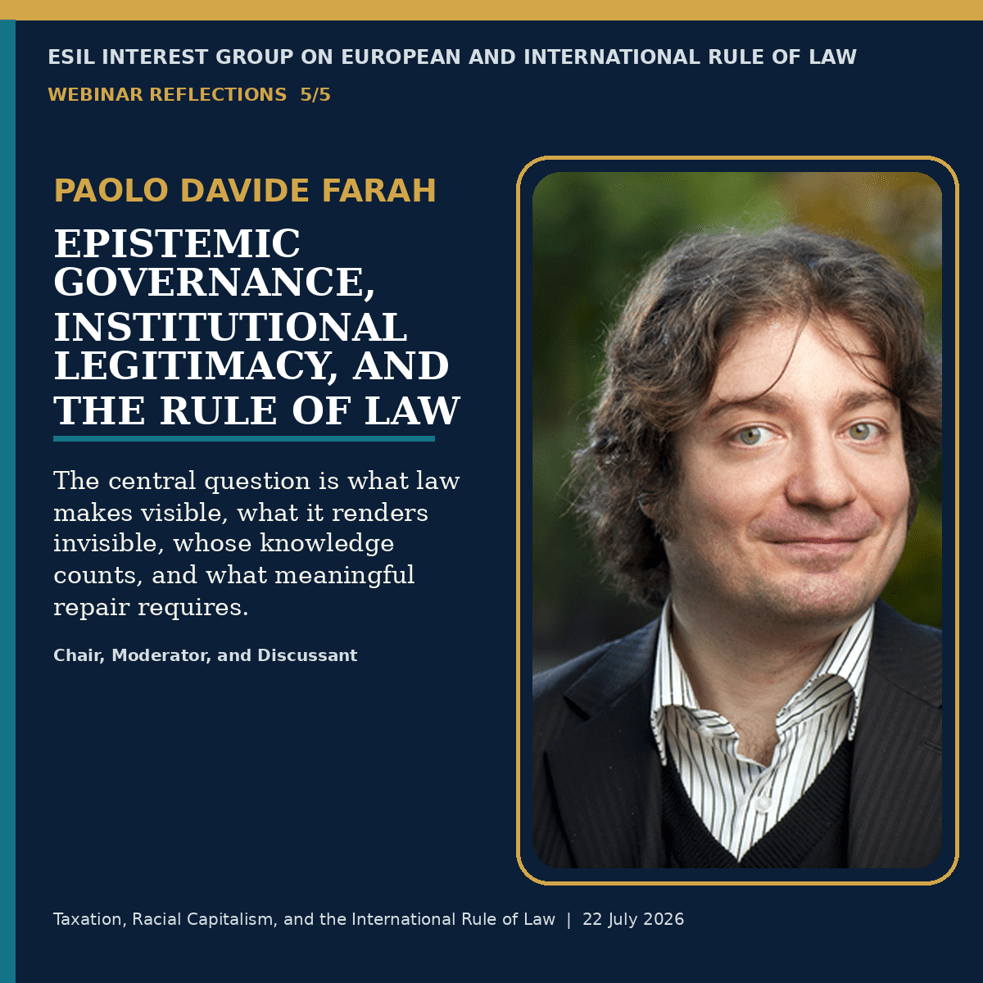

Paolo Davide Farah: Epistemic Governance, Institutional Legitimacy, and the International Rule of Law – Reflections on the Inaugural Webinar – ESIL Interest Group on European and International Rule of Law Webinar Series · Webinar 1 · Reflection 5/5
As Chair, Moderator, and Discussant of the inaugural ESIL Interest Group webinar, I developed a framework intended to place Anthony C. Infanti’s The Human Toll: Taxation and Slavery in Colonial America, Steven A. Dean’s Racial Capitalism and International Tax Law: The Story of Global Jim Crow, and Carliss N. Chatman’s intervention within a broader inquiry into epistemic governance, institutional design, and the substantive rule of law.
This framework was set out in the discussion guide that I prepared as Chair and Moderator and circulated to all the speakers before the webinar. The guide approached taxation not as an isolated technical subject, but as legal and institutional infrastructure: a system that classifies persons and property, structures markets and political authority, distributes resources and vulnerability, and determines whose claims, experiences, and knowledge receive institutional recognition.
The preparatory framework connected taxation with governance, power, legal ordering, institutional design, knowledge production, racial capitalism, fiscal sovereignty, corporate power, historical memory, reparations, institutional legitimacy, and the rule of law. It invited the speakers to examine how apparently technical or formally neutral arrangements may reproduce durable inequalities and how legal institutions might be redesigned to support accountability, participation, and reparative justice.
During the webinar, I reiterated and developed these themes through my questions, comments, and concluding reflections. In particular, I emphasized that the organization of legal scholarship into separate fields—tax, commercial law, corporate law, administrative law, evidence, constitutional law, international law, and comparative law—can obscure the larger institutional architecture connecting them. Specialization is necessary, but remaining within disciplinary silos may prevent us from seeing how related structures of exclusion, authority, and distribution recur across different parts of the legal order.
Following Professor Chatman’s intervention, I connected this problem of disciplinary fragmentation to my work on epistemic governance. I explained that legal institutions do not merely receive facts, categories, and expertise produced elsewhere. They participate in determining what counts as relevant knowledge, who may speak with authority, which experiences enter the legal record, and which questions are accepted as legitimate subjects of legal analysis.
My central question was therefore: what does law make visible, and what does it render invisible?
The recognition—or rejection—of Indigenous law provided one illustration. Legal institutions decide whether the customs, normative practices, and knowledge of Indigenous communities count as “law” at all. That decision is not simply descriptive. It allocates epistemic authority and determines whose legal experience is recognized, discounted, excluded, or rendered invisible.
I then developed the implications of this epistemic function through administrative law. Agencies help construct the official record by deciding what information must be disclosed, what remains in the file, when disclosure occurs, and which categories appear on official forms. These apparently technical choices determine which experiences become administratively visible and how authority is distributed among agencies, courts, regulated industries, professional experts, affected communities, and members of the public.
Evidence law performs a related filtering function within adjudication. Rules concerning relevance, expert testimony, burdens of proof, credibility, hearsay, privilege, authentication, and judicial notice determine whether knowledge can enter the legal record. A person may possess direct and important knowledge but still be discounted because that knowledge is not expressed in an accepted professional vocabulary or supported by institutionally recognized documentation.
The historical and international examples presented during the webinar made these processes concrete. Tax schedules preserved slaveholders’ economic claims while frequently excluding the names, experiences, and humanity of the enslaved persons whose deaths produced those claims. The technical label “Subpart F” obscured the political conflict surrounding treaty abuse. Institutional repetition transformed the questionable characterization of Liberia as a tax haven into seemingly authoritative knowledge. Legal education can reproduce similar forms of erasure when technical rules are taught without their histories.
During the discussion, I identified five methodological distinctions emerging across the speakers’ contributions.
First, a legal rule may reproduce racial hierarchy without using explicit racial language or requiring proof of discriminatory intent.
Second, the presence of historically excluded states or communities within an institution does not necessarily guarantee agenda control, recognition of their expertise, meaningful participation, or distributive influence.
Third, legal authorization does not by itself establish institutional legitimacy. A measure may be formally lawful while remaining inconsistent with equality, dignity, accountability, or meaningful participation.
Fourth, repair may require material transfers, but it may also require alteration of the institutions that produced or continue to reproduce the harm. Compensation without institutional reconstruction may leave the underlying architecture unchanged.
Fifth, legal mechanisms can recur in transformed forms across different historical periods. Identifying continuity does not require treating distinct historical systems as identical, but it does require examining how apparently changed institutions may preserve earlier distributions of power, resources, and vulnerability.
These distinctions connect taxation to a substantive understanding of the rule of law. The rule of law cannot be reduced to whether institutions acted pursuant to validly enacted rules. It must also ask whether the legal order protects equality and dignity, provides meaningful participation and public justification, distributes authority and resources fairly, and supplies mechanisms of accountability, historical responsibility, and repair.
In the final round, I proposed epistemic due process as one possible institutional response. Courts, agencies, and international institutions should make clear what knowledge they considered, why particular forms of expertise were accepted, why other knowledge or experience was rejected, and how those choices affected the outcome. Epistemic due process would connect transparency, reason-giving, participation, and accountability while exposing the institutional processes through which law produces both knowledge and ignorance.
My concluding reflection was that taxation constitutes a central architecture of governance through which law defines persons and property, allocates resources and authority, and shapes the material conditions under which equality, sovereignty, and public institutions can exist.
The webinar also demonstrated why historical recovery matters to present governance. Recovering silenced names, suppressed political conflicts, and excluded forms of expertise is not merely retrospective. It changes how we understand contemporary institutional legitimacy and responsibility and expands the range of reforms that law can imagine.
The discussion therefore moved from diagnosis toward reconstruction. Meaningful repair may require compensation, but it also requires attention to fiscal sovereignty, corporate responsibility, institutional design, public knowledge, and meaningful participation in the making of legal rules.
Because readers may not have seen those earlier posts, the principal bibliography is reproduced below.
Selected Bibliography
Books in Dialogue
Dean, Steven A. (2025). Racial Capitalism and International Tax Law: The Story of Global Jim Crow. Oxford: Oxford University Press – Examines how international tax law has historically contributed to racialized structures of economic power and inequality on a global scale.
Infanti, Anthony C. (2025). The Human Toll: Taxation and Slavery in Colonial America. New York: New York University Press – Explores the relationship between taxation, slavery, and state-building in colonial America, highlighting the human costs embedded in fiscal and legal institutions.
Related Scholarship by Steven A. Dean
Racialized International Tax Law in Research Handbook on Critical Tax Studies (forthcoming Edinburgh University Press, Yvette Lind and Dominic de Cogan, eds.)
Fear of a Black Planet: Africa’s Decolonisation and the Transformation of the International Tax Regime in Taxing People: The Next 100 Years (Cambridge University Press 2026, Tsilly Dagan and Ruth Mason, eds.)
Filing While Black: The Casual Racism of the Tax Law, 2022 Utah Law Review 801, available at https://papers.ssrn.com/sol3/papers.cfm?abstract_id=4081456
Inclusive International Tax Policymaking: FATCA, the U.S. Congressional Black Caucus, and the OECD Blacklist, Revue Européenne et Internationale de Droit Fiscal(2021) (Reprinted in Tax Notes International)
Ten Truths about Tax Havens: Inclusion and the ‘Liberia’ Problem, 70 Emory Law Journal1657 (2021) (with Attiya Waris), available at https://papers.ssrn.com/sol3/papers.cfm?abstract_id=3822421
Dean’s SSRN Author Page https://papers.ssrn.com/sol3/cf_dev/AbsByAuth.cfm?per_id=440250
Related Scholarship by Anthony Infanti
Our Selfish Tax Laws: Toward Tax Reform That Mirrors Our Better Selves (The MIT Press 2018).
Critical Tax Theory: An Introduction (Cambridge University Press, Anthony C. Infanti & Bridget J. Crawford eds., 2009). The Introduction is available at https://papers.ssrn.com/sol3/papers.cfm?abstract_id=1333799
Internation Equity and Human Development, in Tax, Law and Development (Edward Elgar Publishing, Miranda Stewart & Yariv Brauner eds., 2013).
Tax Equity, 55 Buff. L. Rev. 1191 (2008), available at https://digitalcommons.law.buffalo.edu/buffalolawreview/vol55/iss4/5/
Tax and Time: On the Use and Misuse of Legal Imagination (NYU Press 2022), available at https://papers.ssrn.com/sol3/papers.cfm?abstract_id=4006652
Tax Reform Discourse, 32 Va. Tax Rev. 205 (2012), available at https://papers.ssrn.com/sol3/papers.cfm?abstract_id=2034869
Critical Tax Theory: Insights from the US and Opportunities for All, 51 Austl. Tax Rev. 81 (2022) (with Bridget J. Crawford), available at https://papers.ssrn.com/sol3/papers.cfm?abstract_id=4236410
Infanti’s SSRN Author Page
Related Scholarship by Carliss N. Chatman
(2023). “Teaching Slavery in Commercial Law.” 28 Michigan Journal of Race & Law 1–38. SMU Dedman School of Law Legal Studies Research Paper No. 611. Available at SSRN: https://papers.ssrn.com/sol3/papers.cfm?abstract_id=3926671 – Examines how slavery and its enduring legacies can be more meaningfully integrated into the teaching and understanding of commercial law.
(2026). “The Contract and the Cure: Building a Private Infrastructure for Reparations.” In Slavery’s Long Tentacles: Entanglements in Historical and Modern Forms of Slavery (Cambridge University Press, forthcoming). https://ssrn.com/abstract=6140369 – Explores the role of private law, contracts, and institutional design in advancing reparative justice for the enduring harms of slavery.
(October 24, 2024). “1981”, 82 Wash. & Lee L. Rev. 1655 (2026), SMU Dedman School of Law Legal Studies Research Paper No. 666, Available at SSRN: https://ssrn.com/abstract=4998718 – Analyzes the continuing significance of 42 U.S.C. § 1981 and its role in addressing racial discrimination, equality, and access to economic opportunity.
(2018). “The Corporate Personhood Two-Step.” 18 Nevada Law Journal 811–862. Posted July 17, 2017; revised August 11, 2023. Chatman, Carliss, The Corporate Personhood Two-Step (June 25, 2017). 18 Nev. L. J. 811 (2018), Available at SSRN: https://ssrn.com/abstract=2992275 – Investigates how legal doctrines of corporate personhood shape corporate power, accountability, and the allocation of rights within modern governance systems.
Chatman’s SSRN Author Page https://papers.ssrn.com/sol3/cf_dev/AbsByAuth.cfm?per_id=2419097
Related Scholarship by Paolo D. Farah
(2026). Epistemic Governance. Available at SSRN: https://papers.ssrn.com/sol3/papers.cfm?abstract_id=6487038 – Develops a framework for understanding how knowledge, authority, expertise, and competing narratives shape governance structures, institutional legitimacy, and global ordering.
(2025) China’s Path to Modernization and Legal Pluralism: Transplants and the Belt and Road Initiative, Asian Journal of Law and Society, Cambridge University Press https://papers.ssrn.com/sol3/papers.cfm?abstract_id=5215873 – Examines how competing legal traditions, governance models, and development paradigms contribute to evolving forms of legal pluralism and the reconfiguration of global order.
(2024). “Energy Justice, Just Transition and International Environmental Law.” In ASIL Proceedings (Just Energy Transition: Legal Challenges Associated with Coal Phase Out), Cambridge University Press. Available at SSRN: https://papers.ssrn.com/sol3/papers.cfm?abstract_id=5055884 – Explores how legal and governance frameworks shape the distribution of benefits and burdens during energy transitions, highlighting questions of historical responsibility, distributive justice, institutional legitimacy, and the role of law in addressing structural inequalities associated with climate and energy transformation.
Farah’s SSRN Author Page https://papers.ssrn.com/sol3/cf_dev/AbsByAuth.cfm?per_id=629289
Paolo Farah, Paolo Davide Farah

Webinar Reflections 5/5: Paolo Davide Farah—Epistemic Governance, Institutional Legitimacy, and the International Rule of Law