

Coming Full Circle: Reconnecting with Europe-China Law Studies Association (ECLS)
There are moments in an academic career when things seem to come full circle.
At the beginning of my academic career, the European China Law Studies Association (ECLS) was one of the professional communities that helped shape my intellectual journey. At the time, there were a number of us working, from different perspectives, across Chinese law, comparative law, international law, and EU-China relations. ECLS offered something particularly valuable: the opportunity to move beyond our individual institutions and national academic communities and meet scholars working on China across Europe, China, the United States, and many other parts of the world.
For a young academic, that was incredibly rewarding. Conferences were not simply places to present a paper. They were places where one discovered new scholarship and new questions, met people whose work one had been reading, developed friendships and collaborations, and gradually became part of an international scholarly community.
Those memories are also connected with another important period of my academic life, when I began teaching at various Chinese universities, including the China-EU School of Law (CESL), and spending significant periods of time in China. China was not simply an object of research from afar: teaching there, working with Chinese and international colleagues and students, and returning repeatedly—several times per year and often for extended periods—became an important part of how I approached comparative, international, economic, environmental, and energy law.
And then academic—and personal—life took me in many different directions.
It has been several years since I last attended an ECLS Annual Conference. In between came COVID, a growing family, moves, increasing responsibilities within the university and in other academic and professional associations, and an ever-expanding range of teaching, research, institutional, and international commitments.
Throughout those years, however, I continued to teach and research on China, including courses fully dedicated to China and others in which China served as an important comparative case study. My engagement with Chinese law and policy continued to evolve, as did my interest in following and reading the scholarship produced by colleagues in the ECLS community. But being intellectually connected to a field and being physically present at its annual gathering are not always the same thing.
That is why being back at the ECLS Annual Conference 2026 in Barcelona, hosted at the University of Barcelona Faculty of Law from 7–9 September, feels particularly meaningful.
There is something special about walking into a conference after several years and encountering colleagues I first met much earlier in my career, seeing how their scholarship and careers have developed, and at the same time meeting a new generation of scholars who have joined and enriched the ECLS community during the years in between.
And perhaps that is one of the most rewarding aspects of academic associations. Their membership changes, our research evolves, our institutions and countries change, and our personal lives certainly change—but the intellectual conversations can continue across all of those transitions.
This time, I am especially pleased to return also as Chair of Panel 26, “Environmental Law and Sustainable Development,” bringing together work on China’s Ecological and Environmental Code, international environmental obligations, biosecurity, ecological damage compensation, natural-rights enforcement, and maritime sustainability law. In many ways, the panel itself reflects the evolution of my own research across Chinese law, international law, environmental protection, sustainability, and global governance.
Barcelona feels both familiar and new: old colleagues, new colleagues, new questions—and a scholarly community that I am very happy to reconnect with.
People such as Gianmaria Ajani, Piercarlo Rossi, Marina Timoteo, Angela Carpi, and many others are closely connected in my memory with the beginning of my intensive China-related work in Turin, and with so many stimulating and constructive exchanges over the years in Bologna, Beijing, and elsewhere. Those experiences were linked not only to research, but also to communities such as ECLS and CESL, which created lasting connections across institutions and countries.
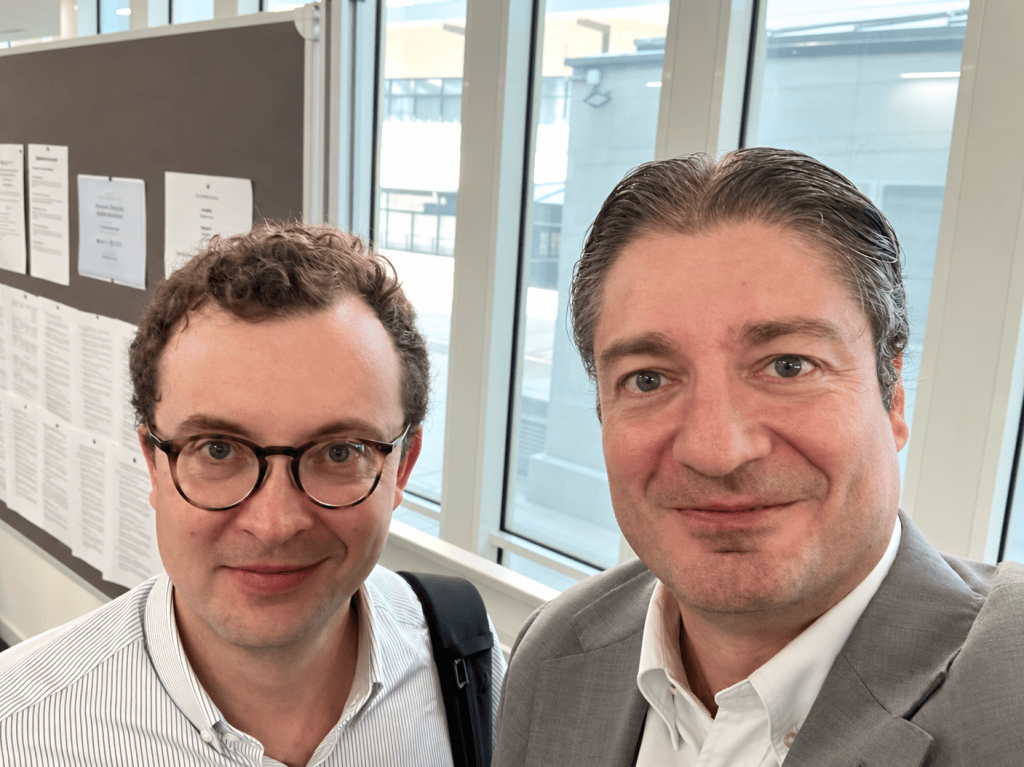
It has therefore been especially rewarding to meet again here in Barcelona colleagues such as Samuli Seppänen, Larry Catá Backer, Benjamin Liebman, Sarah Biddulph, Knut Benjamin Pissler, Rogier Creemers, Eva Pils, and Björn Ahl. Many of us have moved across institutions, countries, and even continents—sometimes more than once—while continuing to encounter one another through shared scholarly interests and evolving professional paths.
Congratulations to the University of Barcelona for hosting the conference, and a very special thank you to Monika Prusinowska for the organization and for creating such a valuable opportunity to reconnect with long-standing colleagues, meet new ones, and continue conversations that began many years ago.
Paolo Davide Farah, Paolo Farah
Selected Bibliography by Paolo Davide Farah
Books
- China’s Influence on Non-Trade Concerns in International Economic Law, Routledge, 2016.https://www.routledge.com/Chinas-Influence-on-Non-Trade-Concerns-in-International-Economic-Law/Farah-Cima/p/book/9780367439897
- CHINA’S INFLUENCE ON NON-TRADE CONCERNS IN INTERNATIONAL ECONOMIC LAW (in Chinese) – 中国在国际经济法上对非贸易关注问题的影响, LAW PRESS OF CHINA (法律出版社), Beijing, China, 2017.
- Artificial Intelligence, Governance and Sustainable Development: Peace, Justice and Strong Institutions, Routledge, 2026.https://www.routledge.com/Artificial-Intelligence-Governance-and-Sustainable-Development-Peace-Justice-and-Strong-Institutions/Ibrahim-Truby-Farah/p/book/9781032524047
- Science, Technology, Policy and International Law, co-edited with Justo Corti Varela, Routledge, 2024.https://www.routledge.com/Science-Technology-Policy-and-International-Law/Varela-Farah/p/book/9781032751139
- Globalization, Environmental Law, and Sustainable Development in the Global South: Challenges for Implementation, Routledge, 2021.https://www.routledge.com/Globalization-Environmental-Law-and-Sustainable-Development-in-the-Global-South-Challenges-for-Implementation/Junker-Farah/p/book/9780367749262
Book Chapters and Related Contributions
- “Framing AI’s Role in Achieving SDG 16,” in Artificial Intelligence, Governance and Sustainable Development: Peace, Justice and Strong Institutions, Routledge, 2026.https://ssrn.com/abstract=5399415
- “The Intersections Among Science, Technology, Policy and Law: In Between Truth and Justice,” win Science, Technology, Policy and International Law, Routledge, 2024.https://ssrn.com/abstract=4590214
- “Water-Energy-Food Nexus in International Law: A Legal Analysis,” in Handbook on the Water-Energy-Food Nexus, Edward Elgar Publishing, 2022, pp. 381–397.https://ssrn.com/abstract=4243774
Articles
- Five Years of China’s WTO Membership: EU and US Perspectives about China’s Compliance with Transparency Commitments and the Transitional Review Mechanism, 33 Legal Issues Econ. Integration 3, 263–304 (2006).
- The Implementation of the WTO Agreement on Trade-Related Aspects of Intellectual Property Rights (TRIPs) in China, 2 Tsinghua China L. Rev. 2, 317–51 (Spring 2010).
- China’s Role and Contribution in the Global Governance of Climate Change: Institutional Adjustments for Carbon Tax Introduction, Collection and Management in China, 8 J. World Energy L. & Bus. 6, 581–99 (Dec. 2015).
- China’s Water Environmental Management Towards Institutional Integration: A Review of Current Progress and Constraints vis-a-vis the European Experience, 113 J. Cleaner Prod. 285–98 (2016).
- Desirability of Commodification of Intangible Cultural Heritage: The Unsatisfying Role of IPRs, 11 Transnat’l Dispute Mgmt. 2, 2014.
- Global Governance and Intangible Cultural Heritage in the Information Society: At the Crossroads of IPRs and Innovation, in Daniele Archibugi & Andrea Filippetti (eds.), HANDBOOK OF GLOBAL SCIENCE, TECHNOLOGY, AND INNOVATION 462–79 (Oxford: Wiley Publisher 2015).
- Public Ownership and the WTO in a Post Covid-19 Era: From Trade Disputes To a ‘Social’ Function, 125 W. Va. L. Rev. 644 (2022).
- “Energy Trade and the WTO: Implications for Renewable Energy and the OPEC Cartel,”, 16 Journal of International Economic Law 707–740 (2013).https://doi.org/10.1093/jiel/jgt024
- World Trade Organization, Renewable Energy Subsidies and the Case of Feed-in Tariffs: Time for Reform Toward Sustainable Development?, 27 Geo. Envtl. L. Rev. 515 (2015).
- Trade and Progress: The Case of China, 30 Colum. J. Asian L. 51 (2016).
- “Trade in Clean Energy Technologies: Sliding from Protection to Protectionism Through Obligations for Technology Transfer in Climate Change Law, or Vice Versa?,”13 Journal of World Energy Law & Business 114–128 (2020).https://ssrn.com/abstract=3646993
- China’s Role and Contribution in the Global Governance of Climate Change: Institutional Adjustments for Carbon Tax Introduction, Collection and Management in China, 8 J. World Energy L. & Bus. 6, 581–99 (Dec. 2015).
- “China’s Energy Policies and Strategies for Climate Change and Energy Security,” 13 Journal of World Energy Law & Business 141–156 (2020).https://doi.org/10.1093/jwelb/jwaa018
- Evaluating China’s Environmental Management and Risks Avoidance Policies and Regulations on Offshore Methane Hydrate Extraction, 12 Sustainability 13, 5331 (2020).
- “A Comparison Between Shale Gas in China and Unconventional Fuel Development in the United States: Water, Environment and Sustainable Development,” 41 Brooklyn Journal of International Law 579–654 (2016).https://ssrn.com/abstract=2802157
- “Balancing Technological Innovation and Regulation: Safeguarding Societal Interests in the Age of AI,” JURIST, February 25, 2025.https://ssrn.com/abstract=5156010
- China’s Belt and Road Initiative and Its Impact on the Energy Independence of the European Union, Asian J. Law & Soc’y, 1 -30 (Cambridge Univ. Press 2025)
- China’s Path to Modernization and Legal Pluralism: Transplants and the Belt and Road Initiative, Asian J. Law & Soc’y, pp. 1 – 36 (Cambridge Univ. Press 2025).