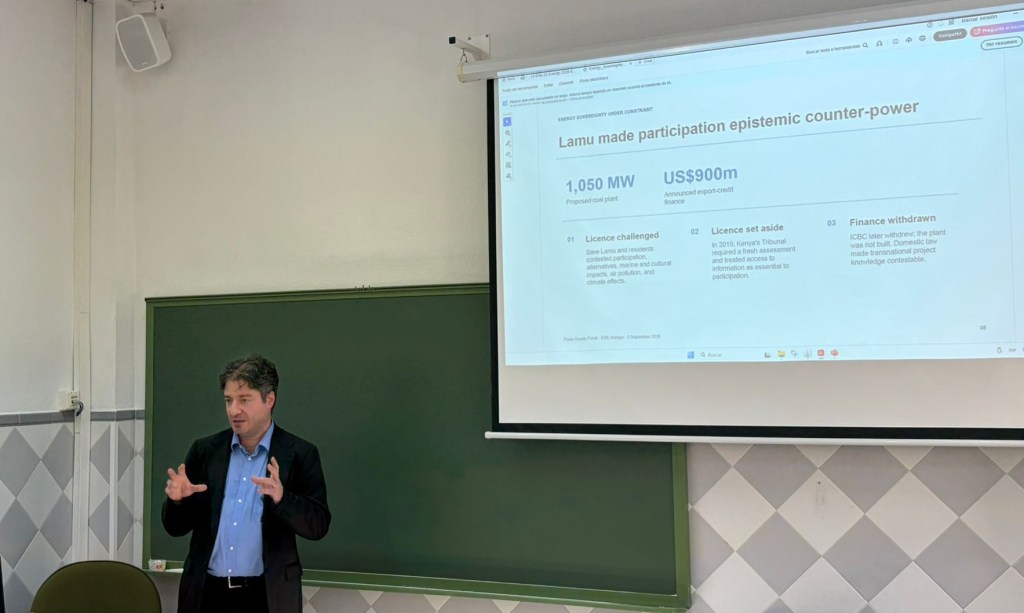

Rethinking Energy Sovereignty at the 2026 Annual Conference of the European Society of International Law (ESIL) — Málaga, Spain
It was a pleasure to present my paper, “Energy Sovereignty Under Constraint: Tribal Governance, Global Infrastructure, and the Politics of Knowledge in the Energy Transition,” at the 2026 European Society of International Law (ESIL) Annual Conference in Málaga.
A longer and more detailed version is available here: https://paolofarah.wordpress.com/2026/09/04/rethinking-energy-sovereignty-at-the-2026-annual-conference-of-the-european-society-of-international-law-esil-malaga-spain/
The presentation formed part of the workshop “From Interdependence to Weaponisation: Energy Security and International Law,” organized by the ESIL Interest Group on Energy and International Law, and specifically its panel on “Energy Sovereignty, Regionalism, and Contested Legal Orders.”
My central argument is that energy sovereignty cannot be understood simply as formal legal authority over resources, infrastructure, or project approval. Nor does it require energy autarky. Rather, it concerns the effective capacity to determine the terms on which energy interdependence occurs.
Drawing on U.S. Tribal energy governance and global infrastructure projects—including projects associated with China’s Belt and Road Initiative—I distinguished three interconnected dimensions of energy sovereignty:
• jurisdictional authority;
• material and institutional capacity; and
• epistemic power—the ability to define problems and alternatives, produce and control data, validate expertise, and demand reasons from decision-makers.
The comparison does not equate Tribal nations, host states, or local communities. Instead, it reveals recurring mechanisms through which actors may retain formal authority while losing effective control over their energy futures.
A genuinely just transition must therefore change not only the sources of energy, but also who participates in defining risks, producing knowledge, evaluating alternatives, and ultimately authoring the future.
My sincere thanks to the workshop conveners—Elena Cima, Ilaria Espa, and Martin Švec—and to my fellow panelists for an engaging and thought-provoking discussion.
#ESIL #ESIL2026 #InternationalLaw #EnergyLaw #EnergySovereignty #EnergyTransition #IndigenousPeoples #JustTransition
Paolo Davide Farah, Paolo Farah
Related Scholarship by Paolo Davide Farah
Selected Bibliography
Books
- Artificial Intelligence, Governance and Sustainable Development: Peace, Justice and Strong Institutions, co-edited with Imad Antoine Ibrahim and Jon Truby, Routledge, 2026.https://www.routledge.com/Artificial-Intelligence-Governance-and-Sustainable-Development-Peace-Justice-and-Strong-Institutions/Ibrahim-Truby-Farah/p/book/9781032524047
- Science, Technology, Policy and International Law, co-edited with Justo Corti Varela, Routledge, 2024.https://www.routledge.com/Science-Technology-Policy-and-International-Law/Varela-Farah/p/book/9781032751139
- China’s Influence on Non-Trade Concerns in International Economic Law: Trade, Investment and Beyond, co-edited with Elena Cima, Routledge, 2016.https://www.routledge.com/Chinas-Influence-on-Non-Trade-Concerns-in-International-Economic-Law/Farah-Cima/p/book/9780367439897
- Globalization, Environmental Law, and Sustainable Development in the Global South: Challenges for Implementation, co-edited with Kirk W. Junker, Routledge, 2021.https://www.routledge.com/Globalization-Environmental-Law-and-Sustainable-Development-in-the-Global-South-Challenges-for-Implementation/Junker-Farah/p/book/9780367749262
Book Chapters and Related Contributions
- “Framing AI’s Role in Achieving SDG 16,” with Imad Antoine Ibrahim and Jon Truby, in Artificial Intelligence, Governance and Sustainable Development: Peace, Justice and Strong Institutions, Routledge, 2026.https://ssrn.com/abstract=5399415
- “The Intersections Among Science, Technology, Policy and Law: In Between Truth and Justice,” with Justo Corti Varela, in Science, Technology, Policy and International Law, Routledge, 2024.https://ssrn.com/abstract=4590214
- “Water-Energy-Food Nexus in International Law: A Legal Analysis,” with Imad Antoine Ibrahim, in Handbook on the Water-Energy-Food Nexus, Edward Elgar Publishing, 2022, pp. 381–397.https://ssrn.com/abstract=4243774
Articles
- Five Years of China’s WTO Membership: EU and US Perspectives about China’s Compliance with Transparency Commitments and the Transitional Review Mechanism, 33 Legal Issues Econ. Integration 3, 263–304 (2006).
- When John Locke Meets Lao Tzu: The Relationship between Intellectual Property, Biodiversity and Indigenous Knowledge and the Implications for Food Security, 33 Duke Envtl. L. & Pol’y F. 297 (2024).
- Conflict between Intellectual Property Rights and Human Rights: A Case Study on Intangible Cultural Heritage, 94 Or. L. Rev. 125 (2015).
- The Implementation of the WTO Agreement on Trade-Related Aspects of Intellectual Property Rights (TRIPs) in China, 2 Tsinghua China L. Rev. 2, 317–51 (Spring 2010).
- China’s Water Environmental Management Towards Institutional Integration: A Review of Current Progress and Constraints vis-a-vis the European Experience, 113 J. Cleaner Prod. 285–98 (2016).
- Desirability of Commodification of Intangible Cultural Heritage: The Unsatisfying Role of IPRs, 11 Transnat’l Dispute Mgmt. 2, 2014.
- Global Governance and Intangible Cultural Heritage in the Information Society: At the Crossroads of IPRs and Innovation, in Daniele Archibugi & Andrea Filippetti (eds.), HANDBOOK OF GLOBAL SCIENCE, TECHNOLOGY, AND INNOVATION 462–79 (Oxford: Wiley Publisher 2015).
- Public Ownership and the WTO in a Post Covid-19 Era: From Trade Disputes To a ‘Social’ Function, 125 W. Va. L. Rev. 644 (2022).
- “Energy Trade and the WTO: Implications for Renewable Energy and the OPEC Cartel,” with Elena Cima, 16 Journal of International Economic Law 707–740 (2013).https://doi.org/10.1093/jiel/jgt024
- World Trade Organization, Renewable Energy Subsidies and the Case of Feed-in Tariffs: Time for Reform Toward Sustainable Development?, 27 Geo. Envtl. L. Rev. 515 (2015).
- Trade and Progress: The Case of China, 30 Colum. J. Asian L. 51 (2016).
- “Trade in Clean Energy Technologies: Sliding from Protection to Protectionism Through Obligations for Technology Transfer in Climate Change Law, or Vice Versa?,” with Anthi Koskina-Saridaki and Imad Antoine Ibrahim, 13 Journal of World Energy Law & Business 114–128 (2020).https://ssrn.com/abstract=3646993
- China’s Role and Contribution in the Global Governance of Climate Change: Institutional Adjustments for Carbon Tax Introduction, Collection and Management in China, 8 J. World Energy L. & Bus. 6, 581–99 (Dec. 2015).
- “China’s Energy Policies and Strategies for Climate Change and Energy Security,” with Haifeng Deng, 13 Journal of World Energy Law & Business 141–156 (2020).https://doi.org/10.1093/jwelb/jwaa018
- Evaluating China’s Environmental Management and Risks Avoidance Policies and Regulations on Offshore Methane Hydrate Extraction, 12 Sustainability 13, 5331 (2020).
- “A Comparison Between Shale Gas in China and Unconventional Fuel Development in the United States: Water, Environment and Sustainable Development,” with Riccardo Tremolada, 41 Brooklyn Journal of International Law 579–654 (2016).https://ssrn.com/abstract=2802157
- “Balancing Technological Innovation and Regulation: Safeguarding Societal Interests in the Age of AI,” JURIST, February 25, 2025.https://ssrn.com/abstract=5156010
- China’s Belt and Road Initiative and Its Impact on the Energy Independence of the European Union, Asian J. Law & Soc’y, 1 -30 (Cambridge Univ. Press 2025)
- China’s Path to Modernization and Legal Pluralism: Transplants and the Belt and Road Initiative, Asian J. Law & Soc’y, pp. 1 – 36 (Cambridge Univ. Press 2025).