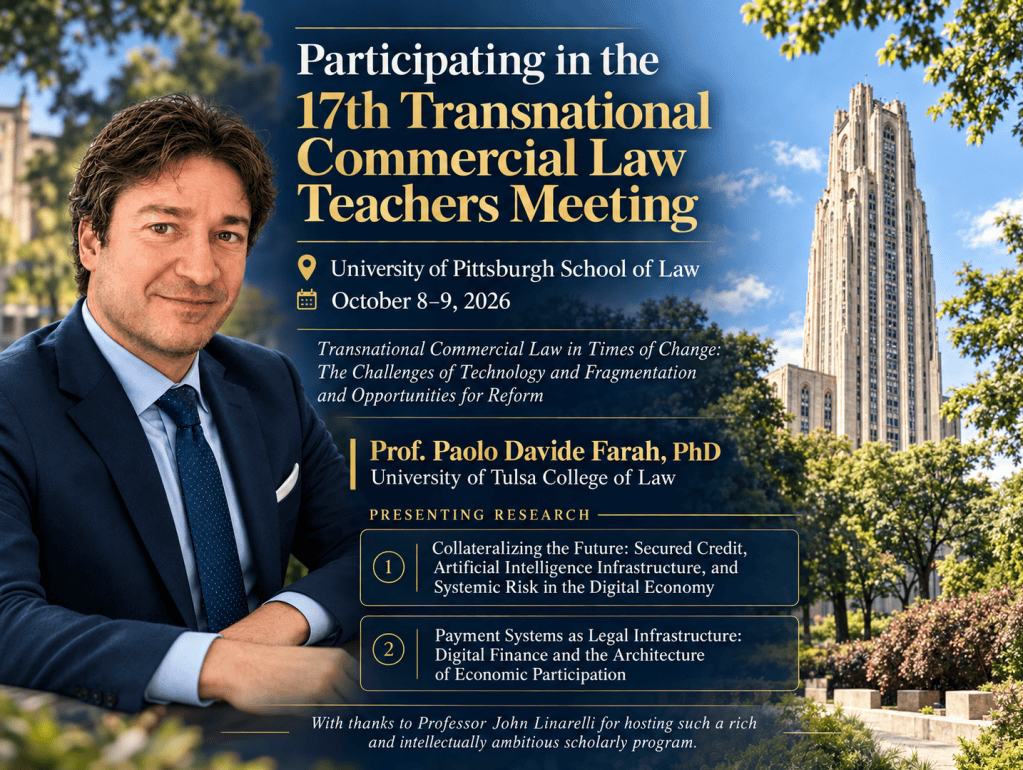
Participating in the 17th Transnational Commercial Law Teachers Meeting at the University of Pittsburgh School of Law
I am pleased to participate in the 17th Transnational Commercial Law Teachers Meeting, taking place on October 8–9, 2026 at the University of Pittsburgh School of Law.
The full post is available here: https://lnkd.in/gWX9-VXC
This year’s meeting addresses the timely theme “Transnational Commercial Law in Times of Change: The Challenges of Technology and Fragmentation and Opportunities for Reform.”
The full post is available here: https://paolofarah.wordpress.com/2026/10/06/participating-in-the-17th-transnational-commercial-law-teachers-meeting-at-the-university-of-pittsburgh-school-of-law/
I am especially looking forward to presenting two papers that develop a broader research agenda on the role of commercial law as economic and technological infrastructure.
The first, “Collateralizing the Future: Secured Credit, Artificial Intelligence Infrastructure, and Systemic Risk in the Digital Economy,” examines how secured transactions law, traditionally understood primarily as a mechanism for facilitating private credit, increasingly influences the financing, ownership, control, and resilience of strategically important infrastructure—including data centers, artificial intelligence infrastructure, cloud-computing systems, semiconductor facilities, energy infrastructure, and other assets supporting the digital economy.
This paper will be presented in the panel “Critical Infrastructure, Systemic Risk, and Public Authority,” chaired by Gaby Bellaver, alongside presentations by Lev Breydo, Marcelo Marzouka, & Bojan Perovic.
The second, “Payment Systems as Legal Infrastructure: Digital Finance and the Architecture of Economic Participation,” examines payment systems not simply as technical mechanisms for transferring money and settling obligations, but as foundational legal infrastructure that shapes access to economic participation, allocates financial power and risk, and increasingly connects commercial law to questions of digital finance, financial inclusion, technological dependence, and geopolitical fragmentation.
This paper will be part of the panel “Digital Finance, Payments, and Assets,” chaired by Josh Kapiloff, alongside presentations by Jane Winn, Amy Held, and Noriyuki Aoki.
Taken together, the two papers explore how commercial law does more than facilitate private transactions: it also helps structure access to essential systems, allocate systemic risk, and determine control over the technological and financial infrastructures on which contemporary economic life increasingly depends.
I am particularly grateful to Professor John Linarelli, Vice Dean and John E. Murray Faculty Scholar at Pitt Law, for organizing and hosting such a rich and intellectually ambitious scholarly program, for bringing together colleagues working across the many dimensions of transnational commercial law, and to Amy Change and the organizing team for all their work in coordinating the meeting.
The program brings together scholars working across a remarkably broad range of contemporary transnational commercial law questions. It opens with a keynote panel paying tribute to Sir Roy Goode, chaired by Herbert Kronke, and continues with discussions addressing the modernization of global trade and transport law, geopolitics and economic sanctions, the methodology and uniformity of commercial law, dispute resolution, emerging technologies and artificial intelligence, digital finance and payments, critical infrastructure and systemic risk, and cross-border lending.
I very much look forward to the discussions at Pitt Law’s Barco Law Building, to reconnecting with longstanding colleagues, and to meeting and exchanging ideas with new colleagues over the course of the meeting.