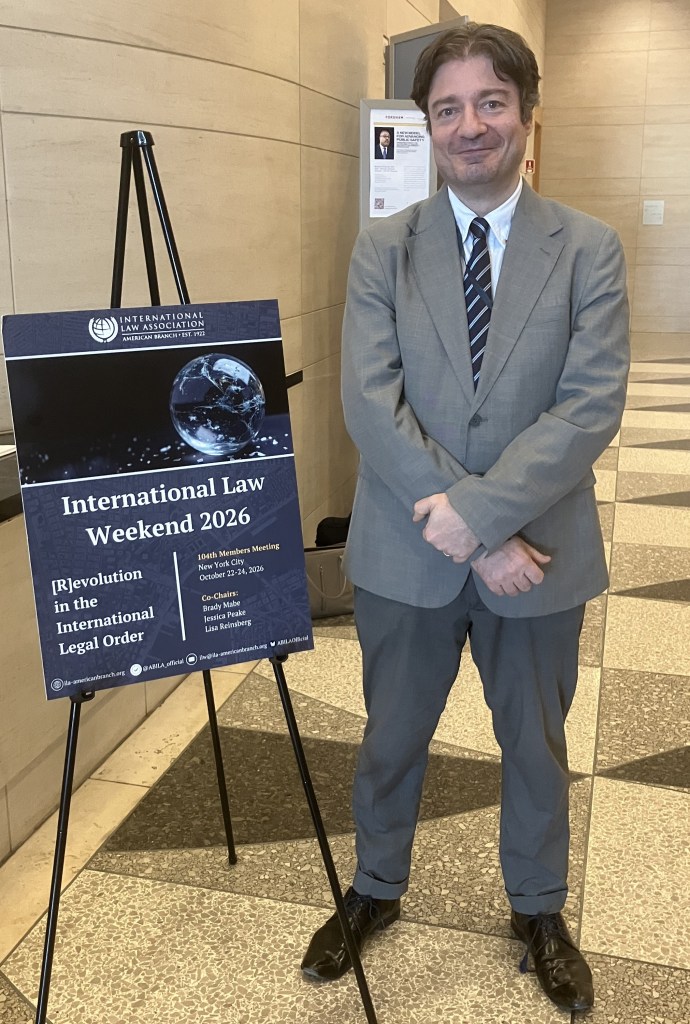
Great to be at Fordham Law School in New York City for International Law Weekend 2026, organized by theAmerican Branch of the International Law Association (ABILA)!
This year’s gathering marks my first opportunity since the establishment of the ABILA Committee on International Law, China, and the Reconfiguration of the Global Order to participate in my capacity as its Chair, represent the Committee, and contribute to the work of the American Branch to the best of my abilities.
I am also looking forward to the completion of the membership formation process for the International Law Association(ILA) Study Group on “International Law, Global Challenges, and the Impact of Emerging Powers on Global Governance,” which I have the privilege of chairing.
These two complementary initiatives offer important opportunities to foster international dialogue, strengthen scholarly cooperation, and examine the evolving role of international law in an increasingly complex and multipolar global order.
Grateful for the opportunity to serve the ILA and its American Branch and to work alongside colleagues from around the world.
My special and heartfelt thanks toMichael Scharf, Mortimer Sellers, Mortimer Sellers, Milena Sterio, Peter Yu, Amity Boye, Lucas Lixinski, and Ron Brand for their generous support, encouragement, and collegiality. I am deeply grateful for their confidence, guidance, and commitment to fostering new initiatives, creating opportunities for collaboration, and strengthening the international legal community. Their support has been particularly meaningful as these initiatives take shape, and I look forward to continuing our work together.
It is both a privilege and a responsibility to contribute to the mission of the ILA and its American Branch, working alongside colleagues from different countries, legal traditions, and perspectives to advance international legal scholarship, dialogue, and cooperation.
#InternationalLaw #InternationalLawAssociation #ILW2026 #ABILA #GlobalGovernance #China #EmergingPowers #Multipolarity #InternationalCooperation Ron Brand
Selected Bibliography by Paolo Davide Farah
Books
- China’s Influence on Non-Trade Concerns in International Economic Law, Routledge, 2016.https://www.routledge.com/Chinas-Influence-on-Non-Trade-Concerns-in-International-Economic-Law/Farah-Cima/p/book/9780367439897
- CHINA’S INFLUENCE ON NON-TRADE CONCERNS IN INTERNATIONAL ECONOMIC LAW (in Chinese) – 中国在国际经济法上对非贸易关注问题的影响, LAW PRESS OF CHINA (法律出版社), Beijing, China, 2017.
- Globalization, Environmental Law, and Sustainable Development in the Global South: Challenges for Implementation, Routledge, 2021.https://www.routledge.com/Globalization-Environmental-Law-and-Sustainable-Development-in-the-Global-South-Challenges-for-Implementation/Junker-Farah/p/book/9780367749262
- The Crisis of Multilateral Legal Order: Causes, Dynamics and Implications, Routledge Publishing (2022)
- Artificial Intelligence, Governance and Sustainable Development: Peace, Justice and Strong Institutions, Routledge, 2026.https://www.routledge.com/Artificial-Intelligence-Governance-and-Sustainable-Development-Peace-Justice-and-Strong-Institutions/Ibrahim-Truby-Farah/p/book/9781032524047
- Science, Technology, Policy and International Law, co-edited with Justo Corti Varela, Routledge, 2024.https://www.routledge.com/Science-Technology-Policy-and-International-Law/Varela-Farah/p/book/9781032751139
Articles, Book Chapters and Related Contributions
- L’adesione della Cina all’Organizzazione Mondiale del Commercio: ovvero come conciliare cultura e diritto (China Accession to the WTO: How to Conciliate Culture and Law), Rivista Trimestrale Mondo Cinese, Sezione Economia e Diritto, N. 124, Luglio-Settembre 2005, ISSN 0390-2811, pp. 34-42 (in Italian).
- L’accession de la Chine à l’Organisation mondiale du commerce : les règles internationales et les barrières culturelles internes (China’s Accession to the WTO: International Rules and Internal Cultural Barriers), Lettre de l’Antenne Franco-Chinoise, Janvier 2006, pp. 1–12 (in French).
- Five Years of China’s WTO Membership: EU and US Perspectives about China’s Compliance with Transparency Commitments and the Transitional Review Mechanism, 33 Legal Issues Econ. Integration 3, 263–304 (2006).
- L’influenza della concezione confuciana sulla costruzione del sistema giuridico e politico cinese (The Influence of Confucianism in the Construction of the Chinese Juridical and Political System), in Giovanni Bombelli & Bruno Montanari (eds), Identità Europea e Politiche Migratorie, Vita e Pensiero, 2008, ISBN: 9788834316849, pp. 193-226 (in Italian).
- The Implementation of the WTO Agreement on Trade-Related Aspects of Intellectual Property Rights (TRIPs) in China, 2 Tsinghua China L. Rev. 2, 317–51 (Spring 2010).
- China’s Participation in the World Trade Organization: Trade in Goods, Services, Intellectual Property Rights and Transparency Issues, in Aurelio Lopez-Tarruella Martinez (ed.), EL COMERCIO CON CHINA. OPORTUNIDADES EMPRESARIALES, INCERTIDUMBRES JURÍDICAS 83–121 (Tirant le Blanch 2010).
- Le rôle de la Chine et de l’OMC dans le développement des « Considérations Autres que Commerciales » pour réguler le commerce mondial de façon plus juste et durable (The Role of China and the WTO for the Development of Non-Trade Concerns to Regulate World Trade More Justly and Sustainably), in Laurence Potvin-Solis & Hiromi Ueda (eds), Economie de Marché, Droits et Libertés et Valeurs Communes en Europe et en Asie, Publication of the Jean Monnet Chair of the University of Lorraine, Metz, France (2012), pp. 67-80 (in French).
- “Energy Trade and the WTO: Implications for Renewable Energy and the OPEC Cartel,”, 16 Journal of International Economic Law 707–740 (2013).https://doi.org/10.1093/jiel/jgt024
- Desirability of Commodification of Intangible Cultural Heritage: The Unsatisfying Role of IPRs, 11 Transnat’l Dispute Mgmt. 2, 2014.
- Global Governance and Intangible Cultural Heritage in the Information Society: At the Crossroads of IPRs and Innovation, in Daniele Archibugi & Andrea Filippetti (eds.), HANDBOOK OF GLOBAL SCIENCE, TECHNOLOGY, AND INNOVATION 462–79 (Oxford: Wiley Publisher 2015).
- Lo shale gas in Cina alla luce della sicurezza energetica e dei principi dello sviluppo sostenibile (Shale Gas in China in the Light of Energy Security and Sustainable Development Principles), ItalianiEuropei, 2/2015, March 2015, pp. 132-141 (in Italian).
- Regolazione e prospettive del mercato dello shale gas in Cina tra diritto del commercio internazionale, diritto dell’energia, accordi di produzione, protezione ambientale e sviluppo sostenibile: un confronto con l’esperienza statunitense (Regulation and Prospects of the Shale Gas Market in China in Light of International Trade Law, Energy Law, Production-Sharing Agreements, Environmental Protection, and Sustainable Development: A Comparison with the US Experience), Diritto Comunitario e degli Scambi Internazionali, 1-2/2015, pp. 29-83 (in Italian).
- China’s Role and Contribution in the Global Governance of Climate Change: Institutional Adjustments for Carbon Tax Introduction, Collection and Management in China, 8 J. World Energy L. & Bus. 6, 581–99 (Dec. 2015).
- Introduction, in Paolo Davide Farah & Piercarlo Rossi (eds.), ENERGY: POLICY, LEGAL AND SOCIAL-ECONOMIC ISSUES UNDER THE DIMENSIONS OF SUSTAINABILITY AND SECURITY 1–12 (World Scientific Reference on Globalisation in Eurasia and the Pacific Rim, Imperial College Press 2015).
- Global Energy Governance, International Environmental Law and Regional Dimension, in Paolo Davide Farah & Piercarlo Rossi (eds.), ENERGY: POLICY, LEGAL AND SOCIAL-ECONOMIC ISSUES UNDER THE DIMENSIONS OF SUSTAINABILITY AND SECURITY 143–61 (World Scientific Reference on Globalisation in Eurasia and the Pacific Rim, Imperial College Press 2015).
- Energy Security, Water Resources and Economic Development in Central Asia, in Paolo Davide Farah & Piercarlo Rossi (eds.), ENERGY: POLICY, LEGAL AND SOCIAL-ECONOMIC ISSUES UNDER THE DIMENSIONS OF SUSTAINABILITY AND SECURITY 179–93 (World Scientific Reference on Globalisation in Eurasia and the Pacific Rim, Imperial College Press 2015).
- Energy Investments and Environmental Concerns in South-East Asia, in Paolo Davide Farah & Piercarlo Rossi (eds.), ENERGY: POLICY, LEGAL AND SOCIAL-ECONOMIC ISSUES UNDER THE DIMENSIONS OF SUSTAINABILITY AND SECURITY 195–210 (World Scientific Reference on Globalisation in Eurasia and the Pacific Rim, Imperial College Press 2015).
- China’s Water Environmental Management Towards Institutional Integration: A Review of Current Progress and Constraints vis-a-vis the European Experience, 113 J. Cleaner Prod. 285–98 (2016).
- World Trade Organization, Renewable Energy Subsidies and the Case of Feed-in Tariffs: Time for Reform Toward Sustainable Development?, 27 Geo. Envtl. L. Rev. 515 (2015).
- Trade and Progress: The Case of China, 30 Colum. J. Asian L. 51 (2016).
- Evaluating China’s Environmental Management and Risks Avoidance Policies and Regulations on Offshore Methane Hydrate Extraction, 12 Sustainability 13, 5331 (2020).
- Contextualism in WTO Case Law on Mineral Export Restrictions: Puzzles and Implications, 15 Asian J. WTO & Int’l Health L. & Pol’y 2, 503–38 (Nov. 2020).
- “Trade in Clean Energy Technologies: Sliding from Protection to Protectionism Through Obligations for Technology Transfer in Climate Change Law, or Vice Versa?,”13 Journal of World Energy Law & Business 114–128 (2020).https://ssrn.com/abstract=3646993
- China’s Role and Contribution in the Global Governance of Climate Change: Institutional Adjustments for Carbon Tax Introduction, Collection and Management in China, 8 J. World Energy L. & Bus. 6, 581–99 (Dec. 2015)
- La Perspectiva China del Derecho Internacional (Chinese Perspective of International Law), Revista Española de Derecho Internacional (Spanish Journal of International Law), Volume 70/1, January – June 2018, pp. 227-234 (in Spanish)..
- “China’s Energy Policies and Strategies for Climate Change and Energy Security,” 13 Journal of World Energy Law & Business 141–156 (2020).https://doi.org/10.1093/jwelb/jwaa018
- “A Comparison Between Shale Gas in China and Unconventional Fuel Development in the United States: Water, Environment and Sustainable Development,” 41 Brooklyn Journal of International Law 579–654 (2016).https://ssrn.com/abstract=2802157
- Book Review of Julien Chaisse, China’s International Investment Strategy: Bilateral, Regional, and Global Law and Policy, Oxford University Press, published in Leiden Journal of International Law (LJIL), Cambridge University Press, 2021, pp. 1 – 4.
- Public Ownership and the WTO in a Post Covid-19 Era: From Trade Disputes To a ‘Social’ Function, 125 W. Va. L. Rev. 644 (2022).
- “Water-Energy-Food Nexus in International Law: A Legal Analysis,” in Handbook on the Water-Energy-Food Nexus, Edward Elgar Publishing, 2022, pp. 381–397.https://ssrn.com/abstract=4243774
- “The Intersections Among Science, Technology, Policy and Law: In Between Truth and Justice,” win Science, Technology, Policy and International Law, Routledge, 2024.https://ssrn.com/abstract=4590214
- “Balancing Technological Innovation and Regulation: Safeguarding Societal Interests in the Age of AI,” JURIST, February 25, 2025.https://ssrn.com/abstract=5156010
- China’s Belt and Road Initiative and Its Impact on the Energy Independence of the European Union, Asian J. Law & Soc’y, 1 -30 (Cambridge Univ. Press 2025)
- China’s Path to Modernization and Legal Pluralism: Transplants and the Belt and Road Initiative, Asian J. Law & Soc’y, pp. 1 – 36 (Cambridge Univ. Press 2025).
- “Framing AI’s Role in Achieving SDG 16,” in Artificial Intelligence, Governance and Sustainable Development: Peace, Justice and Strong Institutions, Routledge, 2026.https://ssrn.com/abstract=5399415
- Rethinking the Rule of Law for Sustainable Development in the Age of AI, in Artificial Intelligence, Governance and Sustainable Development: Peace, Justice and Strong Institutions, Routledge, 2026