

ESIL Interest Group on European and International Rule of Law Webinar Series
Recordings, Materials and Resources
The European Society of International Law (ESIL) Interest Group on European and International Rule of Law Webinar Series brings recent scholarship into dialogue with broader questions concerning international and comparative law, legal theory, public and private law, global governance, economic regulation, human rights, environmental justice, sustainability, institutional design, and the rule of law.
The Webinar Series was conceived and is organized, chaired, and moderated by Professor Paolo Davide Farah, Chair of the ESIL Interest Group on European and International Rule of Law.
Rather than organizing conventional book presentations, the series seeks to create sustained scholarly conversations among authors, invited discussants, researchers, practitioners, policymakers, and participants from different jurisdictions and disciplines. Recent publications provide a point of departure for examining broader legal and institutional questions concerning how international norms are created, interpreted and implemented; how law distributes authority, resources, responsibilities and knowledge; and how legal institutions can respond to changing political, economic, technological, social and environmental conditions.
This page brings together the recordings, programs, bibliographies, background materials and post-webinar resources from the completed webinars in the series. It will be updated as additional webinars take place and further materials become available.
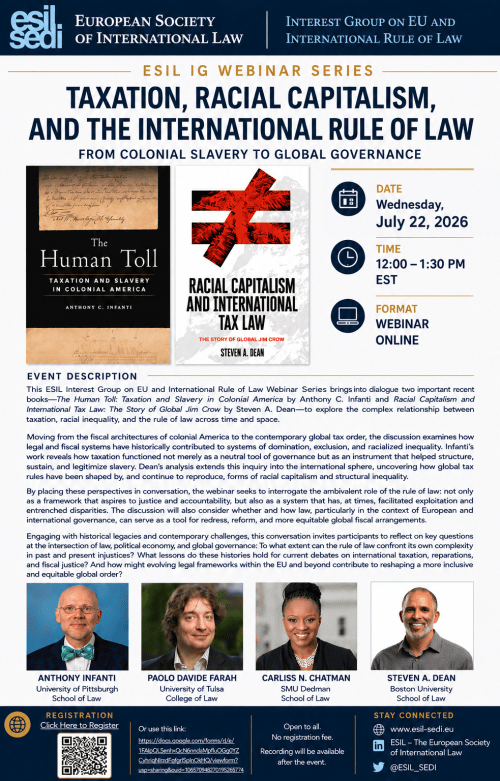
Webinar 1 · July 22, 2026
Taxation, Racial Capitalism, and the International Rule of Law: From Colonial Slavery to Global Governance
Speakers
Anthony C. Infanti
University of Pittsburgh School of Law
Steven A. Dean
Boston University School of Law
Discussant
Carliss N. Chatman
SMU Dedman School of Law
Chair, Moderator, and Discussant
Paolo Davide Farah
University of Tulsa College of Law
Chair, ESIL Interest Group on European and International Rule of Law
Books in Dialogue
Anthony C. Infanti, The Human Toll: Taxation and Slavery in Colonial America (New York University Press, 2025)
Steven A. Dean, Racial Capitalism and International Tax Law: The Story of Global Jim Crow (Oxford University Press, 2025)
About the Conversation
The inaugural webinar examined the historical and contemporary relationships among taxation, slavery, racial capitalism, international economic governance, inequality, and the rule of law.
The conversation explored how legal and fiscal systems do more than raise and allocate revenue. They classify persons and property, structure markets and political authority, allocate resources and vulnerabilities, and shape the institutional recognition of particular interests, experiences and forms of knowledge.
Professor Infanti’s work placed taxation within the legal and institutional history of slavery in colonial America, exposing the human consequences embedded in fiscal systems often treated as technically neutral. Professor Dean examined the racialized architecture of international taxation and the ways in which international tax institutions have distributed fiscal sovereignty and economic power across states.
Professor Chatman brought corporate and commercial law into the discussion, connecting these historical and international dimensions with questions of corporate personhood, property, commercial institutions, legal education, inequality and the continuing effects of racialized legal structures.
The discussion also addressed broader questions of historical responsibility, reparative justice, institutional legitimacy, epistemic governance, fiscal sovereignty, participation and the substantive meaning of the rule of law.
Resources
Full event description, program, background materials and selected bibliography
[LINK – EVENT PAGE]
Watch the full webinar recording
[LINK – YOUTUBE RECORDING]
Post-Webinar Reflection Series
A five-part reflection series further develops the principal themes and individual contributions from the webinar:
Reflection 1/5 – Taxation, Racial Capitalism, and the International Rule of Law: Reflections on the Inaugural Webinar
Reflection 2/5 – Anthony C. Infanti: Taxation, Slavery, and the Human Toll of Colonial Governance
Reflection 3/5 – Steven A. Dean: Global Jim Crow and the Racial Architecture of International Tax Law
Reflection 4/5 – Carliss N. Chatman: Commercial Law, Corporate Personhood, and Racial Inequality
Reflection 5/5 – Paolo Davide Farah: Epistemic Governance, Institutional Legitimacy, and the International Rule of Law
[LINK – BEGIN THE WEBINAR 1 REFLECTION SERIES]
Webinar 2 · August 12, 2026
From Trademark Law to Public Health Governance: Intellectual Property, International Treaties, and the Rule of Law in a Changing Global Order
Speakers
Shujie Feng
Tsinghua University School of Law, China
Srividhya Ragavan
Texas A&M University School of Law, United States
Discussant
Edward Kwakwa
World Intellectual Property Organization (WIPO), Geneva
Chair, Moderator, and Discussant
Paolo Davide Farah
University of Tulsa College of Law
Chair, ESIL Interest Group on European and International Rule of Law
Books in Dialogue
Shujie Feng, Chinese Trademark Law from the Perspective of International Treaties (Springer Nature, 2026)
Shujie Feng, Le Droit Chinois des Marques au Regard des Traités Internationaux (Éditions A. Pedone, 2024)
Srividhya Ragavan and Swaraj Paul Barooah, Fractures in IP, Trade, and Health: Centering a Public Health Framework (Oxford University Press, 2025)
Swaraj Paul Barooah was unable to participate in the live webinar but was represented through the jointly authored book and the discussion of its arguments.
About the Conversation
The second webinar explored the relationship among intellectual property, international treaty obligations, domestic legal development, public health, international trade, economic development and the rule of law.
Professor Feng examined the evolution of Chinese trademark law through international treaty implementation and domestic institutional development. The discussion considered how legal transplantation and international harmonization interact with national legal traditions, administrative institutions, courts, market development and changing domestic regulatory needs.
Professor Ragavan situated intellectual property within a broader framework of public health, access to medicines, development, innovation and international trade, asking what changes when public health is treated not merely as an exception or flexibility within international intellectual-property law but as one of the objectives around which the system itself should be designed.
Edward Kwakwa brought the institutional perspective of WIPO to the discussion, examining treaty implementation, international cooperation, the interaction of WIPO, WTO and WHO mandates, geographical indications, public health, emerging technologies and the changing position of China and other states within global intellectual-property governance.
The webinar used these different fields to explore a broader institutional question: how can international legal systems maintain meaningful common commitments while accommodating legitimate regulatory diversity, different levels of development, different forms of expertise and competing public purposes?
The discussion therefore connected intellectual property to legal pluralism, administrative governance, institutional fragmentation and coordination, epistemic authority, domestic autonomy, global public goods and the international rule of law.
Resources
Full event description, speakers’ biographies, background materials and selected bibliography
[LINK – EVENT PAGE]
Watch the full webinar recording
[LINK – YOUTUBE RECORDING]
Post-Webinar Reflection Series
A five-part reflection series develops the principal arguments and institutional questions emerging from the webinar:
Reflection 1/5 – From Trademark Law to Public Health Governance: Reflections on the Second Webinar
Reflection 2/5 – Shujie Feng: Chinese Trademark Law, Treaty Implementation, and Endogenous Legal Development
Reflection 3/5 – Srividhya Ragavan: Centering Public Health in IP and Trade Governance
Reflection 4/5 – Edward Kwakwa: China, Institutional Mandates, and the Changing Global IP Order
Reflection 5/5 – Paolo Davide Farah: Coordinated Legal Pluralism, Epistemic Governance, and the Rule of Law
[LINK – BEGIN THE WEBINAR 2 REFLECTION SERIES]
Webinar 3 · September 23, 2026
From Environmental Law in Context to Comparative Environmental Governance: Justice, Sustainability, and the Rule of Law
Speakers
Rebecca M. Bratspies
Tulane University School of Law, United States
Carmen G. Gonzalez
Loyola University Chicago School of Law, United States
Tseming Yang
Santa Clara University School of Law, United States
Sara K. Phillips
Center for Science in Public Participation, United States
Discussants
Mekonnen Firew Ayano
University at Buffalo School of Law, State University of New York
Chinonso Tansi Anozie
University of Houston Law Center
Chair, Moderator, and Discussant
Paolo Davide Farah
University of Tulsa College of Law
Chair, ESIL Interest Group on European and International Rule of Law
Books in Dialogue
Rebecca M. Bratspies and Carmen G. Gonzalez, Teaching Environmental Law in Context (Edward Elgar Publishing, 2026)
Tseming Yang, Anastasia Telesetsky and Sara K. Phillips (eds.), Comparative Environmental Law (Edward Elgar Publishing, 2025)
Anastasia Telesetsky is a co-editor of Comparative Environmental Law but did not participate as a live speaker in the webinar.
About the Conversation
The third webinar examined how context and comparison can deepen our understanding of environmental law and environmental governance.
The conversation brought together two complementary approaches. Teaching Environmental Law in Context challenges approaches that isolate environmental doctrine from the historical, social, political and distributive conditions within which environmental law operates. Comparative Environmental Law examines the possibilities and limits of learning across jurisdictions, institutions and legal traditions.
The discussion addressed environmental justice, comparative methodology, climate change, energy transition, sustainability, human rights, Indigenous peoples and Indigenous knowledge, natural-resource governance, scientific expertise, legal education, institutional capacity, participation and accountability.
A central theme concerned the difference between comparing legal rules and comparing systems of environmental governance. Formally similar statutes or legal mechanisms may operate very differently depending on administrative capacity, political economy, legal culture, institutional design, scientific infrastructure, access to justice and the ability of communities to participate effectively in decision-making.
The conversation also examined the relationship between law and knowledge. Environmental institutions must decide what counts as evidence, whose expertise receives authority, how uncertainty is addressed, and whether Indigenous, local and community knowledge can meaningfully influence legal decision-making.
These questions connect environmental law directly to the rule of law: effectiveness must be accompanied by legitimacy, transparency, participation, reason-giving, accountability and opportunities to contest decisions that affect communities, livelihoods and ecosystems.
The webinar therefore moved from comparative environmental law toward comparative environmental governance, examining not only what legal rules say but how institutions identify environmental problems, distribute authority and responsibility, incorporate different forms of knowledge, and translate formal environmental protection into practical outcomes.
Resources
Full event description, participants’ biographies, selected bibliography and preparatory materials
[LINK – EVENT PAGE]
Watch the full webinar recording
[LINK – YOUTUBE RECORDING]
Post-Webinar Reflections and Further Materials
A detailed post-webinar project develops the conversation through reflections on the event as a whole and on the contributions of:
- Rebecca M. Bratspies;
- Carmen G. Gonzalez;
- Tseming Yang;
- Sara K. Phillips;
- Mekonnen Firew Ayano;
- Chinonso Tansi Anozie; and
- Paolo Davide Farah, including reflections on comparative environmental governance and epistemic accountability.
These materials will be linked here as the reflection series is published.
Connecting the Conversations
Although the three completed webinars concern different areas of law, they are connected by a common set of questions.
How do legal institutions organize authority, knowledge, resources and responsibility?
How do apparently technical legal rules interact with histories of inequality, different social and economic conditions, competing forms of expertise and different legal traditions?
How should international law reconcile common commitments with legal and institutional pluralism?
What distinguishes formal legal recognition from meaningful implementation?
Whose knowledge counts in legal decision-making, and how can institutions remain open to perspectives that conventional legal categories may exclude?
And how can the rule of law provide not only formal legality and predictability, but also accountability, participation, reason-giving, equality, legitimacy and justice?
Across taxation, international economic law, intellectual property, public health and environmental governance, the Webinar Series seeks to create a space in which specialized scholarship can illuminate these broader questions of international and comparative law and global governance.
The conversations are intended to remain open-ended. Recordings, bibliographies and post-webinar reflections are made available to support further research, teaching, scholarly exchange and collaboration.
Webinar Series
European Society of International Law (ESIL)
Interest Group on European and International Rule of Law
Series conceived, organized, chaired and moderated by:
Professor Paolo Davide Farah
University of Tulsa College of Law
Chair, ESIL Interest Group on European and International Rule of Law
This page will be updated as additional webinars and resources become available.