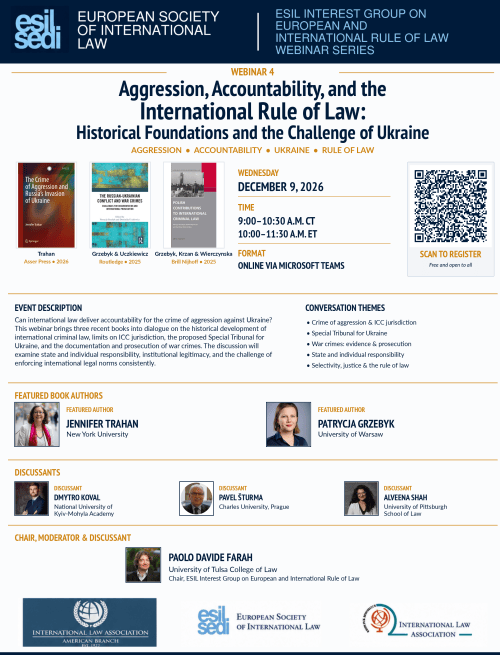
ESIL Interest Group on European and International Rule of Law Webinar Series – Webinar 4 – Aggression, Accountability, and the International Rule of Law: Historical Foundations and the Challenge of Ukraine
Wednesday, December 9, 2026
Time: 9:00–10:30 a.m. U.S. Central Time | 10:00–11:30 a.m. U.S. Eastern Time | 4:00–5:30 p.m. Central European Time | 5:00–6:30 p.m. Kyiv Time
Format: Online – Microsoft Teams
Participation: Free and open to all. Registration required.
Registration: https://docs.google.com/forms/d/e/1FAIpQLSf0xnmbY-mlHxVUs87S9whI1aL6EUdeqgIAoIcIqimlV18n_g/viewform?usp=header
Event Description
The European Society of International Law (ESIL) Interest Group on European and International Rule of Law is pleased to announce the fifth webinar in its ongoing series, conceived, organized, chaired, and moderated by Professor Paolo Davide Farah.
Aggression, Accountability, and the International Rule of Law: Historical Foundations and the Challenge of Ukraine will bring together scholars of international law, international criminal justice, international humanitarian law, and international legal institutions to examine the prohibition of aggression, the evolution of international criminal responsibility, and the challenges of ensuring accountability for serious violations of international law.
Russia’s invasion of Ukraine has brought renewed attention to foundational questions concerning the prohibition of the use of force, the crime of aggression, international criminal jurisdiction, state responsibility, and the effectiveness of international institutions. At the same time, these developments invite a broader historical and critical examination of the international legal order: how its fundamental prohibitions emerged, how they have been interpreted and enforced, and why accountability mechanisms have often operated unevenly across different geopolitical contexts.
The webinar will place three recent publications into dialogue, connecting the historical development of international criminal law with contemporary debates surrounding the investigation, documentation, prosecution, and legal consequences of international crimes committed in Ukraine.
Rather than treating the books as separate presentations, the event will explore their complementary contributions to understanding the relationship between international legal principles, institutional design, accountability, historical experience, and the rule of law.
Featured Books and Publications
Jennifer Trahan
The Crime of Aggression and Russia’s Invasion of Ukraine (T.M.C. Asser Press, 2026).
This book examines the historical development of the crime of aggression, the international legal framework governing its prosecution, and the particular challenges presented by Russia’s invasion of Ukraine.
It addresses the legal elements of the crime of aggression, the jurisdictional limitations of the International Criminal Court, and initiatives to establish a special tribunal capable of addressing individual criminal responsibility for aggression committed against Ukraine.
The publication provides an important starting point for considering how international criminal law can respond to violations of the prohibition of aggressive war and whether existing accountability mechanisms are sufficient.
Patrycja Grzebyk, Bartłomiej Krzan, and Karolina Wierczyńska
Polish Contributions to International Criminal Law (Brill | Nijhoff, 2025).
This volume examines the historical contributions of Polish legal scholarship, legal institutions, and jurists to the development of international criminal law.
By situating contemporary accountability debates within a longer historical trajectory, the book offers perspectives on the formation of international criminal responsibility, the evolution of international legal doctrines, and the relationship between historical experiences of conflict and the development of international justice.
Patrycja Grzebyk and Dominika Uczkiewicz (eds.)
The Russian-Ukrainian Conflict and War Crimes: Challenges for Documentation and International Prosecution (Routledge, 2025).
This edited volume examines the challenges of documenting, investigating, and prosecuting international crimes committed during the Russia–Ukraine conflict.
Bringing together legal, historical, and interdisciplinary perspectives, the publication explores the documentation of atrocities, the collection and preservation of evidence, international humanitarian law, domestic and international accountability mechanisms, and the institutional difficulties of securing justice during and after armed conflict.
Together, these three publications provide complementary perspectives on the historical foundations, contemporary operation, and future development of international criminal law.
Speakers and Discussants
Featured Speakers
Jennifer Trahan
New York University, Center for Global Affairs, United States
Patrycja Grzebyk
University of Warsaw, Poland
Discussants
Dmytro Koval
National University of Kyiv-Mohyla Academy, Ukraine
Pavel Šturma
Charles University, Prague, Czech Republic
Alveena Shah
University of Pittsburgh School of Law, United States
Chair, Moderator, and Discussant
Paolo Davide Farah
University of Tulsa College of Law, United States
Chair, ESIL Interest Group on European and International Rule of Law
Key Questions and Themes
The discussion will examine several interconnected questions.
1. The historical foundations of the prohibition of aggression
How did the modern prohibition of aggressive war emerge? What role did historical experiences, including the development of international criminal law after the Second World War, play in shaping contemporary understandings of international responsibility?
2. The crime of aggression and the limits of international criminal jurisdiction
What are the principal legal obstacles to prosecuting the crime of aggression committed against Ukraine? How do the jurisdictional limitations of the International Criminal Court affect the pursuit of accountability, and what role might a special tribunal play?
3. Documenting and prosecuting international crimes
What challenges arise in documenting international crimes during an ongoing armed conflict? How should international and domestic institutions approach evidentiary standards, witness protection, investigations, and the relationship between national and international accountability mechanisms?
4. State responsibility, individual criminal responsibility, and reparations
How do different forms of international legal responsibility interact? What mechanisms exist to address the consequences of unlawful uses of force, and how should the relationship between criminal accountability, reparations, and the restoration of international legality be understood?
5. Selectivity, legitimacy, and the international rule of law
To what extent do geopolitical power relations influence the enforcement of international legal norms? How can international criminal justice avoid accusations of selectivity and double standards, and what would a more consistent and universally applicable system of accountability require?
6. Ukraine and the future of international legal institutions
What lessons does the war in Ukraine offer for the development of international criminal law, collective security, international adjudication, and the broader international legal order?
Beyond Ukraine: Accountability and the Future of International Law
Although Russia’s aggression against Ukraine provides the central contemporary context, the webinar will address questions extending well beyond this conflict.
The discussion will explore the relationship between legal accountability and international political power, the historical development of international criminal justice, and the capacity of international legal institutions to respond to serious violations of fundamental international norms.
Particular attention will be devoted to the tension between the universal aspirations of international law and the uneven institutional and political conditions under which those aspirations are implemented.
By bringing together historical analysis, contemporary international criminal law scholarship, and perspectives on the documentation and prosecution of international crimes, the webinar aims to contribute to a broader debate about international justice, institutional legitimacy, and the future of the rule of law.
Event Format and Participation
The webinar will consist of introductory contributions by the featured authors, comments from invited discussants, a moderated scholarly conversation, and an opportunity for questions and discussion with the audience.
The event is intended as an interactive exchange rather than a sequence of independent book presentations.
Date: Wednesday, December 9, 2026
Time: 9:00–10:30 a.m. U.S. Central Time / 10:00–11:30 a.m. U.S. Eastern Time / 4:00–5:30 p.m. Central European Time / 5:00–6:30 p.m. Kyiv Time
Platform: Microsoft Teams
Registration: https://docs.google.com/forms/d/e/1FAIpQLSf0xnmbY-mlHxVUs87S9whI1aL6EUdeqgIAoIcIqimlV18n_g/viewform?usp=header
Participation is free and open to academics, researchers, legal practitioners, policymakers, students, and other interested participants.
Registered participants will receive the information necessary to join the webinar.
The event will be recorded for subsequent public dissemination.
About the ESIL Rule of Law Webinar Series
The European Society of International Law Interest Group on European and International Rule of Law Webinar Series is conceived, organized, chaired, and moderated by Professor Paolo Davide Farah.
The series brings recent scholarly publications into dialogue with broader questions concerning legal theory, international and comparative law, public and private law, legal institutions, global governance, economic regulation, human rights, environmental justice, sustainability, and the rule of law.
The objective is to foster substantive interdisciplinary conversations connecting academic scholarship with contemporary legal, political, economic, and institutional challenges.
Participation is free and open to all.
Please complete this registration form to receive the Microsoft Teams joining information before the event.
Registration: https://docs.google.com/forms/d/e/1FAIpQLSf0xnmbY-mlHxVUs87S9whI1aL6EUdeqgIAoIcIqimlV18n_g/viewform?usp=header
The webinar will be recorded for subsequent public dissemination.
More information, including the detailed event description, speakers’ biographies, and a selected bibliography, will become available and updated here
Professor Paolo Davide Farah, PhD
University of Tulsa College of Law
3120 East Fourth Place
Tulsa, OK 74104
https://paolofarah.com/
https://paolofarah.wordpress.com/
https://papers.ssrn.com/sol3/cf_dev/AbsByAuth.cfm?per_id=629289
II. PREVIOUS ESIL WEBINARS AND SCHOLARLY EVENTS
Since July 2026, the ESIL Interest Group on European and International Rule of Law has organized three webinars bringing recent scholarly publications into dialogue with contemporary international legal and governance challenges.
These conversations are designed not simply as book presentations, but as opportunities for substantive exchanges between authors, discussants, and participants working across different disciplines and jurisdictions.
Recordings of all three webinars are now publicly available.
WEBINAR 1 – JULY 22, 2026
ESIL Interest Group on European and International Rule of Law Webinar Series – Inaugural Webinar – Taxation, Racial Capitalism, and the International Rule of Law: From Colonial Slavery to Global Governance
Speakers
- Anthony C. Infanti – University of Pittsburgh School of Law
- Steven A. Dean – Boston University School of Law
Discussant
- Carliss N. Chatman – SMU Dedman School of Law
Chair, Moderator, and Discussant
- Paolo Davide Farah – University of Tulsa College of Law
Featured Books
Anthony C. Infanti
The Human Toll: Taxation and Slavery in Colonial America (New York University Press, 2025).
Steven A. Dean
Racial Capitalism and International Tax Law: The Story of Global Jim Crow (Oxford University Press, 2025).
The webinar examined the historical and contemporary relationships between taxation, racial capitalism, colonial slavery, international economic governance, and the rule of law.
It explored how fiscal and legal institutions have contributed to the production and reproduction of inequalities, from colonial America to the contemporary international tax system.
Further Information, Event Description, and Bibliography: https://paolofarah.wordpress.com/2026/06/17/this-esil-interest-group-on-international-and-european-rule-of-law-conversations/
Watch the Full Webinar Recording:
WEBINAR 2 – AUGUST 12, 2026
ESIL Interest Group on European and International Rule of Law Webinar Series – Webinar 2 – From Trademark Law to Public Health Governance: Intellectual Property, International Treaties, and the Rule of Law in a Changing Global Order
Speakers
- Shujie Feng – Tsinghua University School of Law, China
- Srividhya Ragavan – Texas A&M University School of Law, United States
Discussant
- Edward Kwakwa – World Intellectual Property Organization (WIPO), Geneva, Switzerland
Chair, Moderator, and Discussant
- Paolo Davide Farah – University of Tulsa College of Law
Featured Books
Shujie Feng
Chinese Trademark Law from the Perspective of International Treaties (Springer Nature, 2026).
Le Droit Chinois des Marques au Regard des Traités Internationaux (Éditions A. Pedone, 2024).
Srividhya Ragavan and Swaraj Paul Barooah
Fractures in IP, Trade, and Health: Centering a Public Health Framework (Oxford University Press, 2025).
The webinar explored the relationship between intellectual property rights, international treaty obligations, public health governance, international trade, and the rule of law.
The conversation placed Chinese trademark law and its evolution through international treaty implementation in dialogue with contemporary debates about intellectual property, access to medicines, and public health.
It also examined the relationship between international legal harmonization, domestic regulatory autonomy, economic development, and the legitimacy of international intellectual property institutions.
Further Information, Event Description, and Bibliography: https://paolofarah.wordpress.com/2026/07/20/from-trademark-law-to-public-health-governance-intellectual-property-international-treaties-and-the-rule-of-law-in-a-changing-global-order/
Watch the Full Webinar Recording:
WEBINAR 3 – SEPTEMBER 23, 2026
From Environmental Law in Context to Comparative Environmental Governance: Justice, Sustainability, and the Rule of Law
Speakers
- Rebecca Bratspies – Tulane University School of Law, United States
- Carmen G. Gonzalez – Loyola University Chicago School of Law, United States
- Tseming Yang – Santa Clara University School of Law, United States
- Sara K. Phillips – Center for Science in Public Participation, United States
Discussants
- Mekonnen Firew Ayano – University at Buffalo School of Law, State University of New York
- Chinonso Tansi Anozie – University of Houston Law Center
Chair, Moderator, and Discussant
- Paolo Davide Farah – University of Tulsa College of Law
Featured Books
Rebecca Bratspies and Carmen G. Gonzalez
Teaching Environmental Law in Context (Edward Elgar Publishing, 2026).
Tseming Yang, Anastasia Telesetsky, and Sara K. Phillips (eds.)
Comparative Environmental Law (Edward Elgar Publishing, 2025).
The webinar examined the relationship between environmental law, comparative legal methodology, environmental justice, sustainability, and the rule of law.
Bringing together two recent publications, the discussion explored the importance of contextual and comparative approaches to environmental governance, including the role of scientific knowledge, Indigenous perspectives, institutional design, environmental inequality, and regulatory accountability.
The discussion also addressed how environmental law can respond to contemporary challenges involving climate change, ecological degradation, energy transitions, and the protection of vulnerable communities.
Further Information, Event Description, and Bibliography: https://paolofarah.wordpress.com/2026/09/05/european-society-of-international-law-esil-interest-group-on-european-and-international-rule-of-law-webinar-series-webinar-3-from-environmental-law-in-context-to-comparative-environme/
Watch the Full Webinar Recording:
ADDITIONAL SCHOLARLY EVENT – JUNE 1, 2026
Indigenous Legal Orders, Legal Pluralism, and the Coloniality of Method Across Comparative Law, International Law, Intellectual Property, and Trade Governance
American Branch of the International Law Association (ABILA) CLE Webinar Series
Speakers and Participants
- Elena Baylis – University of Pittsburgh School of Law
- Sergio Alberto Gramitto Ricci – Maurice A. Deane School of Law at Hofstra University
- Dana G. Jones – North Carolina Central University School of Law
- Chidi Oguamanam – University of Ottawa, Faculty of Law
- Srividhya Ragavan – Texas A&M University School of Law
Organizer, Chair, Moderator, and Discussant
- Paolo Davide Farah – University of Tulsa College of Law
This event examined Indigenous legal orders, legal pluralism, comparative legal methods, international economic governance, and the relationship between Indigenous knowledge systems and international law.
The discussion explored how Indigenous legal traditions challenge conventional assumptions about legal authority, sovereignty, institutional legitimacy, and the production of legal knowledge.
Particular attention was devoted to the methodological and substantive implications of recognizing Indigenous legal orders within contemporary domestic, transnational, and international legal frameworks.
The event also addressed intellectual property, traditional knowledge, cultural heritage, Indigenous self-governance, artificial intelligence, institutional bias, and the broader implications of legal pluralism for global governance.
Further Information, Complete Program, Speaker Biographies, and Suggested Readings: https://paolofarah.wordpress.com/2026/04/06/abila-cle-webinar-series-indigenous-legal-orders-legal-pluralism-and-the-coloniality-of-method-in-global-governance/
Detailed Post-Webinar Report and Reflections: https://paolofarah.wordpress.com/2026/06/02/indigenous-legal-orders-legal-pluralism-and-the-coloniality-of-method-in-global-governance-reflections-from-the-abila-cle-webinar/
Complete Collection of Individual Speaker Reflections and Additional Resources: https://paolofarah.wordpress.com/2026/06/19/complete-abila-webinar-collection-and-resource-guide/
Watch the Full Webinar Recording:
III. UNIVERSITY OF TULSA INTERNATIONAL SYMPOSIUM
Tribal Energy Law, Environmental Justice, and Climate Change
March 25, 2026 | University of Tulsa College of Law
I am also pleased to share the newly published recordings of the international symposium Tribal Energy Law, Environmental Justice, and Climate Change, which I organized and chaired at the University of Tulsa College of Law.
The symposium examined critical intersections between tribal sovereignty, energy governance, environmental justice, and climate resilience.
One of its central objectives was to bridge U.S. federal Indian law and comparative and international perspectives on Indigenous peoples, environmental protection, sustainable development, and natural resources governance.
The program brought together scholars from the United States, Europe, and Asia and explored the environmental, legal, economic, and social consequences of energy development and technological transformation for Indigenous communities.
The discussions addressed Indigenous sovereignty and ESG frameworks, energy transitions and environmental justice, critical minerals and nuclear energy, climate displacement, artificial intelligence infrastructure, and Indigenous legal resurgence.
Further Information, Full Symposium Program, and Participants: https://paolofarah.wordpress.com/2026/03/21/tribal-energy-law-environmental-justice-and-climate-change-international-symposium/
PART I – Indigenous Sovereignty, ESG Frameworks, Energy Transitions, and Climate Displacement
Speakers and Presentations
Alberto Iglesias Garzón – CUNEF Universidad, Madrid, Spain
Indigenous Sovereignty, Energy Governance and a Human Rights–Based Assessment of ESG Frameworks
Evgenia I. Gounari – International Hellenic University, Greece
ESG Frameworks in Energy Investments: Standardisation, Contextual Adaptation, and Governance Risks
Obbie Afri – Károli Gáspár University, Budapest, Hungary
Who Pays the Price of Clean Energy? Indigenous Lands and Corporate Projects in Southeast Asia
Soumyaditya Deb, Sujata Arya, and Kshitij Naikade – Symbiosis Law School, Pune, India
Climate Displacement, Environmental Justice, and the Collapse of Tribal Sovereignty for the Mising Indigenous Community of Majuli, Assam, India
Watch the Symposium Recording – Part I:
PART II – Nuclear Energy, AI Infrastructure, Environmental Justice, and Indigenous Legal Resurgence
Speakers and Presentations
Robin M. Rotman – University of Missouri–Columbia
Jhonathan Ordinola Diaz – University of Missouri–Columbia
Sam Carter – Duke University
Indigenous Sovereignty and Nuclear Waste Repository Siting: A Comparative Legal Analysis
Dana G. Jones – North Carolina Central University School of Law
Coding Injustice: AI Infrastructure, Environmental Justice, and Tribal Sovereignty in the Digital Age
Ljavaus Kazangiljan (Wunsyuan Guo) – University of Arizona, James E. Rogers College of Law
Recolonization Through Consultation: Indigenous Legal Resurgence in Taiwan’s Katratripulr Solar Case
Watch the Symposium Recording – Part II:
Chair and Moderator of the International Symposium
Paolo Davide Farah – University of Tulsa College of Law
The symposium was developed through collaboration with academic and professional networks associated with the American Society of International Law (ASIL), the European Society of International Law (ESIL), the American Branch of the International Law Association (ABILA), and gLAWcal – Global Law Initiatives for Sustainable Development.
These included the ASIL Interest Group on Cultural Heritage and the Arts, the ESIL Interest Groups on European and International Rule of Law and International Environmental Law, and the relevant ABILA committees addressing international human rights, business and human rights, China, and global governance.
IV. LOOKING AHEAD – CONTINUING SCHOLARLY DIALOGUE
Through these initiatives, I hope to continue fostering dialogue across international law, comparative law, international relations, public policy, environmental governance, human rights, Indigenous rights, technological change, and sustainable development.
The broader objective is to bring recent scholarship into conversation with contemporary legal and policy challenges, while encouraging greater engagement between international law, comparative law, public policy, and the social sciences.
I would be delighted to welcome colleagues from AAAS and our wider professional networks to the forthcoming webinars on December 9, 2026, and January 27, 2027.
Both events are free and open to the international academic and professional community.
Registration details, complete programs, and additional information will be circulated shortly.
I would also be grateful if you could share these opportunities and recordings with colleagues, researchers, doctoral students, and other interested participants.
Thank you very much for your interest and continued engagement. I look forward to welcoming many of you to these conversations.
With very best wishes,
Paolo Davide Farah
Professor of Law
University of Tulsa College of Law
Chair, ESIL Interest Group on European and International Rule of Law
Chair, ILA Study Group on International Law, Global Challenges, and the Impact of Emerging Powers on Global Governance
Chair, ABILA Committee on China, Other Emerging Powers and Global Challenges
President, gLAWcal – Global Law Initiatives for Sustainable Development
https://paolofarah.com/
https://paolofarah.wordpress.com/