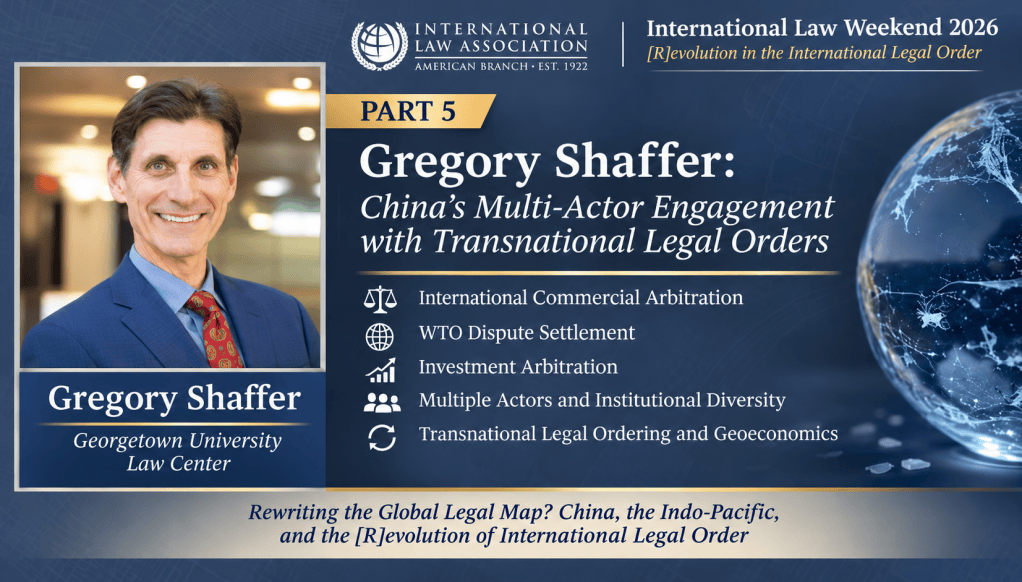
Rewriting the Global Legal Map? China, the Indo-Pacific, and the [R]evolution of International Legal Order — ABILA International Law Weekend 2026 — PART 5 – Gregory Shaffer: China’s Multi-Actor Engagement with Transnational Legal Orders — Disaggregating the State, Institutional Adaptation, and Geoeconomics
Can China’s relationship with international law be understood through a single national strategy, or must we examine the different institutions, businesses, legal professionals, and other actors shaping its engagement with transnational legal orders?
This question was central to the contribution of Professor Gregory Shaffer, Georgetown University Law Center, during the panel I organized, chaired, and moderated at International Law Weekend 2026, held on October 24 at Fordham University School of Law in New York City.
The panel, “Rewriting the Global Legal Map? China, the Indo-Pacific, and the [R]evolution of International Legal Order,” was sponsored by the American Branch of the International Law Association (ABILA) Committee on International Law, China, and the Reconfiguration of the Global Order, which I chair.
This fifth installment of my ILW 2026 series examines Professor Shaffer’s opening presentation and his subsequent interventions during our moderated exchanges and audience discussion.
His contribution offered an important analytical framework for understanding how China’s engagement with international institutions is shaped by different actors, institutional incentives, and legal practices rather than by a single, uniform state strategy.
1. Disaggregating the Chinese State
Professor Shaffer introduced research developed with Ji Li and Henry Gao, presented in their article “China and International Economic Dispute Settlement: Disaggregating the State,” published in the Journal of International Economic Law.
Their research forms part of a broader project examining China’s relationship with transnational legal orders across different areas of economic governance.
The central proposition challenges the tendency to treat China as a monolithic actor.
Different governmental institutions, regulatory agencies, businesses, lawyers, academics, and other participants operate within distinct institutional environments and pursue objectives that may not always coincide.
For example, China’s Ministry of Commerce may have significant incentives to preserve stable international economic relationships, while national-security institutions may prioritize strategic considerations that lead to different policy choices.
Professor Shaffer illustrated these tensions through developments affecting the EU-China Comprehensive Agreement on Investment, where diplomatic confrontation and reciprocal sanctions undermined an agreement that economic institutions had worked to develop.
This example demonstrated that understanding China’s international legal behavior requires examining the interaction among different domestic actors and the changing distribution of influence within the state.
The distinction also matters for evaluating China’s participation in international legal institutions.
The development of professional expertise and institutional investment in international economic law can coexist with increasing political centralization and the growing influence of national-security considerations.
2. Three Forms of International Economic Dispute Settlement
Professor Shaffer’s presentation compared China’s engagement with three different dispute settlement systems:
International commercial arbitration, primarily involving disputes between private commercial actors;
World Trade Organization dispute settlement, involving disputes between states;
and investor-state arbitration, involving legal claims brought by investors against host governments.
These institutional differences are fundamental.
They determine which actors participate, whose interests are represented, which legal strategies are available, and how domestic and international legal institutions interact.
They also help explain why China’s engagement with international law cannot be adequately described through a single account of either cooperation or confrontation.
Commercial Arbitration: Institutional Competition and Legal Experimentation
Professor Shaffer described the extensive development of commercial arbitration institutions within China.
He noted the existence of approximately 270 arbitration centers, emphasizing considerable variation in their institutional practices and relationships with local political environments.
Major commercial centers such as Beijing, Shanghai, and Shenzhen have become important sites of experimentation and international professional engagement.
Academics, internationally trained lawyers, and other legal professionals have contributed to the development of arbitration practices oriented toward international commercial relationships.
Other institutions remain more closely connected to local economic and political conditions.
These differences illustrate how transnational legal ordering can develop unevenly within a single country.
International legal norms and professional practices may become influential in particular institutions without necessarily producing equivalent changes throughout the national legal system.
Professor Shaffer also discussed the increasing significance of Chinese participation in commercial arbitration for the development of transnational practices, including the relationship between mediation and arbitration.
The expansion of Chinese commercial participation may therefore contribute to the evolution of existing international arbitration practices without necessarily replacing their underlying institutional framework.
WTO Dispute Settlement: Building Legal Capacity
Professor Shaffer then examined China’s participation in the WTO dispute settlement system.
Following its accession to the WTO, China progressively developed substantial legal expertise and institutional capacity.
Government officials, lawyers, academics, and businesses became increasingly familiar with WTO procedures and the interpretation of international trade obligations.
China moved from a relatively cautious initial approach toward more extensive participation in disputes, acquiring the capacity to defend its policies and challenge measures adopted by trading partners.
This process demonstrates how participation in international institutions can generate domestic professional communities that subsequently influence international legal developments.
However, Professor Shaffer also emphasized that institutional engagement and professional specialization do not necessarily eliminate geopolitical confrontation.
Indeed, the increasing capacity of a state to operate effectively within established legal institutions may itself contribute to tensions when other participants perceive changes in the distribution of influence.
Investment Arbitration: Chinese Investors and Developing Countries
A particularly revealing comparison concerned investor-state dispute settlement.
Professor Shaffer explained that China’s behavior in WTO disputes and the behavior of Chinese investors in investment arbitration reflect different institutional incentives.
While considerations concerning China’s relationships with developing countries influenced its approach to WTO litigation, Chinese investors have increasingly initiated investment disputes against host states across different regions.
He referred to examples involving countries such as Ghana, Nigeria, Peru, and Mongolia.
These developments illustrate the importance of distinguishing between government-to-government dispute settlement and legal proceedings initiated by private commercial actors.
Chinese investors may pursue commercial and legal interests that differ from the diplomatic or strategic priorities of Chinese government institutions.
The identity of the actor bringing a claim therefore matters considerably for understanding both the operation and the consequences of international economic law.
3. Transnational Legal Ordering Does Not Necessarily Produce Cooperation
One of the most important themes emerging from our subsequent discussion concerned the relationship between legal convergence and geopolitical competition.
Following the presentations by Professor Shaffer, Professor Keith Hand, and Professor Carrie Shu Shang, I raised questions about whether legal mechanisms can help manage international confrontation or whether the increasing use of law in geopolitical competition risks reinforcing escalation.
Professor Shaffer emphasized that transnational legal ordering should not automatically be associated with cooperation or normatively desirable outcomes.
The circulation of legal models can occur even when governments adopt those models to strengthen their capacity to compete with one another.
China’s adoption of legislative instruments resembling American sanctions and export-control frameworks provides an important example.
Similar legal instruments may spread across jurisdictions while serving conflicting strategic objectives.
This observation connected Professor Shaffer’s theoretical framework with Professor Hand’s examination of China’s countermeasure legislation and Professor Shang’s discussion of regulatory learning during technological competition.
The resulting convergence in legal form does not necessarily imply convergence in political objectives.
Indeed, geopolitical rivalry may itself accelerate the circulation of legal models.
4. Institutional Implementation: Who Actually Applies the Rules?
Professor Shaffer also stressed the distinction between adopting legal rules and implementing them.
The incorporation of foreign legal models into domestic legislation does not establish how those rules will operate in practice.
Their implementation depends upon the institutions exercising authority and the incentives influencing their decisions.
A legal measure administered by an institution primarily concerned with international commercial relationships may be applied differently from a similar measure implemented by an agency whose principal responsibility concerns national security.
This distinction returns us to the importance of disaggregating the state.
International legal ordering is not simply a process through which rules move between national legal systems.
It is also a process through which different domestic institutions interpret, adapt, and implement those rules.
The practical consequences therefore depend upon both the content of the legal instruments and the institutional actors responsible for their application.
5. Host States, Local Communities, and the Limits of Centralized Authority
Another important exchange concerned the role of host states and affected communities in international infrastructure and investment relationships.
During our discussion, I asked what would demonstrate that host states and local communities are genuine participants in the development and implementation of legal arrangements rather than merely recipients of decisions made elsewhere.
I connected this question with my research on the Belt and Road Initiative, legal transplantation, energy infrastructure, and unequal bargaining power.
Professor Shaffer emphasized that the implementation of international legal arrangements depends not only on national governments but also on actors operating at regional and local levels.
He referred to examples involving Pakistan, where agreements concluded at the national level may encounter different institutional and social conditions during implementation.
He also drew parallels with variation within China itself, where international commercial practices may become influential in Beijing or Shanghai without necessarily spreading in the same way to other regions.
These observations reinforced an important conclusion.
The formal adoption of international legal arrangements does not eliminate the agency of domestic institutions, local authorities, or affected communities.
Nor does agreement between national governments necessarily guarantee effective implementation.
The distribution of authority and bargaining power at different institutional levels remains essential to understanding the operation of transnational legal arrangements.
6. From Neoliberalism to Geoeconomics: Changing the Framework of International Economic Law
During the audience discussion, Professor Shaffer returned to the broader question of how international economic relationships are conceptualized.
He contrasted the prominence of neoliberal frameworks in earlier discussions of international economic governance with the increasing role of geoeconomic competition, national security, and strategic economic relationships.
His intervention raised an important methodological concern.
The frameworks through which scholars, policymakers, and institutions interpret international economic relations influence how they identify problems and evaluate possible responses.
He also discussed the implications of artificial intelligence for the reproduction and reinforcement of prevailing analytical approaches.
If international economic relationships are increasingly interpreted primarily through competition and national security, those assumptions may influence subsequent political and regulatory decisions.
In this sense, the way international relations are conceptualized can contribute to shaping the developments being analyzed.
Professor Shaffer warned that this dynamic may be particularly consequential for smaller states navigating competition among major powers.
Building upon his observations, I suggested that geoeconomics should also be examined through the perspectives of political geography and legal geography.
International legal relationships have never been uniformly distributed across regions, institutions, and economic systems.
Different legal arrangements coexist within particular geographic and institutional contexts.
Understanding contemporary transformations therefore requires examining not only geopolitical competition but also the spatial distribution of legal authority, economic relationships, and regulatory practices.
This perspective connects the analysis of geoeconomics with legal pluralism and regulatory competition.
7. Rewriting the Global Legal Map: The Importance of Multiple Actors
Professor Shaffer’s contribution provides an important foundation for understanding the contemporary transformation of international legal order.
It challenges explanations that reduce China’s engagement with international law to a single governmental strategy.
It also demonstrates the importance of distinguishing among different institutional settings.
China’s participation in commercial arbitration, WTO dispute settlement, and investment arbitration involves different actors and produces different incentives.
Moreover, the circulation of legal models does not necessarily generate political cooperation, just as the existence of common international institutions does not eliminate competing national interests.
Legal transformation depends not only on the adoption of rules but also on the institutions responsible for implementing them.
Finally, national agreements and international legal arrangements must be examined in light of regional and local conditions, where their application may encounter different interests, institutional capacities, and forms of resistance.
These observations connect closely with the broader questions guiding our panel:
Who makes the operative decision? Through what legal mechanism? Who can contest it? And who bears the costs?
The answers are rarely found by examining states as unified actors.
Instead, they require attention to the institutional relationships, professional communities, commercial incentives, and political considerations shaping the operation of international law.
Continuing the Conversation
I am grateful to Professor Gregory Shaffer for accepting my invitation to participate in our panel and for contributing his extensive scholarship and insights to the discussion.
His presentation and subsequent interventions provided an important analytical framework for understanding China’s participation in transnational legal orders and the broader transformation of international economic governance.
Our exchanges also highlighted several questions that merit further scholarly attention, particularly the relationship between regulatory convergence and geopolitical competition, the institutional implementation of legal transplants, and the growing significance of geoeconomics.
These questions connect closely with the continuing work of the ABILA Committee on International Law, China, and the Reconfiguration of the Global Order and the International Law Association Study Group on International Law, Global Challenges, and the Impact of Emerging Powers on Global Governance, both of which I chair.
The next installment of this series will examine Professor Keith J. Hand’s contribution on legal struggle, sanctions, and China’s developing countermeasure legislation, including the relationship between domestic legal instruments and geopolitical competition.
Selected Bibliographical References
Shaffer, Gregory, Ji Li, and Henry Gao. “China and International Economic Dispute Settlement: Disaggregating the State.” Journal of International Economic Law (2026).
https://papers.ssrn.com/sol3/papers.cfm?abstract_id=6576238
Hand, Keith J. “Waging External Struggle through Law: China’s Evolving Legal Strategies and Pelosi’s Taiwan Visit.” UC San Diego 21st Century China Center Special Report (2022).
https://papers.ssrn.com/sol3/papers.cfm?abstract_id=4208433
Shang, Carrie Shu. “US-China Transnational Law in a Time of Trade Crisis.” Indiana Journal of Global Legal Studies 28, no. 2 (2021): 139–204.
https://www.repository.law.indiana.edu/ijgls/vol28/iss2/4
Zoppolato, Davide Giacomo, and Paolo Davide Farah. “China’s Path to Modernization and Legal Pluralism: Transplants and the Belt and Road Initiative.” Asian Journal of Law and Society 12, no. 2 (2025): 109–144.
https://papers.ssrn.com/sol3/papers.cfm?abstract_id=5215873
Farah, Paolo Davide, Davide Giacomo Zoppolato, and Tivadar Ötvös. “China’s Belt and Road Initiative and Its Impact on the Energy Independence of the European Union.” Asian Journal of Law and Society 12, no. 2 (2025): 274–303.
https://papers.ssrn.com/sol3/papers.cfm?abstract_id=5215879
International Law Weekend 2026
October 22–24, 2026
Fordham University School of Law, New York City
Panel: Rewriting the Global Legal Map? China, the Indo-Pacific, and the [R]evolution of International Legal Order
Sponsored by: ABILA Committee on International Law, China, and the Reconfiguration of the Global Order
Chair, Moderator, and Discussant: Paolo Davide Farah
Participating Speakers: Gregory Shaffer, Keith J. Hand, and Carrie Shu Shang
International Law Weekend 2026 — Complete Publication Series
This article forms part of an ongoing series documenting my participation in International Law Weekend 2026, organized by the American Branch of the International Law Association (ABILA), and the scholarly exchanges developed through the panel “Rewriting the Global Legal Map? China, the Indo-Pacific, and the [R]evolution of International Legal Order.”
The panel, held on October 24, 2026, at Fordham University School of Law in New York City, was sponsored by the ABILA Committee on International Law, China, and the Reconfiguration of the Global Order, which I chair.
The series explores the contributions of Gregory Shaffer, Keith J. Hand, Carrie Shu Shang, and myself, including our presentations, subsequent interventions, and discussions concerning international economic law, transnational legal orders, legal pluralism, regulatory competition, geopolitical transformations, and global governance.
Published Installments
PART 1 — Rewriting the Global Legal Map? China, the Indo-Pacific, and the [R]evolution of International Legal Order — Panel Announcement and Intellectual Framework
Introduction to the panel, its objectives, participating scholars, principal research questions, and relevant academic publications.
PART 2 — International Law Weekend 2026 at Fordham Law School: Reflections on ABILA, International Scholarly Cooperation, and Emerging Initiatives
Reflections on my participation in ILW 2026, my role as Chair of the ABILA Committee on International Law, China, and the Reconfiguration of the Global Order, and the development of the International Law Association Study Group on International Law, Global Challenges, and the Impact of Emerging Powers on Global Governance.
PART 3 — Rewriting the Global Legal Map? The Full Panel Discussion: China, Transnational Legal Orders, Geopolitical Competition, and Global Governance
A comprehensive account of the October 24 panel, bringing together the principal arguments of Gregory Shaffer, Keith J. Hand, Carrie Shu Shang, and my own contributions, including the moderated exchanges, audience questions, and broader implications for international law.
PART 4 — Opening Remarks: Who Is Rewriting the Global Legal Map? Power, Institutions, Legal Pluralism, and International Legal Change
The conceptual framework developed for my introductory remarks, examining the distinction between changes in participation, shifts in institutional authority, and transformations in international legal rules and practices.
PART 5 — Gregory Shaffer: China’s Multi-Actor Engagement with Transnational Legal Orders — Disaggregating the State, Institutional Adaptation, and Geoeconomics
An examination of Professor Shaffer’s opening presentation and subsequent interventions on China’s participation in commercial arbitration, WTO dispute settlement, investment arbitration, institutional adaptation, and the growing importance of geoeconomics.
Forthcoming Installments
PART 6 — Keith J. Hand: Legal Struggle, Sanctions, and China’s Countermeasure Legislation
An examination of Professor Hand’s analysis of China’s foreign-related legislation, legal countermeasures, extraterritoriality, national-security considerations, and the use of domestic law as an instrument of international competition.
PART 7 — Carrie Shu Shang: Transnational Legal Learning, Technology Competition, and Regulatory Adaptation
An exploration of Professor Shang’s research and interventions concerning regulatory learning, technology governance, the circulation of legal models, licensing, private actors, and the adaptation of legal arrangements across jurisdictions.
PART 8 — Paolo Davide Farah: Legal Pluralism, Regulatory Competition, and the Reconfiguration of International Legal Order
An analysis of my substantive contributions concerning legal transplantation, the Belt and Road Initiative, regulatory competition, public and private authority, energy governance, unequal bargaining power, the participation of host states and affected communities, and the relationship between geoeconomics and legal geography.
Continuing the Conversation
Together, these installments document the intellectual foundations of the panel, the contributions of its participants, and the broader questions emerging from our exchanges.
The series also contributes to the continuing activities of the ABILA Committee on International Law, China, and the Reconfiguration of the Global Order and the International Law Association Study Group on International Law, Global Challenges, and the Impact of Emerging Powers on Global Governance, both of which I chair.
Through these complementary initiatives, I hope to encourage further dialogue and scholarly cooperation on the evolving relationship between international law, geopolitical competition
#InternationalLaw #ILW2026 #ABILA #China #TransnationalLaw #InternationalEconomicLaw #DisputeSettlement #LegalPluralism #Geoeconomics #GlobalGovernance