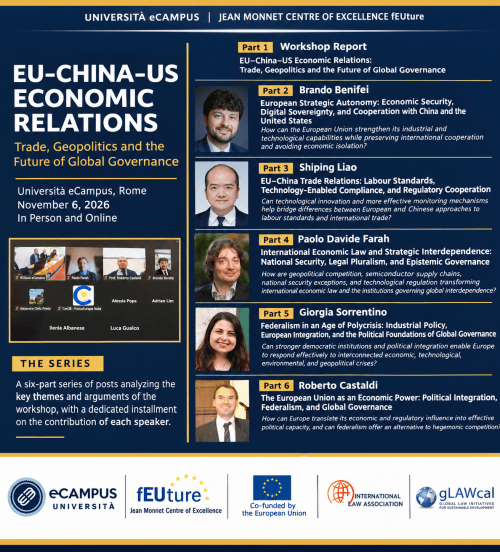


Five Perspectives on the Future of International Economic Law and Global Governance – Workshop on EU–China–US Economic Relations: Trade, Geopolitics and the Future of Global Governance
What did our November 6 Workshop on EU–China–US Economic Relations: Trade, Geopolitics and the Future of Global Governance reveal about the changing international economic order?
The Full post is available at https://paolofarah.wordpress.com/2026/11/25/concluding-reflections-five-perspectives-on-the-future-of-international-economic-law-and-global-governance-workshop-on-eu-china-us-economic-relations-trade-geopol/
Bringing together Roberto Castaldi, Brando Benifei, Shiping Liao, Giorgia Sorrentino, and myself at Università eCampus allowed us to examine the same global transformations through different disciplinary and institutional perspectives.
Several important connections emerged.
Economic interdependence is not disappearing. Instead, it is increasingly governed through competing national security priorities, industrial strategies, and regulatory frameworks.
European strategic autonomy requires more than regulatory influence. It also depends on investment, technological capabilities, institutional coordination, and the availability of credible alternatives.
Semiconductors and Taiwan illustrate the vulnerabilities of concentrated supply chains. The US CHIPS and Science Act, Chinese technological ambitions, and European industrial initiatives raise fundamental questions about the relationship between resilience, competition, and international trade obligations.
Technology is transforming the meaning of regulatory accountability. AI systems, labour monitoring, environmental reporting, and corporate compliance increasingly depend on complex information infrastructures. The central question is not only who makes the rules, but also who produces and verifies the evidence.
Global governance requires political and institutional capacity. Economic interdependence alone cannot guarantee cooperation, particularly when international institutions face growing pressure.
Our discussion also reinforced a proposition that guides my research and the initiatives I chair through the ILA and ABILA:
The transformation of global economic power must be studied together with the transformation of international legal rules, institutions, enforcement mechanisms, and access to remedies.
I am grateful to all our speakers, to Roberto Castaldi for his collaboration and moderation, and to Università eCampus and the Jean Monnet Centre of Excellence fEUture for making this exchange possible.
The workshop has provided a valuable foundation for further research and dialogue through gLAWcal, the ILA Study Group on International Law, Global Challenges, and the Impact of Emerging Powers on Global Governance, and the ABILA Committee on International Law, China, and the Reconfiguration of the Global Order.
Can international economic governance evolve beyond geopolitical rivalry toward a framework that reconciles economic security, democratic legitimacy, technological transformation, and international cooperation?
 Read the full workshop report: https://paolofarah.wordpress.com/2026/11/19/workshop-report-universita-ecampus-rome-and-online-november-6-2026-eu-china-us-economic-relations-trade-geopolitics-and-the-future-of-global-governance/
#InternationalEconomicLaw #GlobalGovernance #EUChinaUS #WTO #EuropeanIntegration #TechnologyGovernance #StrategicAutonomy