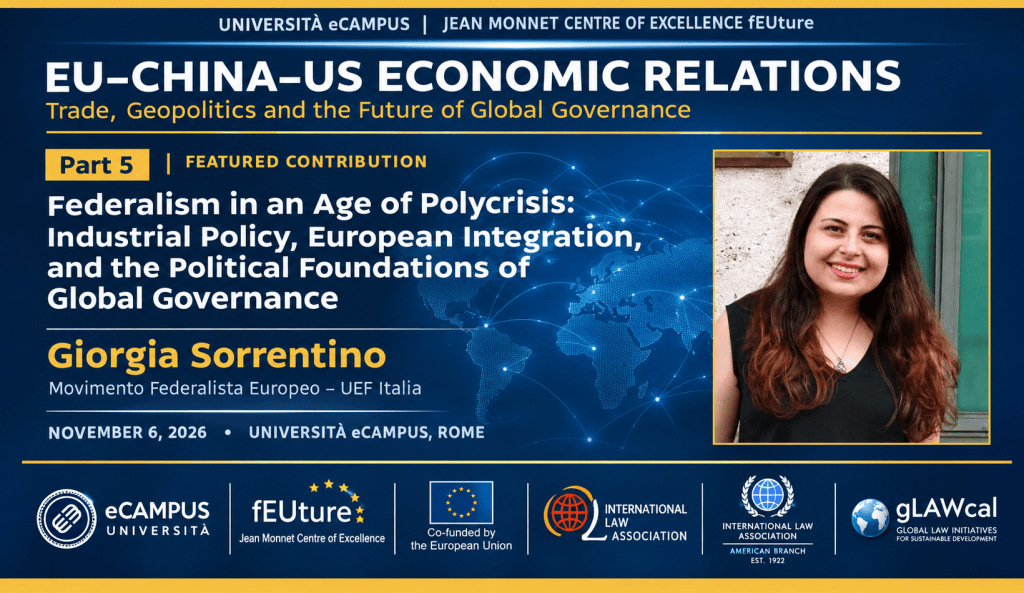


Giorgia Sorrentino: Federalism in an Age of Polycrisis: Industrial Policy, European Integration, and the Political Foundations of Global Governance – Workshop on EU–China–US Economic Relations: Trade, Geopolitics and the Future of Global Governance | Part 5
Giorgia Sorrentino: Polycrisis and the return of political governance – What happens when economic interdependence increases but the political institutions needed to govern it become less effective?
At our November 6 workshop, Giorgia Sorrentino of the European Federalist Movement offered a perspective connecting globalization, industrial policy, technological change, and democratic governance.
Her contribution challenged the assumption that economic integration necessarily leads to political convergence.
Contrasting the optimism associated with the end of the Cold War and European integration with the uncertainty of the present, Giorgia examined the growing interaction among trade conflicts, ecological crises, technological disruption, and political instability.
She situated these developments within the concept of polycrisis: multiple crises interacting across interconnected economic, environmental, technological, and political systems.
A central theme was the return of industrial policy.
China, the United States, and the European Union approach state intervention from different institutional traditions, yet all confront the need to address technological development, industrial capacity, strategic investment, and economic resilience.
Giorgia connected this debate to European discussions on competitiveness and the single market, including the Draghi and Letta reports.
Her argument was that economic policy cannot be separated from political authority and institutional capacity.
Without effective institutions capable of collective decision-making, societies risk losing confidence in their ability to respond to complex challenges and shape their future.
Her federalist perspective complemented our broader discussion of European strategic autonomy and international legal ordering.
It also raised an important question: can European integration provide institutional lessons for governing interdependence beyond the European Union?
Thank you, Giorgia, for bringing this valuable political and historical dimension to our discussion.
 Full workshop report: [INSERT REPORT LINK]
#EuropeanFederalism #Polycrisis #IndustrialPolicy #EuropeanIntegration #GlobalGovernance #EconomicSecurity