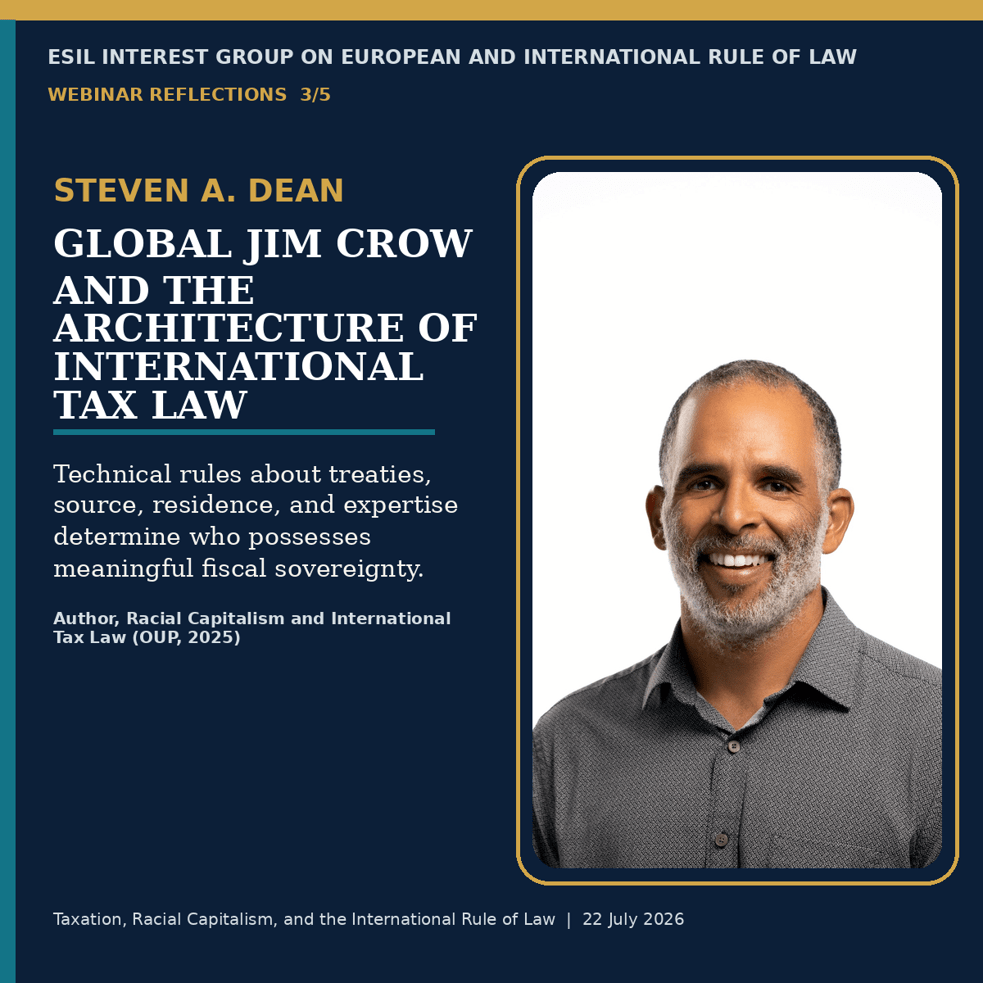

Steven A. Dean: Global Jim Crow and the Racial Architecture of International Tax Law – Reflections on the Inaugural Webinar – ESIL Interest Group on European and International Rule of Law Webinar Series · Webinar 1 · Reflection 3/5
Steven A. Dean’s presentation examined how international tax rules and institutions distribute taxing authority between states and shape the movement and protection of capital across borders. In introducing his contribution, I situated this analysis within a broader question central to the webinar: international tax law is not simply a technical system, but part of an institutional architecture that allocates fiscal sovereignty and affects the capacity of states to provide education, health, infrastructure, and development.
Introducing his 2025 book, Racial Capitalism and International Tax Law: The Story of Global Jim Crow, Professor Dean began with the structures used by multinational enterprises to shift profits into lower-tax jurisdictions. These arrangements are often treated as contemporary innovations, yet President John F. Kennedy warned in 1961 that corporations were exploiting tax treaties to avoid tax. At that moment, the treaty network was still limited. Its later expansion was therefore not inevitable; policymakers embraced thousands of treaties despite knowing their risks.
The historical account showed how corporate resistance and geopolitical considerations narrowed reform. The United States–Switzerland treaty was central to the controversy, while Switzerland’s diplomatic role during the Cuban Missile Crisis made confrontation more difficult. The eventual response became known as “Subpart F”—an anodyne technical label that largely erased the political conflict and corporate power behind the rule.
Professor Dean’s deeper intervention concerned the racialized diagnosis of global tax avoidance. Structures connected to wealthy states and jurisdictions such as Ireland and the Netherlands enabled major corporate tax losses. Yet the OECD’s 2000 campaign directed blame toward predominantly Black and brown jurisdictions, including Liberia. Institutional publications depicted low-tax jurisdictions through sunny-island and coconut-tree imagery, while the glass office towers and sophisticated legal infrastructures of wealthy jurisdictions remained outside the frame.
This was not only a problem of representation. The location of expertise determined which account became authoritative. During decolonization, international tax authority shifted away from the more universal United Nations framework and toward the OECD. Rules favoring residence taxation over source taxation benefited capital-exporting states and limited newly independent states’ capacity to tax economic activity occurring within their territories. The result was a reduction in the fiscal resources available for postcolonial state-building.
Professor Dean described international taxation as a tool of racial capitalism because it redistributed surplus from outsiders to insiders in racialized ways. He also demonstrated how authority over international taxation increasingly shifted from the more universal United Nations framework toward the OECD, raising the question of who is permitted to formulate the rules and whose interests those rules protect.
In my response, I connected this history to the problem of epistemic governance. The OECD’s authority became not merely influential but constitutive: through accumulated expertise, prestige, repetition, and institutional legitimacy, it acquired the power to define what counted as sound and authoritative international tax policy. This led me to formulate one of the webinar’s broader questions: who gets to be the architect of global governance?
Professor Dean’s discussion of knowledge production was especially revealing. He showed how the political controversy surrounding the Swiss treaty disappeared behind the technical name “Subpart F,” while the unsupported classification of Liberia as a tax haven was repeated across lists and institutions until it acquired the appearance of accepted fact.
I connected these examples to a wider concern with epistemic authority: institutions do not merely apply existing knowledge. They determine which histories remain visible, which classifications become authoritative, and which errors acquire legitimacy through repetition. Expert authority can therefore obscure accurate histories while transforming unsupported claims into institutional knowledge.
In the final round, Professor Dean identified restored fiscal sovereignty as a minimum form of repair. He invited reconsideration of double-tax treaties that continue to protect multinational enterprises and wealthy individuals from taxation. Their legitimacy rests heavily on age, repetition, and institutional pedigree. Stripped of that inherited authority, the proposal to create thousands of agreements shielding private capital from tax would be difficult to defend publicly.
Professor Dean’s presentation connected racial capitalism, institutional exclusion, corporate power, and the distribution of fiscal sovereignty. His call for restored fiscal sovereignty also made clear that reform cannot be reduced to changes in the location or membership of international negotiations.
In drawing together the discussion, I emphasized the implications for institutional design and the international rule of law. A more inclusive forum is essential, but representation alone cannot repair decades of lost public revenue or guarantee distributive justice. The challenge is not merely to relocate negotiations, but to redistribute authority, resources, and responsibility within the international tax system.
Because readers may not have seen those earlier posts, the principal bibliography is reproduced below.
Selected Bibliography
Books in Dialogue
Dean, Steven A. (2025). Racial Capitalism and International Tax Law: The Story of Global Jim Crow. Oxford: Oxford University Press – Examines how international tax law has historically contributed to racialized structures of economic power and inequality on a global scale.
Infanti, Anthony C. (2025). The Human Toll: Taxation and Slavery in Colonial America. New York: New York University Press – Explores the relationship between taxation, slavery, and state-building in colonial America, highlighting the human costs embedded in fiscal and legal institutions.
Related Scholarship by Steven A. Dean
Racialized International Tax Law in Research Handbook on Critical Tax Studies (forthcoming Edinburgh University Press, Yvette Lind and Dominic de Cogan, eds.)
Fear of a Black Planet: Africa’s Decolonisation and the Transformation of the International Tax Regime in Taxing People: The Next 100 Years (Cambridge University Press 2026, Tsilly Dagan and Ruth Mason, eds.)
Filing While Black: The Casual Racism of the Tax Law, 2022 Utah Law Review 801, available at https://papers.ssrn.com/sol3/papers.cfm?abstract_id=4081456
Inclusive International Tax Policymaking: FATCA, the U.S. Congressional Black Caucus, and the OECD Blacklist, Revue Européenne et Internationale de Droit Fiscal(2021) (Reprinted in Tax Notes International)
Ten Truths about Tax Havens: Inclusion and the ‘Liberia’ Problem, 70 Emory Law Journal1657 (2021) (with Attiya Waris), available at https://papers.ssrn.com/sol3/papers.cfm?abstract_id=3822421
Dean’s SSRN Author Page https://papers.ssrn.com/sol3/cf_dev/AbsByAuth.cfm?per_id=440250
Related Scholarship by Anthony Infanti
Our Selfish Tax Laws: Toward Tax Reform That Mirrors Our Better Selves (The MIT Press 2018).
Critical Tax Theory: An Introduction (Cambridge University Press, Anthony C. Infanti & Bridget J. Crawford eds., 2009). The Introduction is available at https://papers.ssrn.com/sol3/papers.cfm?abstract_id=1333799
Internation Equity and Human Development, in Tax, Law and Development (Edward Elgar Publishing, Miranda Stewart & Yariv Brauner eds., 2013).
Tax Equity, 55 Buff. L. Rev. 1191 (2008), available at https://digitalcommons.law.buffalo.edu/buffalolawreview/vol55/iss4/5/
Tax and Time: On the Use and Misuse of Legal Imagination (NYU Press 2022), available at https://papers.ssrn.com/sol3/papers.cfm?abstract_id=4006652
Tax Reform Discourse, 32 Va. Tax Rev. 205 (2012), available at https://papers.ssrn.com/sol3/papers.cfm?abstract_id=2034869
Critical Tax Theory: Insights from the US and Opportunities for All, 51 Austl. Tax Rev. 81 (2022) (with Bridget J. Crawford), available at https://papers.ssrn.com/sol3/papers.cfm?abstract_id=4236410
Infanti’s SSRN Author Page
Related Scholarship by Carliss N. Chatman
(2023). “Teaching Slavery in Commercial Law.” 28 Michigan Journal of Race & Law 1–38. SMU Dedman School of Law Legal Studies Research Paper No. 611. Available at SSRN: https://papers.ssrn.com/sol3/papers.cfm?abstract_id=3926671 – Examines how slavery and its enduring legacies can be more meaningfully integrated into the teaching and understanding of commercial law.
(2026). “The Contract and the Cure: Building a Private Infrastructure for Reparations.” In Slavery’s Long Tentacles: Entanglements in Historical and Modern Forms of Slavery (Cambridge University Press, forthcoming). https://ssrn.com/abstract=6140369 – Explores the role of private law, contracts, and institutional design in advancing reparative justice for the enduring harms of slavery.
(October 24, 2024). “1981”, 82 Wash. & Lee L. Rev. 1655 (2026), SMU Dedman School of Law Legal Studies Research Paper No. 666, Available at SSRN: https://ssrn.com/abstract=4998718 – Analyzes the continuing significance of 42 U.S.C. § 1981 and its role in addressing racial discrimination, equality, and access to economic opportunity.
(2018). “The Corporate Personhood Two-Step.” 18 Nevada Law Journal 811–862. Posted July 17, 2017; revised August 11, 2023. Chatman, Carliss, The Corporate Personhood Two-Step (June 25, 2017). 18 Nev. L. J. 811 (2018), Available at SSRN: https://ssrn.com/abstract=2992275 – Investigates how legal doctrines of corporate personhood shape corporate power, accountability, and the allocation of rights within modern governance systems.
Chatman’s SSRN Author Page https://papers.ssrn.com/sol3/cf_dev/AbsByAuth.cfm?per_id=2419097
Related Scholarship by Paolo D. Farah
(2026). Epistemic Governance. Available at SSRN: https://papers.ssrn.com/sol3/papers.cfm?abstract_id=6487038 – Develops a framework for understanding how knowledge, authority, expertise, and competing narratives shape governance structures, institutional legitimacy, and global ordering.
(2025) China’s Path to Modernization and Legal Pluralism: Transplants and the Belt and Road Initiative, Asian Journal of Law and Society, Cambridge University Press https://papers.ssrn.com/sol3/papers.cfm?abstract_id=5215873 – Examines how competing legal traditions, governance models, and development paradigms contribute to evolving forms of legal pluralism and the reconfiguration of global order.
(2024). “Energy Justice, Just Transition and International Environmental Law.” In ASIL Proceedings (Just Energy Transition: Legal Challenges Associated with Coal Phase Out), Cambridge University Press. Available at SSRN: https://papers.ssrn.com/sol3/papers.cfm?abstract_id=5055884 – Explores how legal and governance frameworks shape the distribution of benefits and burdens during energy transitions, highlighting questions of historical responsibility, distributive justice, institutional legitimacy, and the role of law in addressing structural inequalities associated with climate and energy transformation.
Farah’s SSRN Author Page https://papers.ssrn.com/sol3/cf_dev/AbsByAuth.cfm?per_id=629289
Paolo Farah, Paolo Davide Farah
Webinar Reflections 3/5: Steven A. Dean: Global Jim Crow and the Racial Architecture of International Tax Law