
Cultural Heritage, Constitutional Identity, and the Governance of Memory
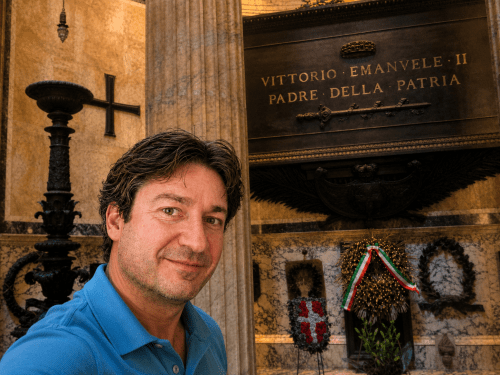
Standing before the tomb of Vittorio Emanuele II inside the Pantheon invites reflection not only on the history of Italy, but also on the broader relationship between cultural heritage, constitutional identity, and collective memory.
The Pantheon is often admired as one of the greatest achievements of Roman engineering. But it is equally remarkable for another reason: it embodies successive layers of political and constitutional history. A Roman temple became a Christian church. A sacred religious space later became a national memorial. Today it functions simultaneously as a place of worship, a cultural monument, and one of the most visited heritage sites in the world.
This remarkable continuity illustrates that cultural heritage is not static. Heritage is continually reinterpreted as societies redefine their identities, political institutions, and constitutional values.
The burial of Vittorio Emanuele II, the first King of unified Italy, transformed the Pantheon into more than an archaeological monument. It became part of the constitutional narrative of the Italian state itself. The subsequent burials of Umberto I and Queen Margherita reinforced this symbolic role.
The significance of these tombs extends beyond the history of the Italian monarchy. They invite broader questions that resonate across comparative constitutional law and global governance.
How do societies preserve historical continuity while embracing political transformation? How do constitutional democracies reconcile competing historical narratives? What role should monuments, memorials, and cultural heritage play in shaping collective identity?
These questions are increasingly relevant worldwide. Debates over monuments, historical memory, colonial legacies, national identity, and public symbolism have become central to constitutional politics in many countries. Heritage has become not only an object of preservation but also an arena of democratic deliberation.
The Pantheon reminds us that monuments do more than commemorate the past. They become living institutions through which successive generations negotiate identity, legitimacy, and belonging.
In this sense, cultural heritage contributes to what might be described as the governance of memory. It provides societies with spaces where historical continuity and democratic transformation coexist rather than compete.
Perhaps the enduring lesson of the Pantheon is that constitutional identity, like cultural heritage itself, is never fully complete. It is continually constructed through dialogue between history, law, institutions, and the communities that give them meaning.
Paolo Davide Farah, Paolo Farah
Suggested Bibliography
- Epistemic Governance, available on SSRN: https://papers.ssrn.com/sol3/papers.cfm?abstract_id=6487038
- Conflict between Intellectual Property Rights and Human Rights: A Case Study on Intangible Cultural Heritage
94 Oregon Law Review 125 (2015) - When John Locke Meets Lao Tzu: The Relationship between Intellectual Property, Biodiversity and Indigenous Knowledge and the Implications for Food Security
33 Duke Environmental Law & Policy Forum 297 (2024)