The U.S. Supreme Court, Independent Agencies, and Epistemic Governance: Reflections on Humphrey’s Executor, Loper Bright, and the Future of the Administrative State
Today’s U.S. Supreme Court decisions on the future of independent federal agencies, including the overruling of Humphrey’s Executor and the Court’s decision concerning the Federal Reserve, will likely become landmark references in constitutional law, administrative law, and the governance of the modern administrative state.
From my perspective, one particularly interesting aspect is how closely they align with the analytical framework I developed nearly six months ago in the original draft of my paper on Epistemic Governance.
https://papers.ssrn.com/sol3/papers.cfm?abstract_id=6487038
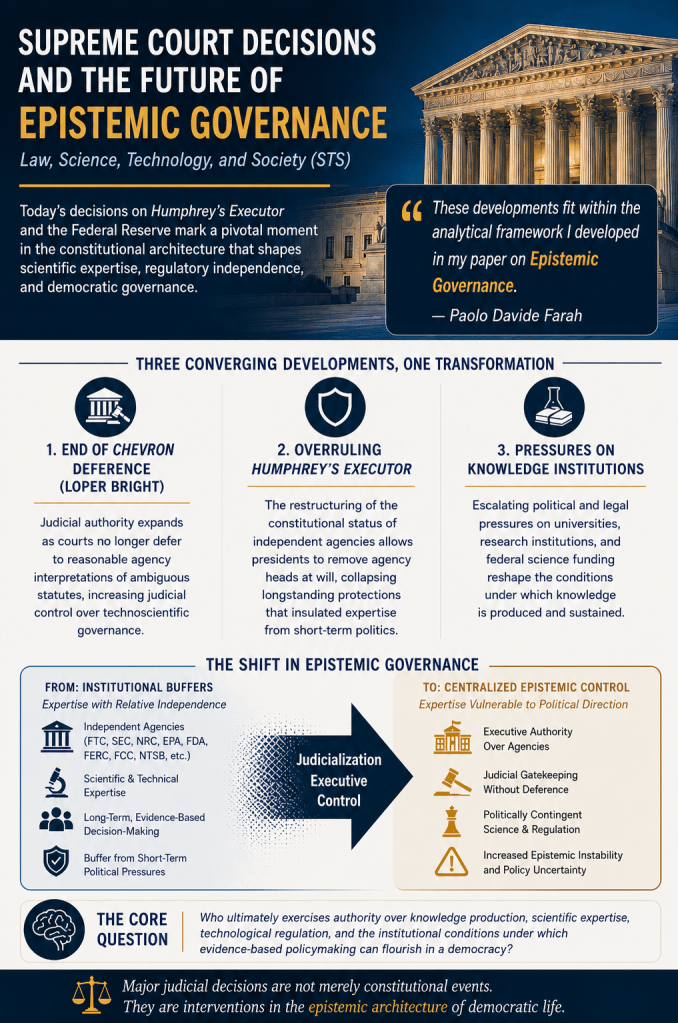
Rather than attempting to predict a particular judicial outcome, the paper examined how Loper Bright, the then-pending challenge to Humphrey’s Executor, and the growing political and legal pressures affecting universities, research institutions, and federal science funding formed part of a broader transformation that I describe as epistemic governance: the evolving allocation of authority over expertise, science, regulation, and knowledge production in democratic societies.
Within that framework, I argued that the erosion of the Chevron doctrine following Loper Bright fundamentally reshapes technoscientific governance by transferring greater authority from expert administrative agencies to the judiciary. I further suggested that eliminating the longstanding protections for independent agencies established by Humphrey’s Executor would have consequences extending well beyond constitutional doctrine.
From an STS perspective, the issue is not simply presidential power. It concerns the institutional architecture through which democratic societies organize scientific expertise, regulatory independence, and long-term decision-making.
Independent agencies—including those responsible for energy regulation, nuclear safety, environmental protection, communications, financial regulation, and public health—have historically served as institutional buffers between scientific and technical expertise and short-term political pressures. Their relative independence has been an essential feature of modern technoscientific governance.
The paper argues that three developments should be understood together rather than in isolation:
• the end of Chevron deference (Loper Bright);
• the restructuring of the constitutional status of independent agencies through the Supreme Court’s decision in Trump v. Slaughter, which overruled Humphrey’s Executor; and
• the broader political and legal pressures affecting universities, research institutions, and federal science funding.
Taken together, these developments raise broader questions about what I describe as epistemic governance: who ultimately exercises authority over knowledge production, scientific expertise, technological regulation, and the institutional conditions under which evidence-based policymaking can flourish.
I look forward to continuing this discussion as the revised manuscript develops.
Paolo Davide Farah, Paolo Farah
Related Scholarship by Paolo D. Farah
(2026). Epistemic Governance. Available at SSRN: https://papers.ssrn.com/sol3/papers.cfm?abstract_id=6487038 – Develops a framework for understanding how knowledge, authority, expertise, and competing narratives shape governance structures, institutional legitimacy, and global ordering.