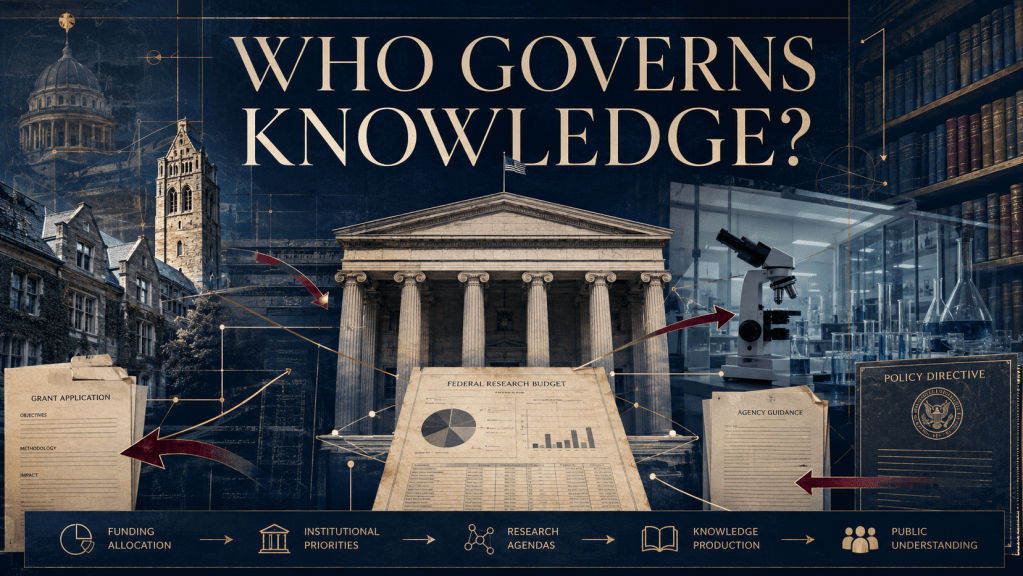
WHO GOVERNS KNOWLEDGE? A REVISED VERSION OF “EPISTEMIC GOVERNANCE”
Censorship is not the only way to control knowledge.
Funding freezes, grant conditions, removal power, administrative restructuring, and compliance demands can redirect research, discipline expertise, and weaken knowledge-producing institutions without censoring a scientist or banning a book.
Today, I began circulating to U.S. law reviews a revised version of my article, “Epistemic Governance.”
The revised Article develops a central constitutional and public-law claim: the authority to govern knowledge is increasingly exercised through legal, financial, and administrative mechanisms that may appear formally neutral but can profoundly reshape the production and circulation of expertise.
The Trump Administration’s attacks on universities, federal research programs, and independent expert agencies have exposed a constitutional struggle over who governs knowledge. The underlying problem extends beyond any particular administration or political moment.
Law has long played a central role in mediating the authority of scientific and technological knowledge. It determines which forms of expertise are officially recognized, which institutions are authorized to speak, which risks are considered legally relevant, and which claims may enter judicial, administrative, and political decision-making.
Law, in other words, does not merely receive or evaluate knowledge produced elsewhere. It helps construct epistemic authority.
The Article asks whether law continues to function as an epistemic gatekeeper under contemporary conditions of technoscientific uncertainty, institutional fragmentation, and political polarization. It also examines what happens when the legal mechanisms ordinarily used to organize and support knowledge-producing institutions become instruments for redirecting, reorganizing, or neutralizing them.
The revised Article argues that the legal allocation of epistemic authority has become an urgent but largely unrecognized problem of American public law.
Understanding that problem requires looking beyond conventional censorship and academic-freedom claims to examine the institutional infrastructure through which knowledge is funded, produced, validated, and given public authority.
The paper is available on SSRN:
Comments, criticisms, and suggestions are very welcome.
Paolo Davide Farah, Paolo Farah