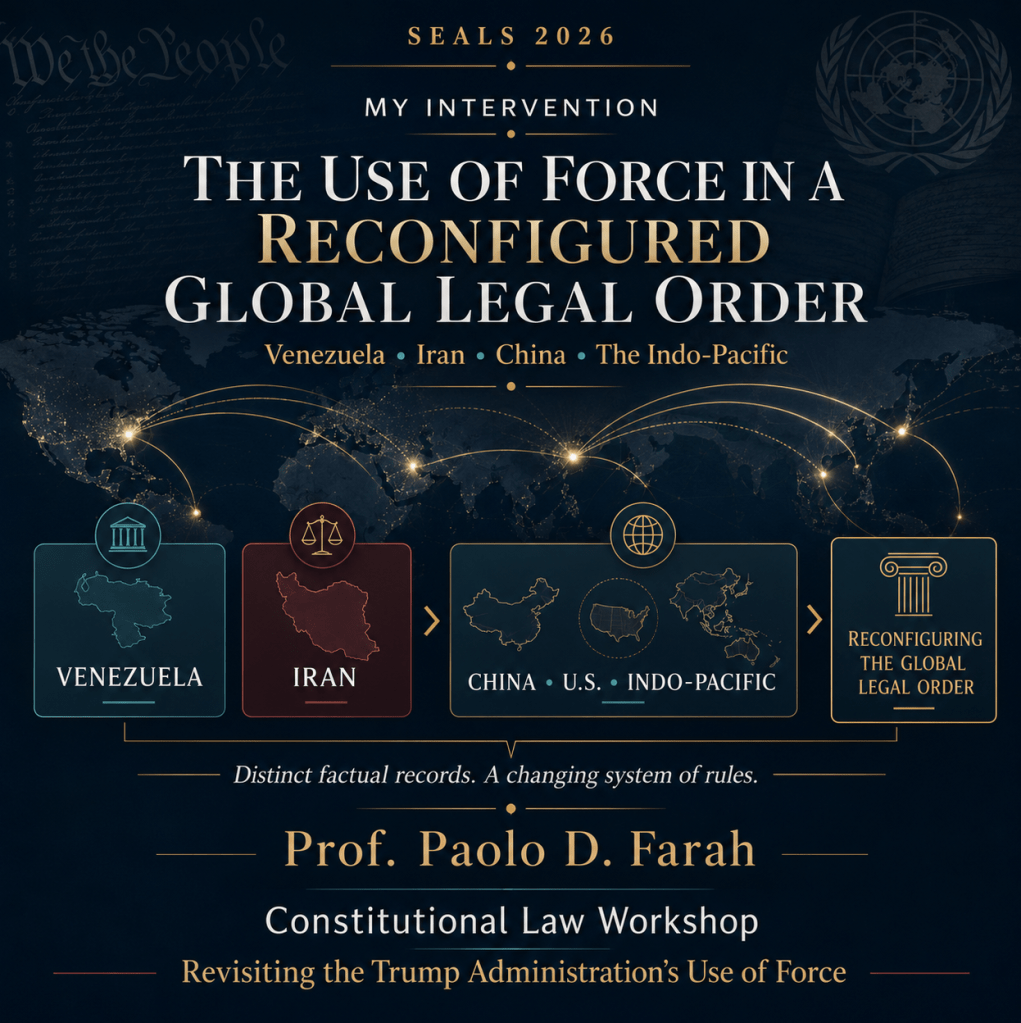
The Use of Force in a Reconfigured Global Legal Order: Venezuela, Iran, China, and the Indo-Pacific – Reflections from the 2026 SEALS Annual Conference – 2026 Southeastern Association of Law Schools (SEALS) Annual Conference
Yesterday, I had the opportunity to contribute on “The Use of Force in a Reconfigured Global Legal Order: Venezuela, Iran, China, and the Indo-Pacific“, to the Constitutional Law Workshop, “Revisiting the Trump Administration’s Use of Force: International and Constitutional Law Issues,” at the 2026 Southeastern Association of Law Schools (SEALS) Annual Conference.
The full long post is available at https://paolofarah.wordpress.com/2026/07/31/the-use-of-force-in-a-reconfigured-global-legal-order-venezuela-iran-china-and-the-indo-pacific/
Moderated by Professors Milena Sterio and Michael Kelly, the panel brought together international-law, constitutional-law, national-security-law, criminal-law, and civil-rights perspectives on recent uses of force involving Venezuela, Iran, and suspected drug traffickers in the Pacific Ocean and Caribbean Sea.
The discussion examined foundational questions: When may the United States resort to force in self-defense? How should the imminence requirement be understood? When does presidential action require congressional authorization? What remedies remain available when standing, political-question, state-secrets, and other justiciability doctrines prevent courts from reaching the merits?
In my intervention, I sought to connect these specific controversies to a larger transformation: the reconfiguration of the international legal order in an increasingly multipolar world.
The issue is not simply whether an individual military action complies with Article 2(4) or Article 51 of the United Nations Charter. We must also ask how repeated departures from established rules, and the decreasing willingness even to articulate legal justifications, affect the authority of the international legal system itself.
In that connection, I asked whether the United States’ increasingly open disregard for international law, including its declining willingness even to articulate legal justifications for its conduct, distinguishes it from other major powers. China and Russia frequently contest, reinterpret, or selectively apply international law, but they generally continue to frame their actions through the language of international legal rules and principles. This raises a deeper question: can noncompliance by great powers dissolve the international legal order, or can that order persist because small and middle powers continue to depend upon and defend a rules-based framework?
International trade offers an instructive comparison. Although the United States and China have significantly destabilized the multilateral trading system, that system has not entirely disintegrated, in part because other states continue to rely upon it. I suggested that we should consider whether the prohibition on the use of force might demonstrate a similar form of resilience. These questions become especially important when considering China’s growing global role, the U.S.-led Indo-Pacific strategy, the Belt and Road Initiative, and the competing legal, institutional, and geopolitical frameworks through which major powers are attempting to shape the emerging order. International law is not merely being violated or defended; its rules, institutions, spatial concepts, and sources of authority are being actively reconfigured.
I also emphasized that Venezuela and Iran should not automatically be placed within the same factual narrative, and I questioned whether both cases could be characterized simply as political succession rather than regime change.
In the Venezuelan case, I questioned the characterization of Maduro’s forcible removal and Delcy Rodríguez’s elevation as merely constitutional succession. Although much of the Chavista institutional apparatus remained intact, Rodríguez’s reported prior communications with U.S. interlocutors and the subsequent American leverage over Venezuelan oil revenues and policy suggested something more consequential: an externally managed reconfiguration of the regime. I argued that this could be understood as regime change without complete regime replacement—preserving much of the existing governing structure while redirecting it under a leader more willing, or more compelled, to accommodate U.S. strategic and energy interests. The chair maintained that both Venezuela and Iran represented succession rather than regime change; my intervention questioned whether that formal distinction adequately captured what occurred in Venezuela.
In Iran, by contrast, the killing of Ali Khamenei produced an externally triggered leadership succession but not the political transformation that the Trump Administration appeared to anticipate. Iran’s existing institutions selected Mojtaba Khamenei despite Trump’s public insistence that Washington should influence the choice of successor. The result preserved the Islamic Republic, strengthened its hard-line and security apparatus, and produced a leadership even less accommodating toward the United States. I therefore characterized the Iranian outcome not as a successfully managed regime change, but as evidence of the Trump Administration’s strategic incoherence and serious miscalculatation in treating leadership decapitation as though it would necessarily produce political transformation.
Our conversation also underscored a longer-term institutional consequence: even if a future administration seeks to restore multilateral cooperation, allies now know that American commitments can be reversed. Realpolitik may encourage countries to work again with a more stable United States, but confidence built over decades cannot be reconstructed immediately. That loss of trust will itself reshape alliances, defense arrangements, and international law.
Finally, I stressed the responsibility of universities and law schools. International and comparative law cannot remain curricular luxuries pursued only by a self-selecting group of students. They must be integrated throughout legal education so that future lawyers can recognize how international rules operate within constitutional law, contracts, torts, civil procedure, business law, environmental law, and other fields.
As scholars, we must also communicate beyond our specialized journals and academic circles. If legal expertise is to contribute meaningfully to democratic accountability, we must explain these developments—and their human, institutional, and geopolitical consequences—to broader public audiences.
My sincere thanks to Professor Milena Sterio and to all the panelists and colleagues whose thoughtful contributions made this such a rich and genuinely interdisciplinary conversation.
Related Series and Scholarship
The arguments developed in this contribution build upon my earlier four-part series, Monroe Doctrine, Regional Power, and the Legal Reconfiguration of Global Order. That series examined how regional power, strategic geography, networked alliances, infrastructure, trade, and fragmented legal regimes are transforming the international legal order.
The present discussion extends that analysis to the use of force. The controversies involving Venezuela and Iran cannot be understood entirely in isolation from the broader reconfiguration of global order involving the United States, China, Russia, the Indo-Pacific, and the Belt and Road Initiative.
Series Overview
4.5. Series Overview: Monroe Doctrine, Regional Power, and the Legal Reconfiguration of Global Order
January 26, 2026 https://paolofarah.wordpress.com/2026/01/26/4-5-series-overview-monroe-doctrine-regional-power-and-the-legal-reconfiguration-of-global-order/
This summary post brings together the four contributions and develops their common argument: the Monroe Doctrine has not returned as a formally articulated doctrine, but as a structure through which power, law, geography, strategic resources, and regional authority increasingly interact.
Individual Contributions
4.1. The Return of the Monroe Doctrine: Why It Matters Now (and Why Europe Should Care)
January 5, 2026 https://paolofarah.wordpress.com/2026/01/05/4-1-the-return-of-the-monroe-doctrine-why-it-matters-now-and-why-europe-should-care/
This contribution examines the re-emergence of privileged regional authority in U.S. policy toward Venezuela, Greenland, and Canada, as well as its implications for Europe, Ukraine, Taiwan, alliances, and strategic supply chains.
4.2. From the Monroe Doctrine to the Indo-Pacific: Spheres, Networks, and Transactional Power
January 10, 2026 https://paolofarah.wordpress.com/2026/01/10/4-2-from-the-monroe-doctrine-to-the-indo-pacific-spheres-networks-and-transactional-power/
This post compares the networked regionalism of the U.S.-led Indo-Pacific strategy with China’s Belt and Road Initiative. It explores how alliances, standards, infrastructure, financing, interoperability, and supply chains generate competing legal and institutional geographies.
4.3. Legal Geography and the Reconfiguration of Global Order
January 17, 2026 https://paolofarah.wordpress.com/2026/01/17/4-3-legal-geography-and-the-reconfiguration-of-global-order/
This contribution reframes contemporary geopolitics as a transformation in legal geography: the ways law organizes territory, connectivity, access, exclusion, dependence, and regional authority.
4.4. Legal Fragmentation and the Future of Global Governance
January 18, 2026 https://paolofarah.wordpress.com/2026/01/18/4-4-legal-fragmentation-and-the-future-of-global-governance/
This post argues that legal fragmentation is increasingly not an unintended consequence but a strategy. International law is becoming a plural legal ecology characterized by overlapping regimes, conditional commitments, competing sources of legitimacy, and instrumental uses of legal rules.
Related Analysis on Venezuela and International Criminal Law
5.1. When International Criminal Law Is Not Invoked: Reflections on Maduro, Jurisdiction, and a Path Not Taken
January 13, 2026 https://paolofarah.wordpress.com/2026/01/13/when-international-criminal-law-is-not-invoked-reflections-on-maduro-jurisdiction-and-a-path-not-taken/
This related contribution examines the Maduro case from the perspective of international criminal law. It considers the significance of the United States’ decision to ground its action exclusively in domestic narcotics and weapons charges rather than in allegations of crimes against humanity, despite extensive international documentation of killings, torture, arbitrary detention, and forced displacement in Venezuela.
The post explores the limitations of the Nikolić precedent and the Ker–Frisbie doctrine, the absence of a general U.S. federal statute criminalizing crimes against humanity, and the United States’ broader resistance to international criminal jurisdiction. It argues that the choice not to invoke international criminal law ensured that the operation would be assessed primarily as a domestic prosecution accompanied by an unlawful use of force, rather than—even arguably—as an exceptional form of international criminal-law enforcement.
The analysis does not suggest that unilateral enforcement of international crimes would necessarily have been lawful or legitimate. Rather, it highlights the enduring gap between international criminal law’s normative ambitions and its available enforcement mechanisms: persistent failures to provide accountability leave victims unprotected while creating incentives for extra-legal responses that further weaken the international legal order.
Related Research
The series and the present contribution draw upon and extend my broader scholarship on China, international economic law, legal pluralism, regional governance, international institutions, and the changing relationship among law, power, and geography.
Books
China’s Influence on Non-Trade Concerns in International Economic Law
Routledge https://papers.ssrn.com/sol3/papers.cfm?abstract_id=2876883
Peer-Reviewed and Law-Journal Articles
China’s Belt and Road Initiative and Its Impact on the Energy Independence of the European Union
Asian Journal of Law and Society, Cambridge University Press, 2025 https://papers.ssrn.com/sol3/papers.cfm?abstract_id=5215879
China’s Path to Modernization and Legal Pluralism: Transplants and the Belt and Road Initiative
Asian Journal of Law and Society, Cambridge University Press, 2025 https://papers.ssrn.com/sol3/papers.cfm?abstract_id=5215873
Trade and Progress: The Case of China
Columbia Journal of Asian Law https://papers.ssrn.com/sol3/papers.cfm?abstract_id=3020365
The Influence of Confucianism in the Construction of the Chinese Juridical and Political System https://papers.ssrn.com/sol3/papers.cfm?abstract_id=1288392
Five Years of China’s WTO Membership: EU and U.S. Perspectives on China’s Compliance with Transparency Commitments and the Transitional Review Mechanism https://papers.ssrn.com/sol3/papers.cfm?abstract_id=916768
Additional Scholarship and Working Papers
Selected publications on China, global governance, international economic law, international institutions, and legal pluralism are available through my SSRN author page: https://papers.ssrn.com/sol3/cf_dev/AbsByAuth.cfm?per_id=629289
How This Research Connects to the Present Contribution
Taken together, these writings provide the conceptual foundation for understanding contemporary uses of force as part of a broader transformation of the international legal order. The interventions involving Venezuela and Iran raise immediate questions concerning self-defense, sovereignty, congressional authorization, presidential power, leadership succession, and regime change. The Maduro case also exposes the relationship between the law governing the use of force and international criminal law: which crimes are invoked, which jurisdictional pathways are available, and how the choice of legal framework shapes the legitimacy and external assessment of an intervention.
The Monroe Doctrine, the U.S.-led Indo-Pacific strategy, China’s Belt and Road Initiative, great-power competition, and recent uses of military force should therefore not be treated as isolated developments. They are interconnected expressions of a movement away from a presumptively universal legal order and toward regionalized and strategically differentiated legal spaces.
International law has not disappeared. It is being contested and reconfigured through power, geography, alliances, infrastructure, trade, strategic resources, and competing institutional frameworks. The continuing reliance of small and middle powers on multilateral rules may nevertheless provide an important source of legal resilience—even when the most powerful states destabilize the system.
The full summary of the earlier series is available here: https://paolofarah.wordpress.com/2026/01/26/4-5-series-overview-monroe-doctrine-regional-power-and-the-legal-reconfiguration-of-global-order/
#SEALS2026 #InternationalLaw #ConstitutionalLaw #UseOfForce #NationalSecurityLaw #UnitedNations #Venezuela #Iran #China #IndoPacific #GlobalGovernance #Multipolarity #LegalEducation