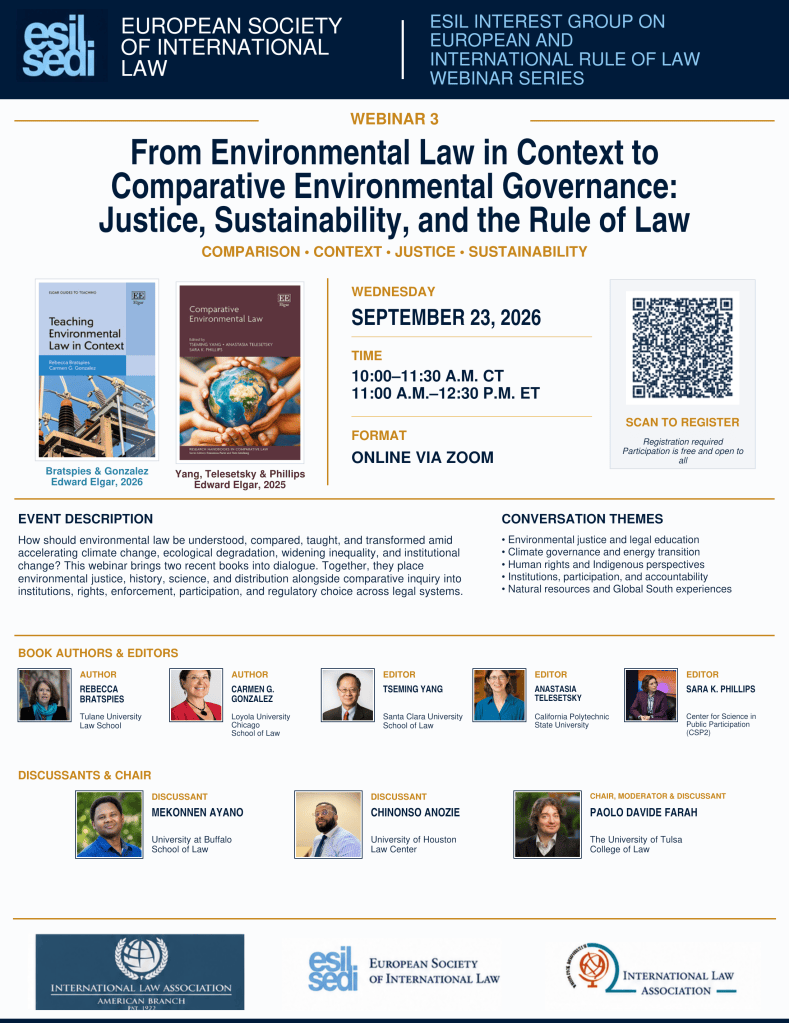
Wednesday, September 23, 2026
European Society of International Law (ESIL) Interest Group on European and International Rule of Law Webinar Series – Webinar 3 – From Environmental Law in Context to Comparative Environmental Governance: Justice, Sustainability, and the Rule of Law
The European Society of International Law (ESIL) Interest Group on EU and International Rule of Law is pleased to announce the next event in its Webinar Series:
Webinar 3 – From Environmental Law in Context to Comparative Environmental Governance: Justice, Sustainability, and the Rule of Law
Wednesday, September 23, 2026 — 10:00–11:30 a.m. Central Time
11:00 a.m.–12:30 p.m. Eastern Time
Online
Participation is free and open to all, but advance registration is required.
Register
More information, including the detailed event description, speakers’ biographies, and a selected bibliography, is available here https://paolofarah.wordpress.com/2026/09/05/european-society-of-international-law-esil-interest-group-on-european-and-international-rule-of-law-webinar-series-webinar-3-from-environmental-law-in-context-to-comparative-environme
Less than one week remains before the third webinar of the European Society of International Law (ESIL) Interest Group on European and International Rule of Law Webinar Series:
From Environmental Law in Context to Comparative Environmental Governance: Justice, Sustainability, and the Rule of Law
The Webinar Series, which I conceived and chair in my capacity as Chair of the ESIL Interest Group on European and International Rule of Law, is designed to place recent books and scholarship into direct dialogue around broader questions of international law, comparative law, global governance, and the rule of law.
For this third conversation, the point of departure is a simple question:
What becomes visible when environmental law is examined simultaneously through context and comparison?
The webinar brings into dialogue two important recent books that approach this question from different but complementary directions:
Rebecca Bratspies and Carmen G. Gonzalez, Teaching Environmental Law in Context (Edward Elgar, 2026)
and
Tseming Yang, Anastasia Telesetsky, and Sara K. Phillips, eds., Comparative Environmental Law (Edward Elgar, 2025).
The first challenges us to resist treating environmental law as an autonomous collection of statutes, doctrines, and technical regulatory rules. Environmental law operates within histories of inequality, political economy, scientific uncertainty, institutional power, and unequal distributions of environmental harms and benefits. Understanding those contexts changes not only how environmental law is taught, but also how its legitimacy and effectiveness are evaluated.
The second expands the inquiry across jurisdictions, institutions, and legal traditions. Comparative environmental law makes it possible to examine patterns of convergence and divergence while asking why apparently similar environmental problems produce different legal responses—and why formally similar regulatory models may generate very different results when transplanted into different institutional, economic, social, and political settings.
Bringing the two perspectives together permits us to move beyond a conventional book discussion.
It allows us to ask how context changes comparison—and how comparison can reveal contexts that domestic legal analysis may otherwise leave invisible.
Participants
Rebecca Bratspies and Carmen G. Gonzalez will discuss the conceptual, pedagogical, historical, and environmental-justice dimensions of Teaching Environmental Law in Context.
Tseming Yang and Sara K. Phillips will engage the comparative project developed in Comparative Environmental Law, edited by Yang, Anastasia Telesetsky, and Phillips, including questions of comparative methodology, institutional variation, convergence and divergence, and regulatory learning across legal systems.
I am also delighted that the conversation will include two invited discussants whose scholarship brings additional dimensions to the dialogue:
Mekonnen Ayano, University at Buffalo School of Law, will contribute perspectives concerning land, property, development, institutional reform, and the complexity of environmental governance.
Chinonso Tansi Anozie, University of Houston Law Center, will engage questions of energy transition, environmental justice, disadvantaged communities, development, and the wider distributive consequences of environmental policy.
I will serve as Chair, Moderator, and Discussant. My own contribution will seek to connect the two books to questions of international and transnational environmental law, climate and energy governance, scientific and epistemic authority, Indigenous peoples and Indigenous knowledge, Global South perspectives, sustainability, institutional accountability, and the international rule of law.
From Environmental Regulation to Environmental Governance
One of the central premises of the conversation is that contemporary environmental problems cannot be understood solely by asking whether a particular jurisdiction has adopted a particular statute, institution, or regulatory instrument.
We must also ask:
Who identifies the problem?
Whose knowledge is recognized as authoritative?
Who participates in decision-making—and whose participation actually affects outcomes?
How are environmental harms, transition costs, economic benefits, and regulatory responsibilities distributed?
Which differences among jurisdictions reflect legitimate legal and institutional pluralism, and which reflect inequality, limited capacity, exclusion, or regulatory failure?
These questions become particularly important as environmental governance confronts climate change, energy transition, environmental justice, human rights, Indigenous sovereignty and knowledge, rights of nature, scientific uncertainty, technological transformation, and widening inequalities within and among states.
They are also rule-of-law questions.
Environmental institutions must be capable of responding to rapidly changing ecological conditions, but effectiveness alone cannot supply legitimacy. Legal systems must also confront questions of accountability, participation, transparency, expertise, distribution, and the ability of affected communities to understand and contest the decisions that shape their environments and livelihoods.
At the center of the webinar is therefore a broader inquiry:
How can environmental legal systems remain legitimate, accountable, inclusive, and capable of responding to rapidly changing ecological and social conditions while addressing the unequal distribution of environmental harms, benefits, knowledge, expertise, and decision-making power?
I look forward to exploring these questions with Rebecca Bratspies, Carmen G. Gonzalez, Tseming Yang, Sara K. Phillips, Mekonnen Ayano, and Chinonso Tansi Anozie next week.
Event Information
Wednesday, September 23, 2026
10:00–11:30 a.m. Central Time
11:00 a.m.–12:30 p.m. Eastern Time
Online
Participation is free and open to all, but advance registration is required.
Registration:
Full event description, participants’ biographies, and selected bibliography:
ESIL Webinar 3 – From Environmental Law in Context to Comparative Environmental Governance
The event is organized as part of the ESIL Interest Group on European and International Rule of Law Webinar Series and is co-sponsored by the American Branch of the International Law Association Committee on International Law, China, and the Reconfiguration of the Global Order and the International Law Association Study Group on International Law, Global Challenges, and the Impact of Emerging Powers on Global Governance.
Participation is free and open to all. Registration is required.
More information, including the detailed event description, speakers’ biographies, and a selected bibliography, is available here https://paolofarah.wordpress.com/2026/09/05/european-society-of-international-law-esil-interest-group-on-european-and-international-rule-of-law-webinar-series-webinar-3-from-environmental-law-in-context-to-comparative-environme
Professor Paolo Davide Farah, PhD
University of Tulsa College of Law
3120 East Fourth Place
Tulsa, OK 74104
https://paolofarah.com/
https://paolofarah.wordpress.com/
https://papers.ssrn.com/sol3/cf_dev/AbsByAuth.cfm?per_id=629289
Selected Bibliography
Books in Dialogue
Rebecca Bratspies and Carmen G. Gonzalez, Teaching Environmental Law in Context (Edward Elgar, 2025) – provides tools, guidance, and historical context for teaching environmental law in a time of turmoil, including resources to seamlessly integrate racial and economic justice into every topic. https://www.e-elgar.com/shop/usd/teaching-environmental-law-in-context-9781035333899.html
Tseming Yang, Anastasia Telesetsky, and Sara K. Phillips, eds., Comparative Environmental Law (Edward Elgar, 2025)
Other Suggested Materials
Blog symposium on Teaching Environmental Law in Context:
https://progressivereform.org/cpr-blog/?cat=914
#RaceClass podcast on Teaching Environmental Law in Context:
Gonzalez and Bratspies on The Unbearable Whiteness of Environmental Law – Center for Progressive Reform (2023), https://progressivereform.org/cpr-blog/the-unbearable-whiteness-of-environmental-law/
Book authors and editors
Related Scholarship by Carmen G. Gonzalez
Climate Migration and Reparations: Reflections on the ICJ Advisory Opinion on Climate Change, Pace Environmental Law Review (forthcoming)
The Color of Carbon: Racial Capitalism, Climate Change, and Law (with Sumudu Atapattu), 5 Journal of Law and Political Economy 635 (2025), available at: https://papers.ssrn.com/sol3/papers.cfm?abstract_id=5976814
Racial Capitalism, Climate Change, and Ecocide, 41 Wisconsin International Law Journal 479 (2024), available at: https://papers.ssrn.com/sol3/papers.cfm?abstract_id=4835218
The Right to a Healthy Environment and the Global South, 117 AJIL Unbound 173 (2023), available at: https://papers.ssrn.com/sol3/papers.cfm?abstract_id=4527384
Mapping Racial Capitalism: Implications for Law (with Athena D. Mutua), 2 Journal of Law and Political Economy 127 (2022), available at: https://papers.ssrn.com/sol3/papers.cfm?abstract_id=4576365
The Sacrifice Zones of Carbon Capitalism: Race, Expendability, and Loss and Damage, in Research Handbook on Climate Change Law and Loss and Damage (Edward Elgar, 2021, Meinhard Doelle and Sara L. Seck, eds.), available at: https://papers.ssrn.com/sol3/papers.cfm?abstract_id=3838069
The Cambridge Handbook of Environmental Justice and Sustainable Development (Cambridge University Press, 2021, Sumudu Atapattu, Carmen G. Gonzalez, and Sara L. Seck, eds).
Racial Capitalism, Climate Justice, and Climate Displacement, 11 Oñati Socio-Legal Series 108 (2021), available at https://papers.ssrn.com/sol3/papers.cfm?abstract_id=3626490
Migration as Reparation: Climate Change and the Disruption of Borders, 66 Loyola Law Review 402 (2020), available at https://papers.ssrn.com/sol3/papers.cfm?abstract_id=3727725
Energy Justice: US and International Perspectives (Edward Elgar, 2018, Raya Salter, Carmen G. Gonzalez, and Elizabeth Kronk Warner, eds.)
Environmental Racism, American Exceptionalism, and Cold War Human Rights, 26 Transnat’l L. & Contemp. Problems 281 (2017), available at https://papers.ssrn.com/sol3/papers.cfm?abstract_id=2992269
Carmen’s SSRN Author Page: https://papers.ssrn.com/sol3/cf_dev/AbsByAuth.cfm?per_id=476828
Related Scholarship by Rebecca M. Bratspies
SSRN author page | Official Tulane profile
- With Carmen G. Gonzalez, Teaching Environmental Law in Context (Edward Elgar Publishing, 2026).
- With Carmen G. Gonzalez, “The Unbearable Whiteness of Environmental Law” (Center for Progressive Reform Symposium, 2023).
- “Access to Environmental Information under International Law,” in Tseming Yang, Anastasia Telesetsky and Sara K. Phillips, eds., Comparative Environmental Law (Edward Elgar Publishing, 2025).
- “‘Underburdened’ Communities,” 110 California Law Review 1933–1989 (2022).
- “Do I Really Have the Right to Breathe Clean Air?” (2025).
- “Climate Justice Begins at Home,” 37 New York International Law Review 13 (2024).
- “The Human Rights Fulcrum: Using Environmental Rights as Leverage for Change,” 38 Pace International Law Review 229 (2026).
Related Scholarship by Tseming Yang
SSRN author page | Official Santa Clara profile | Complete scholarship list
- With Anastasia Telesetsky and Sara K. Phillips, eds., Comparative Environmental Law (Edward Elgar Publishing, 2025).
- With Anastasia Telesetsky and Sara K. Phillips, “Introduction to Comparative Environmental Law,” in Comparative Environmental Law (2025).
- “A Comparative Environmental Law Primer,” in Comparative Environmental Law (2025).
- “Old and New Environmental Racism,” 2024 Utah Law Review No. 1 (2024).
- “The Emergence of the Environmental Impact Assessment Duty as a Global Legal Norm and General Principle of Law,” 70 Hastings Law Journal 525–572 (2019).
- “The Emergence of Global Environmental Law,” 36 Ecology Law Quarterly 615–664 (2009).
- “Melding Civil Rights and Environmentalism: Finding Environmental Justice’s Place in Environmental Regulation,” 26 Harvard Environmental Law Review 1–107 (2002).
- “International Treaty Enforcement as a Public Good: Institutional Deterrent Sanctions in International Environmental Agreements,” 27 Michigan Journal of International Law 1131–1184 (2006).
Related Scholarship by Anastasia Telesetsky
SSRN author page | Official Cal Poly profile and publications
- With Tseming Yang and Sara K. Phillips, eds., Comparative Environmental Law (Edward Elgar Publishing, 2025).
- With Tseming Yang and Sara K. Phillips, “Introduction to Comparative Environmental Law,” in Comparative Environmental Law (2025).
- “Rights of Nature: Time for a Next Generation Normative Paradigm Shift?,” in Comparative Environmental Law (2025).
- With Tseming Yang, Lin Harmon-Walker and Robert V. Percival, Comparative and Global Environmental Law and Policy (Wolters Kluwer, 2019).
- Ecological Restoration in International Environmental Law (Routledge, 2017).
- “Legal Pluralism—Linking Law and Culture in Natural Resource Co-Management and Environmental Compliance,” in James A.R. Nafziger, ed., Comparative Law and Anthropology (Edward Elgar Publishing, 2017).
- “Fulfilling the Human Right to Food and a Healthy Environment: Is It Time for an Agroecological and Aquaecological Revolution?,” 40 Vermont Law Review 791–812 (2016).
- “Ecoscapes: The Future of Ecological Restoration Law,” 14 Vermont Journal of Environmental Law 493–548 (2013).
- “Beyond Voluntary Corporate Social Responsibility: Corporate Human Rights Obligations to Prevent Disasters and to Provide Temporary Emergency Relief,” 48 Vanderbilt Journal of Transnational Law 1003 (2015).
Related Scholarship by Sara K. Phillips
SSRN author page | SEI publication profile | Google Scholar
- With Tseming Yang and Anastasia Telesetsky, eds., Comparative Environmental Law (Edward Elgar Publishing, 2025).
- With Tseming Yang and Anastasia Telesetsky, “Introduction to Comparative Environmental Law,” in Comparative Environmental Law (2025).
- “Mining Law and Governance: Structures and Challenges,” in Comparative Environmental Law, pp. 389–415 (2025).
- “The Legal Construct of Mining Conflicts,” 109 Resources Policy, article 105706 (2025).
- “Strategic Engagement and Legal Pluralism: Navigating Knowledge and Expertise in Mining Disputes,” 56(1) Chulalongkorn University Journal of Social Sciences 177–196 (2026).
- Rights-Based Claims and Extractive Industries in Asia: An Assessment and Ways Forward (Stockholm Environment Institute Working Paper, 2020).
- “Building Business, Human Rights and Climate Change Synergies in Southeast Asia: What the Philippines’ National Inquiry on Climate Change Could Mean for ASEAN,” 13(1) Journal of Human Rights and the Environment 238–264 (2022).
Discussants
Related Scholarship by Mekonnen Firew Ayano
SSRN author page | Official University at Buffalo profile | Google Scholar
- “Understanding the Local Complexities in Land Law Reforms: The Case of Land Inalienability in Ethiopia, 1991–2018,” 49 Law & Social Inquiry 2398–2438 (2024).
- “Law and Land Conflict in Emerging Market Economies: Ethiopia, 2014–2018,” 18 International Journal of Constitutional Law 988–1012 (2020).
- “Rural Land Registration in Ethiopia: Myths and Realities,” 52 Law & Society Review 1060–1097 (2018).
- “Decolonizing Legal Influence: China’s Role in the Changing Landscape of the Ethiopian Legal Profession, 2000–2018,” 13 Notre Dame Journal of International & Comparative Law 1 (2023).
- “Tenants Without Rights: Immigrants’ Experiences in the U.S. Low-Income Housing Market,” 28 Georgetown Journal on Poverty Law & Policy 159–200 (2021).
Related Scholarship by Chinonso Tansi Anozie
SSRN author page | Official University of Houston profile | Google Scholar
- “Left Behind: Funding Climate Action in the Global South,” 11 Texas A&M Law Review 333–363 (2024).
- “Equalizing Remediation,” 2023 Wisconsin Law Review 919 (2023).
- “Energy Sanctions Hegemony” (SSRN working paper, 2026).
- “United States,” in Oil Wealth and Federal Conflict in American Petrofederations (Elsevier, 2022).
- “Ownership of Natural Resources Beneath the Surface: An Appraisal of the American and Nigerian System” (2017).
- “Parallel Application of Monopoly and Competition in Nigeria’s Energy Sector: A Malediction to Energy and Economic Development” (2017).
Chair, moderator, and discussant
Related Scholarship by Paolo Davide Farah
SSRN author page | Official University of Tulsa profile | Google Scholar | Publication profile
- “Epistemic Governance” (SSRN working paper, posted and revised in 2026).
- Globalization, Environmental Law and Sustainable Development in the Global South: Challenges for Implementation (Routledge, 2021; open access).
- “Indicator Species and the Future of Environmental Law,” in Globalization, Environmental Law and Sustainable Development in the Global South: Challenges for Implementation, pp. 305–313 (Routledge, 2021).
- “Urgenda vs. Juliana: Lessons for Future Climate Change Litigation Cases,” 84(3) University of Pittsburgh Law Review 547–584 (2023). Also available on SSRN.
- “Climate Justice in the Anthropocene and Its Relationship with Science and Technology: The Importance of Ethics of Responsibility,” 55 Connecticut Law Review 819–860 (2023).
- “Energy Justice, Just Transition and International Environmental Law,” in “Just Energy Transition: Legal Challenges Associated with Coal Phase Out,” 117 Proceedings of the American Society of International Law Annual Meeting 255–267 (2023; Cambridge University Press, 2024).
- “Water-Energy-Food Nexus in International Law: A Legal Analysis,” in Floor Brouwer, ed., Handbook on the Water-Energy-Food Nexus, pp. 381–397 (Edward Elgar Publishing, 2022).
- “When John Locke Meets Lao Tzu: The Relationship Between Intellectual Property, Biodiversity, and Indigenous Knowledge and the Implications for Food Security,” 33 Duke Environmental Law & Policy Forum 77–112 (2024).
- “The Anthropocene and Climate Change in the Post-Paris Agreement Debate,” in Anu Valtonen, Outi Rantala, and Paolo Davide Farah, eds., Ethics and Politics of Space for the Anthropocene, pp. 197–210 (Edward Elgar Publishing, 2020).
- “China’s Water Environmental Management Towards Institutional Integration: A Review of Current Progress and Constraints vis-à-vis the European Experience,” 113 Journal of Cleaner Production 285–298 (2016).
- “China’s Energy Policies and Strategies for Climate Change and Energy Security,” 13 Journal of World Energy Law & Business 141–156 (2020).
- “A Comparison Between Shale Gas in China and Unconventional Fuel Development in the United States: Water, Environmental Protection, and Sustainable Development,” 41 Brooklyn Journal of International Law 579–654 (2016).
- “The Principle of Common But Differentiated Responsibilities in the International Regime of Climate Change,” in Paolo Davide Farah and Elena Cima, eds., China’s Influence on Non-Trade Concerns in International Economic Law, pp. 146–157 (Routledge, 2016).