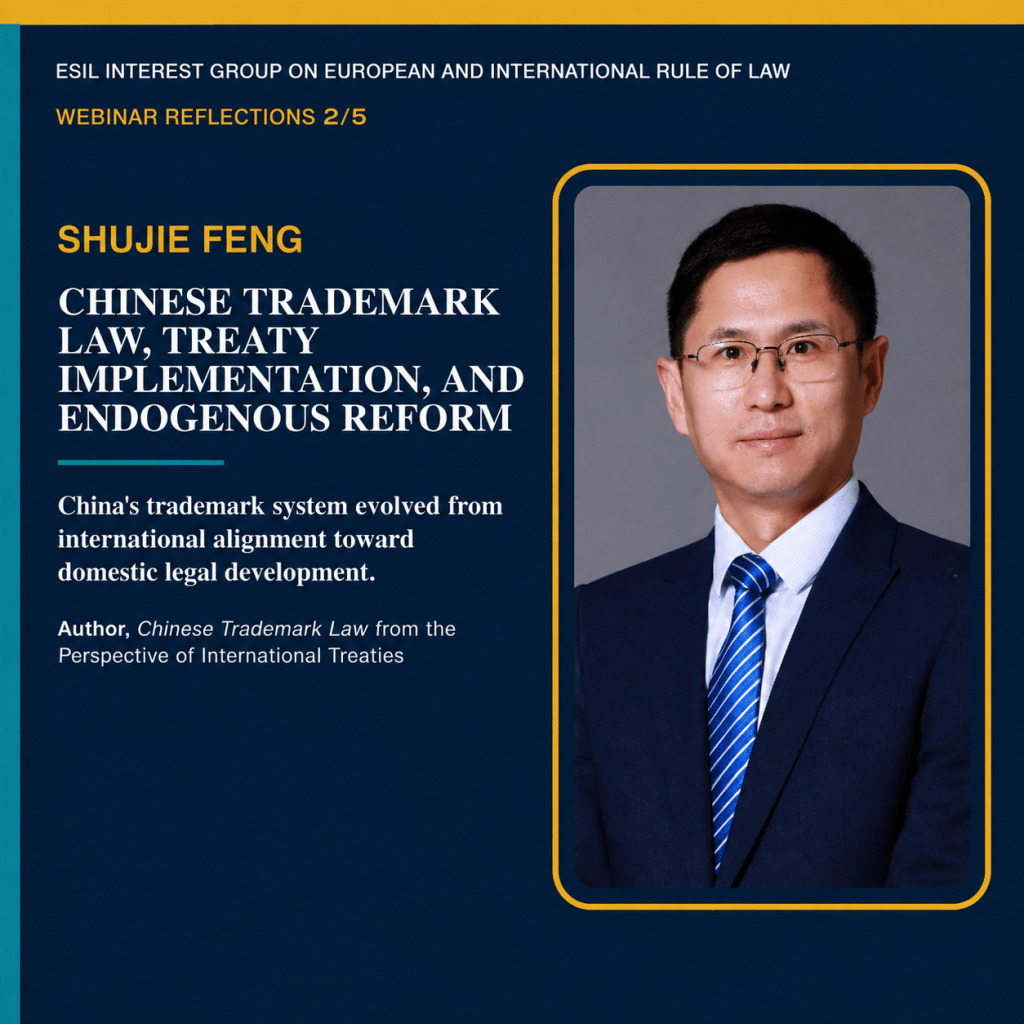

Shujie Feng: Chinese Trademark Law, Treaty Implementation, and Endogenous Legal Development – Reflections on the 2nd Webinar – ESIL Interest Group on European and International Rule of Law Webinar Series · Webinar 2 · Reflection 2/5
When does the implementation of international legal commitments cease to be primarily an exercise in external alignment and become endogenous domestic legal development?
That question became one of the central threads of our second Webinar, From Trademark Law to Public Health Governance: Intellectual Property, International Treaties, and the Rule of Law in a Changing Global Order, and provided an important point of entry into Professor Shujie Feng’s work.
Before turning to the moderated conversation, Professor Feng independently introduced the central argument of Chinese Trademark Law from the Perspective of International Treaties. We also highlighted its French-language edition, Le Droit Chinois des Marques au Regard des Traités Internationaux. The two editions reflect the same underlying monograph, but their circulation across different linguistic and scholarly communities itself illustrates an important dimension of comparative and international law: legal knowledge also travels through languages, institutions, and intellectual traditions.
Professor Feng presented the evolution of modern Chinese trademark law through two connected motivations. The first was alignment with international rules as China opened its economy and integrated into global trade and investment. The second, increasingly important over time, was the domestic need for an effective intellectual-property system capable of supporting a market economy, protecting legitimate businesses, regulating competition, and responding to new forms of abuse.
The early phase involved the importation and implementation of a modern trademark system. Chinese legislation developed alongside accession to international agreements, external negotiations, and preparation for WTO membership. The 2001 reform brought the system into conformity with TRIPS. At that stage, international commitments and comparative models played a particularly visible role.
But the Webinar was designed not simply as a sequence of book presentations. In the discussion framework circulated to the speakers before the event, I proposed a broader institutional question: international intellectual-property law is not a self-executing code. Treaties acquire practical meaning through domestic legislatures, administrative agencies, courts, international organizations, firms, platforms, enforcement authorities, public-interest institutions, and affected communities.
That framing allowed Professor Feng’s historical account to become part of a larger conversation about legal transplantation, institutional adaptation, regulatory autonomy, evidence, expertise, enforcement, and the international rule of law.
One of my first questions to Professor Feng therefore returned directly to the two motivations identified in his book: At what point does treaty implementation become endogenous legal development rather than external compliance? And does the evolution from the WTO-driven 2001 reform toward the 2013 and 2019 reforms suggest that China moved from primarily receiving international norms toward adapting—and potentially shaping—them?
His response sharpened the distinction between two periods.
After WTO accession, rapid economic growth changed the reasons for reform. Chinese and foreign companies increasingly encountered bad-faith applications, trademark squatting, counterfeiting, enforcement difficulties, and strategic uses of the registration system. The 2013 and 2019 reforms therefore responded increasingly to problems generated within China’s own market and legal order. International norms remained important, but internal regulatory needs had become independent engines of legal change.
Professor Feng’s example of trademark squatting made this transition particularly concrete. The Paris Convention addresses certain abusive filings by an agent or representative. Chinese practice, however, revealed comparable conduct by parties possessing commercial relationships or contacts without falling neatly within those categories. The 2013 legislation extended the rule to cover a broader range of relationships.
This was significant for our discussion because it illustrated something more complex than legal transplantation. An international norm supplied a baseline, but domestic experience exposed a gap. Legislators, administrators, courts, and practitioners then had to identify the relevant conduct, evaluate evidence, allocate legal responsibility, and formulate a response appropriate to circumstances that the international rule did not fully capture.
The direction of legal influence can therefore begin to reverse. A state may first receive international norms and later generate practices or doctrines capable of informing comparative experience and perhaps future international rule-making.
That point also connected to another question built into the Webinar framework: how should international law distinguish useful harmonization from excessive uniformity?
Professor Feng challenged the assumption that more international rules are necessarily better. Harmonization can create predictability, facilitate transactions, and support cooperation. But the absence of international agreement may sometimes reflect genuine differences in economic conditions, institutional structures, political choices, or developmental interests that should not simply be eliminated.
TRIPS made an extraordinary contribution to the development of common international IP standards, but it also reduced national regulatory flexibility. Moreover, intellectual-property commitments were negotiated within a broader trade package involving sectors such as agriculture and textiles, meaning that the benefits and burdens of the overall bargain were not necessarily distributed equally among countries.
This observation created an important bridge between Professor Feng’s work and Srividhya Ragavan and Swaraj Paul Barooah’s Fractures in IP, Trade, and Health: Centering a Public Health Framework. The purpose of placing the books in conversation was never to suggest that trademark law and pharmaceutical patent law are doctrinally equivalent. Rather, both works raise a common institutional problem: what happens when formally harmonized international rules operate across legal systems with profoundly different economic, technological, administrative, developmental, and public-health realities?
China was able to combine the introduction of an IP system with rapid economic growth, foreign investment, technology transfer, and expanding domestic innovation. Professor Feng cautioned that many less-developed countries have accepted comparable international commitments without experiencing comparable developmental benefits. His intervention therefore connected treaty implementation to questions of distribution, development, policy space, and equity that ran throughout the conversation.
I also sought to frame these issues through administrative law, evidence law, comparative law, epistemic governance, and the rule of law. Trademark rules do not become operational simply because legislation reproduces an international standard. Administrative offices determine registrability; courts review administrative decisions and interpret legislation; parties must establish consumer perception and bad faith through evidence; customs and criminal authorities participate in enforcement; and e-commerce platforms increasingly exercise forms of private regulatory authority.
The deeper question is therefore not only what the rule says, but which institution interprets it, what evidence enters the record, whose expertise becomes authoritative, what burdens of proof apply, what remedies are available, and how decisions can be reviewed and justified.
From that perspective, formal similarity among national rules does not guarantee functional equivalence among legal systems.
Professor Feng’s intervention also helped us examine the changing place of China and other emerging powers in international legal ordering. The relevant question is no longer only whether such states successfully implement rules developed elsewhere. It is increasingly whether domestic experimentation, jurisprudence, administrative practice, and institutional innovation can themselves contribute to comparative learning and eventually influence international norm-setting.
Professor Feng concluded by calling for continued work in international forums toward a better balance between developed and developing countries, including in relation to public health.
His contribution therefore illuminated a much larger transformation: treaty implementation can begin as international alignment, become domestic institutional learning, and ultimately generate legal practices capable of travelling outward again.
That movement—from reception, to adaptation, to potential contribution—may be one of the most important ways of understanding the relationship between international law, Chinese legal development, emerging powers, and an evolving international rule of law.
Because readers may not have seen those earlier posts, the principal bibliography is reproduced below.
Selected Bibliography – 2nd Webinar
Books in Dialogue
Shujie Feng, Chinese Trademark Law from the Perspective of International Treaties (Springer Nature, 2026);
Shujie Feng, Le Droit Chinois des Marques au Regard des Traités Internationaux (Éditions Pedone, 2024); and
Srividhya Ragavan and Swaraj Paul Barooah, Fractures in IP, Trade, and Health: Centering a Public Health Framework (Oxford University Press, 2025).
Related Scholarship by Shujie Feng
- Shujie FENG, The Copyrightability of AI- Generated Content: A Doctrinal Exploration of the Pioneering Chinese Judicial Practice , Computer Law & Security Review , Vol. 59 , 2025.
- Shujie FENG, Geographical Indications: Can China Reconcile the Irreconcilable Intellectual Property Issue Between E.U. and U.S.? World Trade Review , May 2019. 13.
- Shujie FENG, La mise en œuvre du droit de l’OMC en matière de propriété intellectuelle en Chine —- Etude sur le droit chinois des brevets avec une perspective française- européenne (en Français ) , Edition s A. Pédone, 2019.
- ILA 2023 Paris Conference White Paper on Intellectual Property
Related Scholarship by Srividhya Ragavan
Selected Bibliography
Books
- Intellectual Property Law and Access to Medicine: TRIPS Agreement, Health, and Pharmaceuticals, Amaka Vanni ed., Routledge Press, 2021.Chapter of particular relevance:
“World Trade Organization: A Barrier to Global Public Health?”https://www.taylorfrancis.com/chapters/edit/10.4324/9781003176602-3/world-trade-organization-srividhya-ragavanBook DOI:
https://doi.org/10.4324/9781003176602 - Book Chapter
- “To Sow or Not to Sow: Dilemmas from Creating New Food Rights,” in Agricultural Biotechnology and Intellectual Property: Seeds of Change, Jay P. Kesan ed., CABI Publishers, 2007.https://www.cabidigitallibrary.org/doi/10.1079/9781845932015.0320
Law Review Articles
- “New Paradigms for Protection of Biodiversity.”https://papers.ssrn.com/sol3/Delivery.cfm?abstractid=1742721
- “The Dispute Settlement Process of the WTO: A Normative Structure to Achieve Utilitarian Objectives.”https://scholarship.law.tamu.edu/cgi/viewcontent.cgi?article=1540&context=facscholar
- “Make America Healthy: Reducing High Pharmaceutical Prices Without Reducing Innovation,” 77 SMU Law Review 787 (2024).https://doi.org/10.25172/smulr.77.4.5
- “The Dispute Settlement Process of the WTO: A Normative Structure to Achieve Utilitarian Objectives,” with Brian Manning, 79 UMKC Law Review 1 (2010).
- “Correlative Obligation in Patent Law: The Role of Public Good in Defining the Limits of Patent Exclusivity,” 6 NYU Journal of Intellectual Property and Entertainment Law 6 (2016).
Related Scholarship by Paolo Davide Farah
Selected Bibliography
Books
- Artificial Intelligence, Governance and Sustainable Development: Peace, Justice and Strong Institutions, co-edited with Imad Antoine Ibrahim and Jon Truby, Routledge, 2026.https://www.routledge.com/Artificial-Intelligence-Governance-and-Sustainable-Development-Peace-Justice-and-Strong-Institutions/Ibrahim-Truby-Farah/p/book/9781032524047
- Science, Technology, Policy and International Law, co-edited with Justo Corti Varela, Routledge, 2024.https://www.routledge.com/Science-Technology-Policy-and-International-Law/Varela-Farah/p/book/9781032751139
- China’s Influence on Non-Trade Concerns in International Economic Law: Trade, Investment and Beyond, co-edited with Elena Cima, Routledge, 2016.https://www.routledge.com/Chinas-Influence-on-Non-Trade-Concerns-in-International-Economic-Law/Farah-Cima/p/book/9780367439897
- Globalization, Environmental Law, and Sustainable Development in the Global South: Challenges for Implementation, co-edited with Kirk W. Junker, Routledge, 2021.https://www.routledge.com/Globalization-Environmental-Law-and-Sustainable-Development-in-the-Global-South-Challenges-for-Implementation/Junker-Farah/p/book/9780367749262
Book Chapters and Related Contributions
- “Framing AI’s Role in Achieving SDG 16,” with Imad Antoine Ibrahim and Jon Truby, in Artificial Intelligence, Governance and Sustainable Development: Peace, Justice and Strong Institutions, Routledge, 2026.https://ssrn.com/abstract=5399415
- “The Intersections Among Science, Technology, Policy and Law: In Between Truth and Justice,” with Justo Corti Varela, in Science, Technology, Policy and International Law, Routledge, 2024.https://ssrn.com/abstract=4590214
- “Water-Energy-Food Nexus in International Law: A Legal Analysis,” with Imad Antoine Ibrahim, in Handbook on the Water-Energy-Food Nexus, Edward Elgar Publishing, 2022, pp. 381–397.https://ssrn.com/abstract=4243774
Articles
- Five Years of China’s WTO Membership: EU and US Perspectives about China’s Compliance with Transparency Commitments and the Transitional Review Mechanism, 33 Legal Issues Econ. Integration 3, 263–304 (2006).
- When John Locke Meets Lao Tzu: The Relationship between Intellectual Property, Biodiversity and Indigenous Knowledge and the Implications for Food Security, 33 Duke Envtl. L. & Pol’y F. 297 (2024).
- Conflict between Intellectual Property Rights and Human Rights: A Case Study on Intangible Cultural Heritage, 94 Or. L. Rev. 125 (2015).
- The Implementation of the WTO Agreement on Trade-Related Aspects of Intellectual Property Rights (TRIPs) in China, 2 Tsinghua China L. Rev. 2, 317–51 (Spring 2010).
- China’s Water Environmental Management Towards Institutional Integration: A Review of Current Progress and Constraints vis-a-vis the European Experience, 113 J. Cleaner Prod. 285–98 (2016).
- Desirability of Commodification of Intangible Cultural Heritage: The Unsatisfying Role of IPRs, 11 Transnat’l Dispute Mgmt. 2, 2014.
- Global Governance and Intangible Cultural Heritage in the Information Society: At the Crossroads of IPRs and Innovation, in Daniele Archibugi & Andrea Filippetti (eds.), HANDBOOK OF GLOBAL SCIENCE, TECHNOLOGY, AND INNOVATION 462–79 (Oxford: Wiley Publisher 2015).
- Public Ownership and the WTO in a Post Covid-19 Era: From Trade Disputes To a ‘Social’ Function, 125 W. Va. L. Rev. 644 (2022).
- “Energy Trade and the WTO: Implications for Renewable Energy and the OPEC Cartel,” with Elena Cima, 16 Journal of International Economic Law 707–740 (2013).https://doi.org/10.1093/jiel/jgt024
- World Trade Organization, Renewable Energy Subsidies and the Case of Feed-in Tariffs: Time for Reform Toward Sustainable Development?, 27 Geo. Envtl. L. Rev. 515 (2015).
- Trade and Progress: The Case of China, 30 Colum. J. Asian L. 51 (2016).
- “Trade in Clean Energy Technologies: Sliding from Protection to Protectionism Through Obligations for Technology Transfer in Climate Change Law, or Vice Versa?,” with Anthi Koskina-Saridaki and Imad Antoine Ibrahim, 13 Journal of World Energy Law & Business 114–128 (2020).https://ssrn.com/abstract=3646993
- China’s Role and Contribution in the Global Governance of Climate Change: Institutional Adjustments for Carbon Tax Introduction, Collection and Management in China, 8 J. World Energy L. & Bus. 6, 581–99 (Dec. 2015).
- “China’s Energy Policies and Strategies for Climate Change and Energy Security,” with Haifeng Deng, 13 Journal of World Energy Law & Business 141–156 (2020).https://doi.org/10.1093/jwelb/jwaa018
- Evaluating China’s Environmental Management and Risks Avoidance Policies and Regulations on Offshore Methane Hydrate Extraction, 12 Sustainability 13, 5331 (2020).
- “A Comparison Between Shale Gas in China and Unconventional Fuel Development in the United States: Water, Environment and Sustainable Development,” with Riccardo Tremolada, 41 Brooklyn Journal of International Law 579–654 (2016).https://ssrn.com/abstract=2802157
- “Balancing Technological Innovation and Regulation: Safeguarding Societal Interests in the Age of AI,” JURIST, February 25, 2025.https://ssrn.com/abstract=5156010
- China’s Belt and Road Initiative and Its Impact on the Energy Independence of the European Union, Asian J. Law & Soc’y, 1 -30 (Cambridge Univ. Press 2025)
- China’s Path to Modernization and Legal Pluralism: Transplants and the Belt and Road Initiative, Asian J. Law & Soc’y, pp. 1 – 36 (Cambridge Univ. Press 2025).
Paolo Davide Farah, Paolo Farah
Webinar Reflections 2/5: Shujie Feng: Chinese Trademark Law, Treaty Implementation, and Endogenous Legal Development