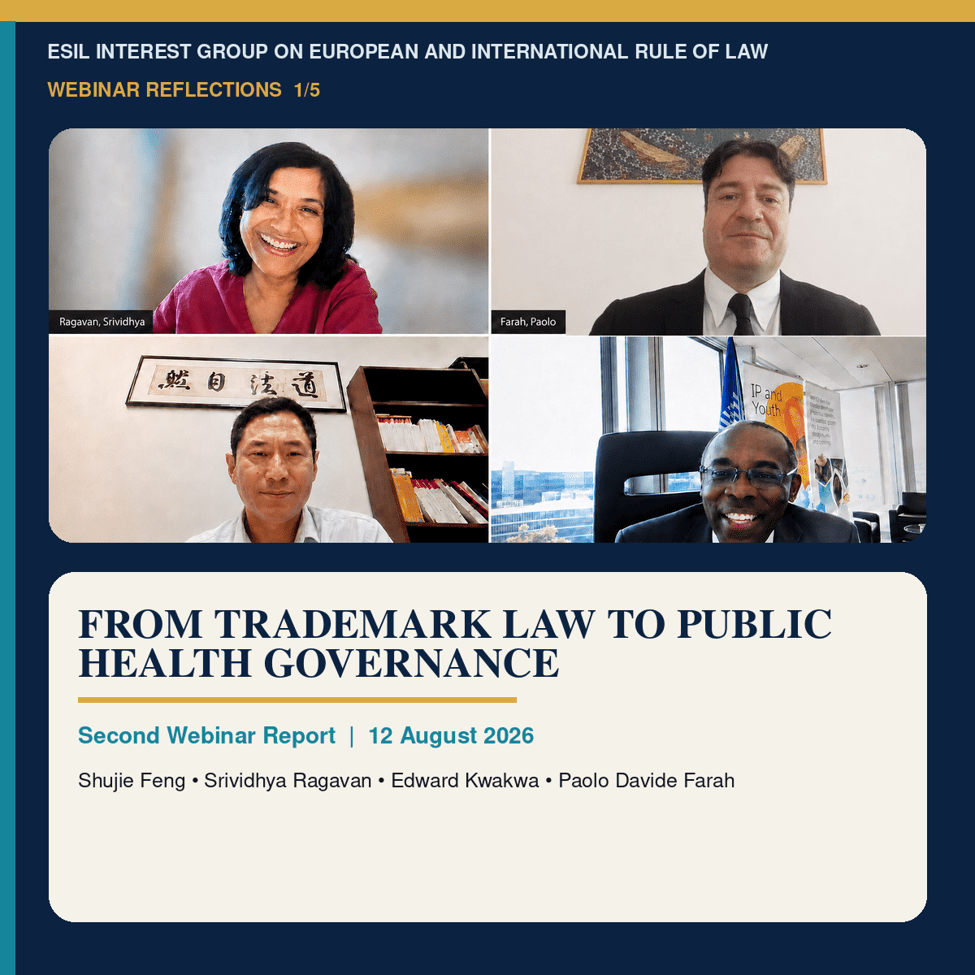
From Trademark Law to Public Health Governance: Intellectual Property, International Treaties, and the Rule of Law in a Changing Global Order – Reflections on the 2nd Webinar – ESIL Interest Group on European and International Rule of Law Webinar Series · Webinar 2 · Reflection 1/5
What happens when common international intellectual-property rules encounter different legal cultures, institutional capacities, development needs, technologies, markets, and public-health realities?
The second event in the European Society of International Law Interest Group on European and International Rule of Law Webinar Series brought into dialogue two distinct strands of contemporary IP scholarship. Shujie Feng presented Chinese Trademark Law from the Perspective of International Treaties (Springer Nature, 2026), while the event also recognized the 2025 French-language edition of the same underlying research. Srividhya Ragavan presented Fractures in IP, Trade, and Health: Centering a Public Health Framework (Oxford University Press, 2026), co-authored with Swaraj Paul Barooah, who was unable to attend. Edward Kwakwa, then Assistant Director General of WIPO, joined as discussant. I chaired and moderated the webinar and also contributed as a discussant.
The books concern different doctrinal fields. Professor Feng’s work focuses on Chinese trademark law and treaty implementation; Professors Ragavan and Barooah focus principally on patents, trade, medicine access, and global public health. The point of the conversation was not to treat trademarks and pharmaceutical patents as equivalent. It was to examine the institutions through which international IP norms are created, translated into domestic law, administered, adjudicated, enforced, contested, and coordinated with other public purposes.
Professor Feng described Chinese trademark law as developing through two connected forces: alignment with international rules during China’s integration into the global economy and, increasingly, reform driven by the needs of China’s own market economy. The trajectory moved from importing a modern IP system and preparing for WTO accession toward domestic responses to bad-faith filings, trademark squatting, counterfeiting, enforcement, and market governance. International obligations supplied a baseline, but legislators, administrators, courts, and scholars gave those obligations operational meaning.
Professor Ragavan argued that the relationship among international trade, IP, and health is structurally fractured. Formally equal rules operate among materially unequal countries, and public health too often appears only as an exception, flexibility, waiver, or emergency response. Her proposed reconstruction is not anti-IP. It seeks to preserve innovation while placing health equity, local production, development, governmental responsibility, and the realities of different countries at the center of sustainable trade governance.
Edward Kwakwa connected the books to institutional practice. He discussed China’s transformation into a leading user and shaper of international IP systems, the Beijing Treaty’s accommodation of national legal choices, the COVID-19 vaccine and TRIPS waiver debates, tobacco plain packaging, cooperation among WIPO, the WTO, and the WHO, and the evolving architecture for geographical indications. His contribution showed that overlapping mandates can generate conflict, but also new forms of cooperation and institutional innovation.
My own interventions focused on institutional and epistemic governance. Treaties do not implement themselves. Legislatures, agencies, courts, international organizations, firms, platforms, public-health authorities, and affected communities determine which evidence matters, whose expertise is recognized, what risks become visible, and how competing objectives are coordinated. This is why formal treaty compliance does not exhaust the rule-of-law inquiry.
The discussion converged on a movement from fragmentation toward design. The future of international IP governance cannot be reduced to choosing harmonization or sovereignty, innovation or access, trade or health. It requires an architecture capable of combining common commitments with legitimate domestic variation, transparent justification, evidence, review, participation, and accountability.
This opening reflection introduces four further posts on the contributions of Shujie Feng, Srividhya Ragavan and Swaraj Paul Barooah, Edward Kwakwa, and my own role as Chair, Moderator, and Discussant.
Because readers may not have seen those earlier posts, the principal bibliography is reproduced below.
Selected Bibliography
Books in Dialogue
Shujie Feng, Chinese Trademark Law from the Perspective of International Treaties (Springer Nature, 2026);
Shujie Feng, Le Droit Chinois des Marques au Regard des Traités Internationaux (Éditions Pedone, 2024); and
Srividhya Ragavan and Swaraj Paul Barooah, Fractures in IP, Trade, and Health: Centering a Public Health Framework (Oxford University Press, 2025).
Related Scholarship by Shujie Feng
- Shujie FENG, The Copyrightability of AI- Generated Content: A Doctrinal Exploration of the Pioneering Chinese Judicial Practice , Computer Law & Security Review , Vol. 59 , 2025.
- Shujie FENG, Geographical Indications: Can China Reconcile the Irreconcilable Intellectual Property Issue Between E.U. and U.S.? World Trade Review , May 2019. 13.
- Shujie FENG, La mise en œuvre du droit de l’OMC en matière de propriété intellectuelle en Chine —- Etude sur le droit chinois des brevets avec une perspective française- européenne (en Français ) , Edition s A. Pédone, 2019.
- ILA 2023 Paris Conference White Paper on Intellectual Property
Related Scholarship by Srividhya Ragavan
Selected Bibliography
Books
- Intellectual Property Law and Access to Medicine: TRIPS Agreement, Health, and Pharmaceuticals, Amaka Vanni ed., Routledge Press, 2021.Chapter of particular relevance:
“World Trade Organization: A Barrier to Global Public Health?”https://www.taylorfrancis.com/chapters/edit/10.4324/9781003176602-3/world-trade-organization-srividhya-ragavanBook DOI:
https://doi.org/10.4324/9781003176602 - Book Chapter
- “To Sow or Not to Sow: Dilemmas from Creating New Food Rights,” in Agricultural Biotechnology and Intellectual Property: Seeds of Change, Jay P. Kesan ed., CABI Publishers, 2007.https://www.cabidigitallibrary.org/doi/10.1079/9781845932015.0320
Law Review Articles
- “New Paradigms for Protection of Biodiversity.”https://papers.ssrn.com/sol3/Delivery.cfm?abstractid=1742721
- “The Dispute Settlement Process of the WTO: A Normative Structure to Achieve Utilitarian Objectives.”https://scholarship.law.tamu.edu/cgi/viewcontent.cgi?article=1540&context=facscholar
- “Make America Healthy: Reducing High Pharmaceutical Prices Without Reducing Innovation,” 77 SMU Law Review 787 (2024).https://doi.org/10.25172/smulr.77.4.5
- “The Dispute Settlement Process of the WTO: A Normative Structure to Achieve Utilitarian Objectives,” with Brian Manning, 79 UMKC Law Review 1 (2010).
- “Correlative Obligation in Patent Law: The Role of Public Good in Defining the Limits of Patent Exclusivity,” 6 NYU Journal of Intellectual Property and Entertainment Law 6 (2016).
Related Scholarship by Paolo Davide Farah
Selected Bibliography
Books
- Artificial Intelligence, Governance and Sustainable Development: Peace, Justice and Strong Institutions, co-edited with Imad Antoine Ibrahim and Jon Truby, Routledge, 2026.https://www.routledge.com/Artificial-Intelligence-Governance-and-Sustainable-Development-Peace-Justice-and-Strong-Institutions/Ibrahim-Truby-Farah/p/book/9781032524047
- Science, Technology, Policy and International Law, co-edited with Justo Corti Varela, Routledge, 2024.https://www.routledge.com/Science-Technology-Policy-and-International-Law/Varela-Farah/p/book/9781032751139
- China’s Influence on Non-Trade Concerns in International Economic Law: Trade, Investment and Beyond, co-edited with Elena Cima, Routledge, 2016.https://www.routledge.com/Chinas-Influence-on-Non-Trade-Concerns-in-International-Economic-Law/Farah-Cima/p/book/9780367439897
- Globalization, Environmental Law, and Sustainable Development in the Global South: Challenges for Implementation, co-edited with Kirk W. Junker, Routledge, 2021.https://www.routledge.com/Globalization-Environmental-Law-and-Sustainable-Development-in-the-Global-South-Challenges-for-Implementation/Junker-Farah/p/book/9780367749262
Book Chapters and Related Contributions
- “Framing AI’s Role in Achieving SDG 16,” with Imad Antoine Ibrahim and Jon Truby, in Artificial Intelligence, Governance and Sustainable Development: Peace, Justice and Strong Institutions, Routledge, 2026.https://ssrn.com/abstract=5399415
- “The Intersections Among Science, Technology, Policy and Law: In Between Truth and Justice,” with Justo Corti Varela, in Science, Technology, Policy and International Law, Routledge, 2024.https://ssrn.com/abstract=4590214
- “Water-Energy-Food Nexus in International Law: A Legal Analysis,” with Imad Antoine Ibrahim, in Handbook on the Water-Energy-Food Nexus, Edward Elgar Publishing, 2022, pp. 381–397.https://ssrn.com/abstract=4243774
Articles
- When John Locke Meets Lao Tzu: The Relationship between Intellectual Property, Biodiversity and Indigenous Knowledge and the Implications for Food Security, 33 Duke Envtl. L. & Pol’y F. 297 (2024).
- Conflict between Intellectual Property Rights and Human Rights: A Case Study on Intangible Cultural Heritage, 94 Or. L. Rev. 125 (2015).
- The Implementation of the WTO Agreement on Trade-Related Aspects of Intellectual Property Rights (TRIPs) in China, 2 Tsinghua China L. Rev. 2, 317–51 (Spring 2010).
- Desirability of Commodification of Intangible Cultural Heritage: The Unsatisfying Role of IPRs, 11 Transnat’l Dispute Mgmt. 2, 2014.
- Global Governance and Intangible Cultural Heritage in the Information Society: At the Crossroads of IPRs and Innovation, in Daniele Archibugi & Andrea Filippetti (eds.), HANDBOOK OF GLOBAL SCIENCE, TECHNOLOGY, AND INNOVATION 462–79 (Oxford: Wiley Publisher 2015).
- Public Ownership and the WTO in a Post Covid-19 Era: From Trade Disputes To a ‘Social’ Function, 125 W. Va. L. Rev. 644 (2022).
- “Energy Trade and the WTO: Implications for Renewable Energy and the OPEC Cartel,” with Elena Cima, 16 Journal of International Economic Law 707–740 (2013).https://doi.org/10.1093/jiel/jgt024
- World Trade Organization, Renewable Energy Subsidies and the Case of Feed-in Tariffs: Time for Reform Toward Sustainable Development?, 27 Geo. Envtl. L. Rev. 515 (2015).
- Trade and Progress: The Case of China, 30 Colum. J. Asian L. 51 (2016).
- “Trade in Clean Energy Technologies: Sliding from Protection to Protectionism Through Obligations for Technology Transfer in Climate Change Law, or Vice Versa?,” with Anthi Koskina-Saridaki and Imad Antoine Ibrahim, 13 Journal of World Energy Law & Business 114–128 (2020).https://ssrn.com/abstract=3646993
- “China’s Energy Policies and Strategies for Climate Change and Energy Security,” with Haifeng Deng, 13 Journal of World Energy Law & Business 141–156 (2020).https://doi.org/10.1093/jwelb/jwaa018
- “Urgenda v. Juliana: Lessons for Future Climate Change Litigation Cases,” with Imad Antoine Ibrahim, 84 University of Pittsburgh Law Review 547 (2023).https://ssrn.com/abstract=4352769
- “A Comparison Between Shale Gas in China and Unconventional Fuel Development in the United States: Water, Environment and Sustainable Development,” with Riccardo Tremolada, 41 Brooklyn Journal of International Law 579–654 (2016).https://ssrn.com/abstract=2802157
- “Balancing Technological Innovation and Regulation: Safeguarding Societal Interests in the Age of AI,” JURIST, February 25, 2025.https://ssrn.com/abstract=5156010
Paolo Davide Farah, Paolo Farah
Webinar Reflections 1/5: From Trademark Law to Public Health Governance: International IP, Domestic Institutions, and the Rule of Law