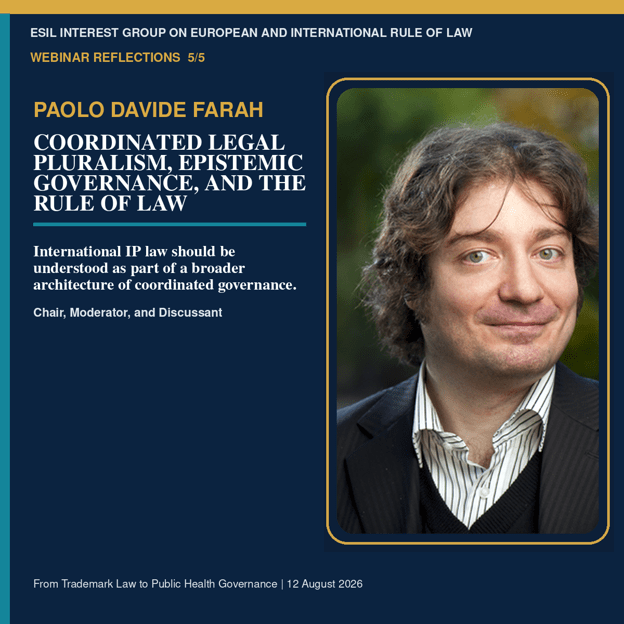


Paolo Davide Farah: Coordinated Legal Pluralism, Epistemic Governance, and the Rule of Law – Reflections on the 2nd Webinar – ESIL Interest Group on European and International Rule of Law Webinar Series · Webinar 2 · Reflection 5/5
What kind of legal architecture can preserve common international commitments while accommodating regulatory diversity, competing forms of expertise, public health, innovation, development, and domestic autonomy—without allowing any one of these objectives systematically to displace the others?
That was the broader question I sought to place at the center of our second Webinar, From Trademark Law to Public Health Governance: Intellectual Property, International Treaties, and the Rule of Law in a Changing Global Order.
As Chair, Moderator, and Discussant, my role was necessarily different from those of Shujie Feng, Srividhya Ragavan, and Edward Kwakwa.
Professor Feng presented the research published in English as Chinese Trademark Law from the Perspective of International Treaties and first published in French as Le Droit Chinois des Marques au Regard des Traités Internationaux. Professor Ragavan presented Fractures in IP, Trade, and Health: Centering a Public Health Framework, co-authored with Swaraj Paul Barooah, who was unable to participate in the live Webinar. Edward Kwakwa brought the institutional perspective of the World Intellectual Property Organization (WIPO).
My task was to construct the intellectual space in which those different contributions could speak to one another—and then to test what that conversation might tell us about comparative law, international law, administrative governance, evidence, epistemic authority, institutional design, emerging powers, and the substantive rule of law.
That required, first, methodological discipline.
Professor Feng’s monograph principally concerns trademark law, international treaties, and the evolution of Chinese legal institutions.
Professors Ragavan and Barooah principally examine patents, international trade, pharmaceutical innovation, medicine access, and public health.
The purpose of bringing them together was never to suggest that trademarks and pharmaceutical patents are doctrinally equivalent.
They are not.
The productive comparison lies elsewhere: in the institutions through which international intellectual-property norms are created, translated, implemented, interpreted, administered, enforced, contested, and coordinated with other public purposes.
That distinction was expressly built into the discussion framework I circulated to the speakers before the Webinar.
The central proposition I proposed was that international intellectual-property law is not a self-executing code.
Treaties establish commitments, but they do not implement themselves.
Domestic legislatures write statutes.
Trademark and patent offices examine applications.
Administrative agencies interpret regulatory requirements.
Courts review decisions and construct doctrine.
Customs authorities and criminal institutions enforce rights at borders and through sanctions.
International organizations generate standards, statistics, technical assistance, and negotiating frameworks.
Companies structure investment, innovation, licensing, pricing, and distribution.
E-commerce platforms increasingly make decisions that function much like administrative enforcement.
Public-health institutions assess risks and access needs.
Consumers, patients, local producers, civil society, and affected communities possess knowledge about how legal rules actually operate.
International IP law therefore becomes real through an institutional architecture.
Once the discussion is reframed in that way, a different set of questions becomes visible.
Who sets the norm?
Who interprets it?
Who implements it?
Which forms of domestic variation remain legitimate?
Which institution decides when mandates conflict?
Whose evidence counts?
Whose knowledge becomes authoritative?
And what distinguishes treaty compliance from a genuinely legitimate rule-of-law order?
These were not questions added retrospectively after hearing the speakers.
They formed the intellectual architecture circulated to them before the Webinar and informed the questions I used to structure the live conversation.
They also reflect a broader concern running through my work on epistemic governance.
Legal institutions do not merely receive facts that have already been discovered somewhere else and then mechanically apply law to them.
They participate in producing the legally relevant world.
A trademark office must decide what counts as evidence of consumer perception, distinctiveness, confusion, market recognition, or bad faith.
A patent system must determine what qualifies as novelty, inventive activity, or legally cognizable innovation.
A public-health institution must decide how disease burdens, affordability, access, risk, manufacturing capacity, and health consequences are measured.
A court must determine which evidence enters the record, which experts are credible, what burdens of proof apply, and when administrative expertise should receive deference.
An international organization chooses which statistics to collect, which categories to create, which indicators become internationally comparable, and which practices are presented as models or “best practices.”
These are exercises of legal authority.
But they are also exercises of epistemic authority.
That is why one of the central questions I brought to the Webinar concerned not simply who has jurisdiction, but who has authority to define the problem itself.
A trademark office, patent office, public-health authority, court, WIPO, WTO, WHO, pharmaceutical company, university researcher, patient organization, consumer association, developing-country government, and local community may encounter the same policy problem through radically different forms of knowledge.
The rule-of-law problem is not solved merely by confirming that each actor has some legal competence.
We must also ask how disagreement among those forms of knowledge becomes visible, contestable, reasoned through, and reviewable.
This is what connects intellectual-property governance to what I have described elsewhere as epistemic due process.
Institutions should be capable of explaining what evidence they considered, what methodological assumptions they used, why particular expertise prevailed, how contrary evidence was treated, and whether the communities most affected by the decision had meaningful opportunities to influence the institutional record.
Participation alone is therefore not enough.
An affected community can be formally invited into a consultation while the categories defining the problem, the evidentiary standards, and the institutional agenda have already been fixed elsewhere.
Presence does not necessarily produce epistemic influence.
The framework circulated before the Webinar therefore distinguished several concepts that are too easily collapsed into one another:
harmonization is not the same as uniformity;
legal certainty is not the same as administrative rigidity;
an innovation incentive is not itself proof of an innovation outcome;
institutional fragmentation is not necessarily the same as legitimate pluralism;
participation is not necessarily epistemic influence;
and formal legality is not identical to institutional legitimacy.
Not every one of those distinctions could become a separate oral exchange within ninety minutes.
But they shaped the questions that were asked and the direction in which the speakers’ answers developed.
The first important test concerned implementation.
I asked what should count as successful implementation of an international IP norm beyond formal legislative conformity.
Professor Feng’s response demonstrated why this question matters.
China’s early trademark reforms were strongly influenced by international agreements, external negotiations, and WTO accession. But later reforms increasingly responded to domestic problems encountered by Chinese and foreign firms operating inside a rapidly developing market.
His example of trademark squatting was particularly revealing.
The international rule provided a baseline. Domestic experience exposed conduct that did not fit perfectly within the treaty category. Chinese institutions then developed a broader response.
Implementation therefore became something more than copying.
It became institutional learning.
This led naturally to a second question: when does a state move from receiving international norms to producing legal practices capable of influencing others?
That question has significance well beyond trademark law.
It connects directly to the changing role of China, India, and other emerging powers in global governance.
International law has too often approached emerging economies as sites at which internationally generated norms are implemented, monitored, or assessed for compliance.
But legal influence increasingly travels in several directions.
States receive norms, translate them, modify them, experiment with institutional solutions, generate jurisprudence, construct regulatory practices, and then bring those experiences back into international negotiations and comparative debate.
Professor Feng’s account therefore connected directly with Edward Kwakwa’s institutional observations concerning China’s growing use of WIPO systems, its enormous participation in international patent, trademark, and design activity, and its increasing significance within international IP governance.
But Professor Ragavan introduced a necessary epistemic warning.
More applications do not necessarily mean more creativity.
More intellectual-property rights do not automatically mean better innovation.
And more innovation, however measured, does not necessarily establish greater social welfare.
The categories through which institutional success is measured must themselves remain open to scrutiny.
This point took us from norm production to harmonization.
International intellectual-property law understandably seeks common rules.
Predictability matters.
Cross-border transactions matter.
Rights holders need legal certainty.
States benefit from common expectations.
International cooperation would become extremely difficult if every jurisdiction simply ignored shared commitments.
But the opposite assumption is equally problematic: that uniform rules, procedures, indicators, or institutional models will produce equivalent results across states possessing radically different economic structures, technological capacities, administrative resources, development trajectories, market institutions, and public-health needs.
Professor Ragavan and Professor Barooah describe one manifestation of that problem through presumption risk.
Professor Feng’s comparative account reveals it through the process by which international norms must be adapted to domestic institutions.
Edward Kwakwa’s examples from international treaty-making demonstrated that cooperation may actually succeed because international instruments preserve meaningful national discretion.
The issue is therefore not a choice between international harmonization and sovereignty.
It is an institutional-design problem:
How can common commitments coexist with legitimate regulatory variation?
That question brought legal pluralism directly into the discussion.
Pluralism is sometimes described primarily as fragmentation—a danger to predictability, coherence, and international cooperation.
But institutional diversity can also provide experimentation, specialized expertise, regulatory learning, and protection against excessive concentration of authority.
The challenge is to distinguish legitimate pluralism from arbitrary divergence.
Domestic policy space cannot mean that governments simply invoke “local circumstances” whenever they wish to escape legal commitments.
But harmonization cannot mean that international institutions treat different socioeconomic and institutional realities as irrelevant noise.
Regulatory diversity must therefore be accompanied by reason-giving, evidence, transparency, institutional competence, review, and accountability.
The same problem appears internationally.
One of the central institutional questions I asked concerned the relationship among WIPO, the WTO, and the WHO.
Each possesses legitimate authority.
Each possesses specialized expertise.
Each sees only part of the problem.
An intellectual-property institution may focus on the protection and administration of rights.
A trade institution examines obligations affecting international commerce.
A health institution focuses on disease, mortality, prevention, and access.
When a single controversy implicates all three, which institution defines the legally relevant problem?
Edward Kwakwa’s discussion of Australian tobacco plain packaging made the problem particularly concrete.
The same regulatory measure can simultaneously become a trademark problem, a trade problem, a health problem, and a question about domestic regulatory autonomy.
Institutional coordination therefore cannot mean simply selecting one mandate and subordinating all the others to it.
Nor can every institution operate as though the others did not exist.
This was why I repeatedly sought to move the discussion from fragmentation toward architecture.
What must be coordinated?
What should remain plural?
What evidence should institutions share?
Where must authority remain specialized?
When should one institution defer to another?
Who reviews a decision when multiple forms of expertise conflict?
And how can responsibility be allocated when the ultimate result emerges from decisions made across treaties, domestic legislation, agencies, courts, companies, platforms, international organizations, and market actors?
This last point is particularly important.
Before attributing a problematic outcome to “international IP law,” we should identify where in the institutional chain the outcome was actually produced.
Was it required by the treaty?
Was it created by domestic legislation?
Did an administrative agency choose a particular interpretation?
Did evidentiary rules exclude relevant information?
Did judicial doctrine expand or constrain the rule?
Did enforcement practices produce consequences that the substantive norm did not require?
Did private firms use formally lawful rights strategically?
Did regulatory procedures generate delay?
Did market structure transform a legal entitlement into a much broader practical barrier?
Accurate institutional diagnosis is indispensable to legal responsibility.
It also prevents us from using labels such as “China,” “India,” “developing countries,” or “the Global South” as though they described internally uniform legal experiences.
The conversation with Professor Ragavan concerning patent linkage, patent thickets, serial patenting, and delayed generic entry demonstrated precisely why this matters.
The existence of a patent is only one element of the legal environment.
Practical exclusivity may result from the interaction of patent portfolios, regulatory approval, litigation, market structure, administrative procedures, pricing, procurement, manufacturing capacity, and distribution.
Likewise, unequal vaccine access during COVID-19 cannot be explained satisfactorily through a single institutional variable.
Edward Kwakwa emphasized regulatory approval, production constraints, supply limitations, distribution capacity, and vaccine nationalism alongside intellectual property.
Professor Ragavan asked why the extraordinary scientific, governmental, financial, and industrial coordination achieved during catastrophe could not become part of ordinary institutional preparedness.
The deeper question is therefore not simply whether one side of a debate is “correct.”
It is whether legal institutions are capable of seeing the whole architecture through which outcomes are produced.
That is also why I sought to distinguish a substantive rule-of-law inquiry from formal compliance alone.
Treaty compliance matters.
Predictability matters.
Legality matters.
But a legal order can be formally compliant and still raise serious questions about how power, knowledge, risk, and opportunity are distributed.
A legitimate institutional architecture should therefore also concern itself with transparency, public justification, reliable evidence, participation, proportionality, review, remedies, institutional competence, and distributional consequences.
Those requirements do not displace legality.
They help make legality institutionally legitimate.
When we reached the concluding round, no audience questions had been submitted, so I exercised my prerogative as Chair to answer the same final question I had posed to the speakers:
What single institutional change—or change in legal imagination—would most improve the capacity of international intellectual-property law to reconcile innovation, public welfare, national regulatory autonomy, and legitimate global cooperation?
My response was to propose a movement from hierarchical harmonization toward coordinated legal pluralism.
For me, international intellectual-property law should no longer be imagined as a largely self-contained regime in which public health, competition, development, trade, and national regulatory autonomy appear mainly after IP rights have already been defined—as exceptions, flexibilities, limitations, or external policy concerns.
They are not external.
They are constitutive objectives.
They should therefore participate in the design, interpretation, administration, and implementation of the system itself.
Coordinated legal pluralism would retain common international commitments.
It would not abandon treaties, predictability, or international cooperation.
But it would recognize legitimate space for domestic experimentation and institutional diversity where different legal, economic, technological, developmental, and health conditions justify different responses.
That space would not be unstructured.
Regulatory variation would require transparent justification, reliable evidence, institutional competence, reviewability, and accountability for the consequences of regulatory choices.
International institutions would continue to possess specialized mandates, but cooperation would not automatically become hierarchy.
Domestic institutions would retain policy space, but autonomy would not become an excuse for arbitrariness.
Expertise would remain indispensable, but expertise would have to explain itself.
Participation would matter, but institutions would also have to ask whether participation produces meaningful epistemic influence.
Common international norms would remain possible without requiring identical institutional pathways everywhere.
This is why the concept is coordinated legal pluralism, rather than simply pluralism.
Coordination matters because IP, trade, health, competition, development, innovation, technology, and national regulation increasingly operate through interdependent legal regimes.
Pluralism matters because no single institution, doctrinal field, or form of expertise possesses all of the knowledge necessary to govern those relationships legitimately.
The rule-of-law question is therefore ultimately architectural.
It asks not only:
Did the state comply with the treaty?
It also asks:
Who defined the problem?
Which institution exercised authority?
What evidence entered the decision?
Whose expertise counted?
Which local realities were made visible or invisible?
What opportunities existed for contestation and review?
Who bore the consequences?
And could the institutional arrangement explain why the resulting allocation of rights, risks, benefits, and responsibilities was justified?
Our second Webinar therefore moved, for me, from fragmentation toward design.
Professor Feng showed how international norms become domestic law, how implementation can become endogenous development, and how a state initially receiving international norms may itself generate legal solutions capable of travelling outward.
Professors Ragavan and Barooah showed why public health, development, local productive capacity, and welfare cannot remain afterthoughts within an architecture organized principally around trade and exclusivity.
Edward Kwakwa showed how international organizations operate within distinct mandates while developing the treaties, filing systems, statistics, technical capacity, compromises, and institutional mechanisms through which global IP governance actually functions.
Bringing these perspectives together revealed a larger lesson.
The future of international intellectual-property governance will depend not only on what treaties say, but on the relationships among the institutions that give those treaties meaning.
WIPO, the WTO, the WHO, states, legislatures, administrative agencies, courts, firms, platforms, universities, researchers, patients, consumers, producers, civil society, and affected communities all participate in that architecture.
The international rule of law therefore requires more than coordination of rules.
It requires coordination of authority, evidence, expertise, responsibility, and accountability.
The objective should not be a perfectly uniform global legal order.
Nor should it be an uncoordinated collection of national exceptions.
The more promising direction is an international legal architecture capable of maintaining common commitments while learning from difference—predictable without becoming rigid, plural without becoming arbitrary, expert without becoming epistemically closed, innovative without becoming indifferent to access, and internationally coordinated without erasing legitimate domestic autonomy.
That is the promise I see in coordinated legal pluralism: an international rule-of-law framework in which legal diversity becomes not simply a problem to be eliminated, but—when institutionally justified, transparent, evidence-based, and accountable—a potential source of learning, adaptation, and more legitimate global governance.
Because readers may not have seen those earlier posts, the principal bibliography is reproduced below.
Selected Bibliography – 2nd Webinar
Books in Dialogue
Shujie Feng, Chinese Trademark Law from the Perspective of International Treaties (Springer Nature, 2026);
Shujie Feng, Le Droit Chinois des Marques au Regard des Traités Internationaux (Éditions Pedone, 2024); and
Srividhya Ragavan and Swaraj Paul Barooah, Fractures in IP, Trade, and Health: Centering a Public Health Framework (Oxford University Press, 2025).
Related Scholarship by Shujie Feng
- Shujie FENG, The Copyrightability of AI- Generated Content: A Doctrinal Exploration of the Pioneering Chinese Judicial Practice , Computer Law & Security Review , Vol. 59 , 2025.
- Shujie FENG, Geographical Indications: Can China Reconcile the Irreconcilable Intellectual Property Issue Between E.U. and U.S.? World Trade Review , May 2019. 13.
- Shujie FENG, La mise en œuvre du droit de l’OMC en matière de propriété intellectuelle en Chine —- Etude sur le droit chinois des brevets avec une perspective française- européenne (en Français ) , Edition s A. Pédone, 2019.
- ILA 2023 Paris Conference White Paper on Intellectual Property
Related Scholarship by Srividhya Ragavan
Selected Bibliography
Books
- Intellectual Property Law and Access to Medicine: TRIPS Agreement, Health, and Pharmaceuticals, Amaka Vanni ed., Routledge Press, 2021.Chapter of particular relevance:
“World Trade Organization: A Barrier to Global Public Health?”https://www.taylorfrancis.com/chapters/edit/10.4324/9781003176602-3/world-trade-organization-srividhya-ragavanBook DOI:
https://doi.org/10.4324/9781003176602 - Book Chapter
- “To Sow or Not to Sow: Dilemmas from Creating New Food Rights,” in Agricultural Biotechnology and Intellectual Property: Seeds of Change, Jay P. Kesan ed., CABI Publishers, 2007.https://www.cabidigitallibrary.org/doi/10.1079/9781845932015.0320
Law Review Articles
- “New Paradigms for Protection of Biodiversity.”https://papers.ssrn.com/sol3/Delivery.cfm?abstractid=1742721
- “The Dispute Settlement Process of the WTO: A Normative Structure to Achieve Utilitarian Objectives.”https://scholarship.law.tamu.edu/cgi/viewcontent.cgi?article=1540&context=facscholar
- “Make America Healthy: Reducing High Pharmaceutical Prices Without Reducing Innovation,” 77 SMU Law Review 787 (2024).https://doi.org/10.25172/smulr.77.4.5
- “The Dispute Settlement Process of the WTO: A Normative Structure to Achieve Utilitarian Objectives,” with Brian Manning, 79 UMKC Law Review 1 (2010).
- “Correlative Obligation in Patent Law: The Role of Public Good in Defining the Limits of Patent Exclusivity,” 6 NYU Journal of Intellectual Property and Entertainment Law 6 (2016).
Related Scholarship by Paolo Davide Farah
Selected Bibliography
Books
- Artificial Intelligence, Governance and Sustainable Development: Peace, Justice and Strong Institutions, co-edited with Imad Antoine Ibrahim and Jon Truby, Routledge, 2026.https://www.routledge.com/Artificial-Intelligence-Governance-and-Sustainable-Development-Peace-Justice-and-Strong-Institutions/Ibrahim-Truby-Farah/p/book/9781032524047
- Science, Technology, Policy and International Law, co-edited with Justo Corti Varela, Routledge, 2024.https://www.routledge.com/Science-Technology-Policy-and-International-Law/Varela-Farah/p/book/9781032751139
- China’s Influence on Non-Trade Concerns in International Economic Law: Trade, Investment and Beyond, co-edited with Elena Cima, Routledge, 2016.https://www.routledge.com/Chinas-Influence-on-Non-Trade-Concerns-in-International-Economic-Law/Farah-Cima/p/book/9780367439897
- Globalization, Environmental Law, and Sustainable Development in the Global South: Challenges for Implementation, co-edited with Kirk W. Junker, Routledge, 2021.https://www.routledge.com/Globalization-Environmental-Law-and-Sustainable-Development-in-the-Global-South-Challenges-for-Implementation/Junker-Farah/p/book/9780367749262
Book Chapters and Related Contributions
- “Framing AI’s Role in Achieving SDG 16,” with Imad Antoine Ibrahim and Jon Truby, in Artificial Intelligence, Governance and Sustainable Development: Peace, Justice and Strong Institutions, Routledge, 2026.https://ssrn.com/abstract=5399415
- “The Intersections Among Science, Technology, Policy and Law: In Between Truth and Justice,” with Justo Corti Varela, in Science, Technology, Policy and International Law, Routledge, 2024.https://ssrn.com/abstract=4590214
- “Water-Energy-Food Nexus in International Law: A Legal Analysis,” with Imad Antoine Ibrahim, in Handbook on the Water-Energy-Food Nexus, Edward Elgar Publishing, 2022, pp. 381–397.https://ssrn.com/abstract=4243774
Articles
- Five Years of China’s WTO Membership: EU and US Perspectives about China’s Compliance with Transparency Commitments and the Transitional Review Mechanism, 33 Legal Issues Econ. Integration 3, 263–304 (2006).
- When John Locke Meets Lao Tzu: The Relationship between Intellectual Property, Biodiversity and Indigenous Knowledge and the Implications for Food Security, 33 Duke Envtl. L. & Pol’y F. 297 (2024).
- Conflict between Intellectual Property Rights and Human Rights: A Case Study on Intangible Cultural Heritage, 94 Or. L. Rev. 125 (2015).
- The Implementation of the WTO Agreement on Trade-Related Aspects of Intellectual Property Rights (TRIPs) in China, 2 Tsinghua China L. Rev. 2, 317–51 (Spring 2010).
- China’s Water Environmental Management Towards Institutional Integration: A Review of Current Progress and Constraints vis-a-vis the European Experience, 113 J. Cleaner Prod. 285–98 (2016).
- Desirability of Commodification of Intangible Cultural Heritage: The Unsatisfying Role of IPRs, 11 Transnat’l Dispute Mgmt. 2, 2014.
- Global Governance and Intangible Cultural Heritage in the Information Society: At the Crossroads of IPRs and Innovation, in Daniele Archibugi & Andrea Filippetti (eds.), HANDBOOK OF GLOBAL SCIENCE, TECHNOLOGY, AND INNOVATION 462–79 (Oxford: Wiley Publisher 2015).
- Public Ownership and the WTO in a Post Covid-19 Era: From Trade Disputes To a ‘Social’ Function, 125 W. Va. L. Rev. 644 (2022).
- “Energy Trade and the WTO: Implications for Renewable Energy and the OPEC Cartel,” with Elena Cima, 16 Journal of International Economic Law 707–740 (2013).https://doi.org/10.1093/jiel/jgt024
- World Trade Organization, Renewable Energy Subsidies and the Case of Feed-in Tariffs: Time for Reform Toward Sustainable Development?, 27 Geo. Envtl. L. Rev. 515 (2015).
- Trade and Progress: The Case of China, 30 Colum. J. Asian L. 51 (2016).
- “Trade in Clean Energy Technologies: Sliding from Protection to Protectionism Through Obligations for Technology Transfer in Climate Change Law, or Vice Versa?,” with Anthi Koskina-Saridaki and Imad Antoine Ibrahim, 13 Journal of World Energy Law & Business 114–128 (2020).https://ssrn.com/abstract=3646993
- China’s Role and Contribution in the Global Governance of Climate Change: Institutional Adjustments for Carbon Tax Introduction, Collection and Management in China, 8 J. World Energy L. & Bus. 6, 581–99 (Dec. 2015).
- “China’s Energy Policies and Strategies for Climate Change and Energy Security,” with Haifeng Deng, 13 Journal of World Energy Law & Business 141–156 (2020).https://doi.org/10.1093/jwelb/jwaa018
- Evaluating China’s Environmental Management and Risks Avoidance Policies and Regulations on Offshore Methane Hydrate Extraction, 12 Sustainability 13, 5331 (2020).
- “A Comparison Between Shale Gas in China and Unconventional Fuel Development in the United States: Water, Environment and Sustainable Development,” with Riccardo Tremolada, 41 Brooklyn Journal of International Law 579–654 (2016).https://ssrn.com/abstract=2802157
- “Balancing Technological Innovation and Regulation: Safeguarding Societal Interests in the Age of AI,” JURIST, February 25, 2025.https://ssrn.com/abstract=5156010
- China’s Belt and Road Initiative and Its Impact on the Energy Independence of the European Union, Asian J. Law & Soc’y, 1 -30 (Cambridge Univ. Press 2025)
- China’s Path to Modernization and Legal Pluralism: Transplants and the Belt and Road Initiative, Asian J. Law & Soc’y, pp. 1 – 36 (Cambridge Univ. Press 2025).
Paolo Davide Farah, Paolo Farah
Webinar Reflections 5/5: Paolo Davide Farah: Coordinated Legal Pluralism, Epistemic Governance, and the Rule of Law