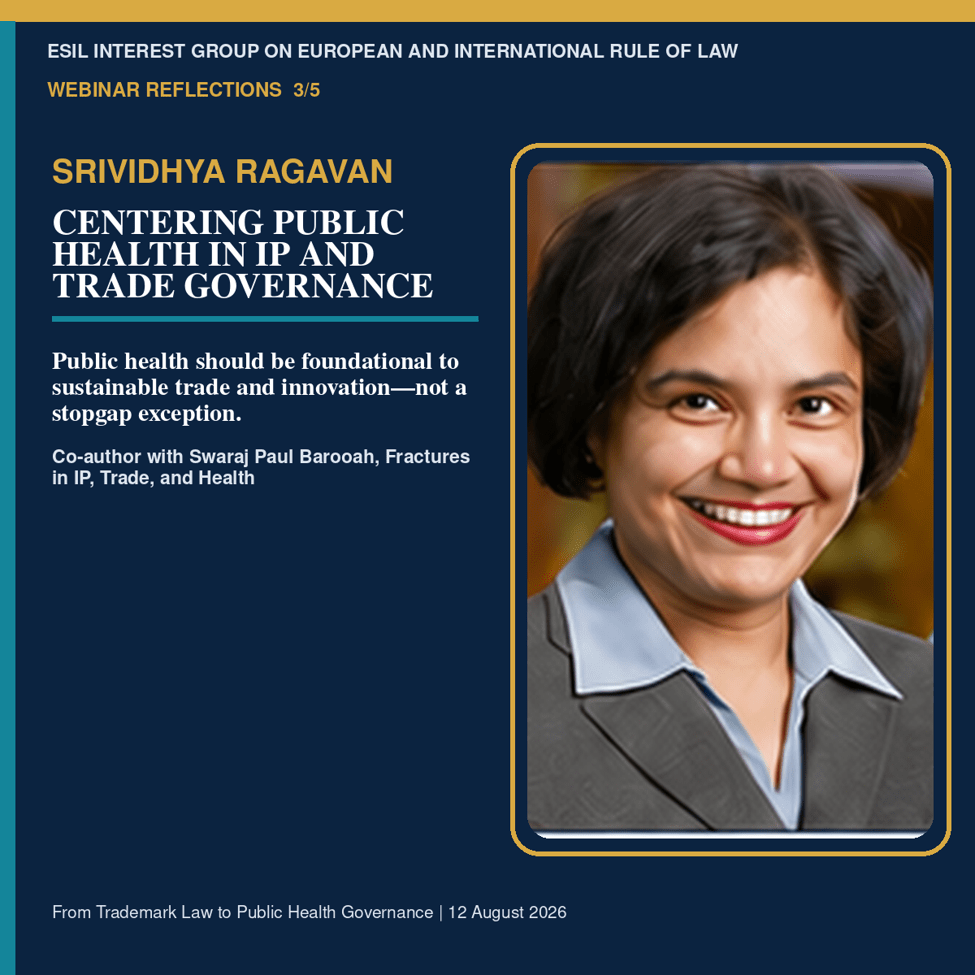

Srividhya Ragavan: Centering Public Health in IP and Trade Governance – Reflections on the 2nd Webinar – ESIL Interest Group on European and International Rule of Law Webinar Series · Webinar 2 · Reflection 3/5
What changes when public health is treated not as an exception to intellectual-property and trade rules, but as one of the foundations on which those systems must themselves be designed?
That question lay at the center of Srividhya Ragavan and Swaraj Paul Barooah’s Fractures in IP, Trade, and Health: Centering a Public Health Framework (Oxford University Press, 2026), and became one of the principal threads of our second Webinar, From Trademark Law to Public Health Governance: Intellectual Property, International Treaties, and the Rule of Law in a Changing Global Order.
Professor Ragavan began her independent presentation with an important acknowledgment: the book is co-authored with Swaraj Paul Barooah, who had hoped to participate but was unable to join the live Webinar. His contribution therefore remained integral both to the presentation and to the discussion of the book.
The starting point of their argument is a structural one.
International trade and intellectual-property law operate through forms of juridical equality among states that remain profoundly unequal in economic power, industrial capacity, technological development, administrative resources, manufacturing infrastructure, disease burdens, and health systems. Rules that appear formally equal can consequently produce radically different effects depending on the institutional and socioeconomic environment in which they operate.
Professors Ragavan and Barooah describe these disconnections as fractures.
Public health has repeatedly entered the trade-IP system after its principal architecture has already been established: as a flexibility, exception, compulsory measure, waiver, emergency response, or temporary accommodation. COVID-19 did not create that structural problem. It exposed it dramatically. A health crisis can destroy human productive capacity, interrupt manufacturing, fracture supply chains, restrict movement, destabilize markets, and ultimately bring trade itself to a halt.
Public health, on this account, is therefore not external to economic governance.
It is one of its conditions.
That argument was particularly important to the framework I circulated to the speakers before the Webinar. I wanted the conversation to avoid a false doctrinal equation between Professor Shujie Feng’s analysis of Chinese trademark law and the principally patent-, medicine-, and public-health-centered questions addressed by Professors Ragavan and Barooah. Trademarks and pharmaceutical patents are not the same.
The point of bringing the works together was instead to ask what happens institutionally when international IP norms move through treaties, national legislation, administrative agencies, courts, international organizations, firms, markets, public-health institutions, and affected communities.
From that perspective, the shared questions became broader:
How much international harmonization is necessary for predictability and cooperation, and how much domestic regulatory autonomy is necessary to respond to different local realities?
Who produces the knowledge on which intellectual-property and public-health policies are based?
What counts as evidence of innovation, access, affordability, public-health need, or successful implementation?
How should the WHO, WIPO, WTO, national governments, regulatory agencies, courts, companies, universities, donors, and civil society coordinate when responsibility is distributed across all of them?
And, ultimately, when is formal treaty compliance insufficient for an institutionally legitimate rule-of-law order?
Professor Ragavan’s presentation provided a particularly powerful way into these questions through the book’s concepts of presumption risk, attribution gaps, and local realities.
Presumption risk arises when policymakers assume that standardized IP protection—or increasing numbers of exclusive rights—will reliably generate comparable innovation, investment, development, and welfare across radically different national environments.
But formal uniformity can conceal institutional difference.
Technological capacity, manufacturing infrastructure, purchasing power, disease burdens, regulatory institutions, research ecosystems, and access needs affect what apparently identical rules actually do.
The related attribution gap concerns how innovation and access are explained. Innovation rarely emerges from one actor or one legal entitlement. Public research funding, private investment, universities, government procurement, regulatory approval, manufacturing, price negotiations, distribution networks, courts, international organizations, donors, patients, and civil society all participate in producing the final outcome.
Attributing innovation exclusively to patent incentives—or attributing failure simply to insufficient IP protection—can therefore make much of the institutional process disappear.
This aspect of the book connected directly with the epistemic-governance questions I brought into the Webinar.
Legal institutions do not merely receive facts that have already been established elsewhere. They participate in determining what counts as evidence, which indicators become authoritative, whose expertise is credited, which local knowledge enters the decision-making process, and which consequences remain invisible.
A public-health impact assessment, for example, cannot simply be an additional technocratic exercise. It raises prior questions: Who defines the relevant health impact? Who produces the data? Which populations are represented? What happens when standardized international indicators conflict with local knowledge or experience?
The same problem extends to the meaning of innovation itself.
Professor Ragavan repeatedly emphasized that the book does not propose sacrificing innovation or abandoning intellectual property.
To the contrary, she identified the emergence of talent and inventive capacity from previously unexpected parts of the world as one of the achievements associated with expanding international economic integration.
The question is what happens next.
Innovation must be connected to local manufacturing, productive capacity, development, access, welfare, and sustainable national economic growth rather than measured simply by the existence or quantity of legal rights.
This became especially concrete during the moderated exchange.
One of the questions running through our conversation was what should count as successful implementation of international intellectual-property norms beyond formal legislative conformity.
A state can reproduce treaty language without developing the administrative, regulatory, judicial, or economic institutions necessary to make those rules work. It can produce very large numbers of applications or registered rights without demonstrating that those numbers correspond to socially valuable creativity, productive development, or welfare.
Professor Ragavan brought this point directly into the discussion of China.
She praised the strategic character of China’s engagement with intellectual property across statutes, administrative agencies, regulation, institutional implementation, and enforcement, contrasting this multilayered approach with systems that may import international norms without constructing the surrounding institutional capacity needed to connect them to domestic priorities.
But she simultaneously posed a series of deliberately uncomfortable questions:
Do more applications necessarily mean more intellectual property?
Does more intellectual property necessarily mean more creativity?
And is more intellectual property necessarily good?
Those questions were especially valuable because they prevented our discussion of China’s extraordinary expansion within the international IP system from collapsing quantity, institutional participation, innovation quality, and welfare into a single metric.
They also connected the discussion to one of the larger themes of the Webinar: emerging powers should no longer be examined only as recipients or implementers of international rules. China, India, and other jurisdictions increasingly generate practices, institutions, regulatory strategies, and policy alternatives that can influence international legal development.
But becoming a norm-producing state does not eliminate the need to ask who benefits from those norms or how their effects should be measured.
Professor Ragavan then returned the discussion to medicine access through patent linkage, serial patents, patent thickets, and litigation capable of delaying generic entry.
Her example of Humira illustrated how market exclusivity in practice may result not simply from a single patent and its nominal term, but from the interaction of multiple patents and applications, regulatory mechanisms, litigation strategies, and barriers confronting competitors.
The relevant unit of analysis is therefore not simply “the patent.”
It is the institutional environment surrounding the patent.
That insight connected closely with another distinction I sought to emphasize throughout the Webinar: a problematic outcome may originate at several different levels. It may result from an international treaty obligation, domestic legislation, administrative interpretation, regulatory procedure, evidentiary rules, judicial doctrine, enforcement choices, market structure, or private conduct.
Identifying the level at which the problem occurs is indispensable to identifying responsibility—and to designing a remedy.
This is also why national governments occupy such a distinctive place in Ragavan and Barooah’s reconstruction.
Governments fund research, approve medical products, procure and distribute medicines, negotiate prices, regulate markets, design competition rules, implement international treaties, and remain politically accountable for public welfare.
Yet the book does not treat the state as the only relevant actor.
Courts, pharmaceutical companies, universities, international organizations, donors, manufacturers, distributors, civil society, patients, and other affected communities all influence access outcomes.
The problem is therefore simultaneously one of authority and distributed responsibility.
The proposed response is what the authors describe as pragmatic multilateralism: stronger institutional cooperation capable of addressing health, trade, IP, development, and innovation together rather than allowing each institutional regime to treat the others as external constraints.
This includes meaningful cooperation among the WHO, WIPO, and WTO, but our conversation also raised a further question: institutional coordination cannot itself be assumed to produce justice.
Those organizations possess different mandates, forms of expertise, legal authority, membership dynamics, and institutional cultures. When their priorities diverge, coordination requires decisions about competence, evidence, responsibility, review, and ultimately authority.
The question therefore becomes not simply whether institutions should cooperate, but how they should cooperate without allowing one specialized mandate to dominate all the others.
This was one reason I framed the discussion through the distinction between harmonization and uniformity.
International cooperation requires common commitments. But common commitments need not imply identical procedures, institutions, evidentiary rules, remedies, developmental strategies, or regulatory outcomes in every country.
Professor Ragavan’s insistence on local realities supplied an important corrective: local difference is not necessarily a deviation from an international norm. Sometimes it is indispensable information about what the international norm actually does when applied to unequal circumstances.
The challenge is therefore to distinguish legitimate regulatory pluralism from arbitrary non-compliance, while preserving transparency, reason-giving, evidence, review, participation, and accountability.
This connects directly to the broader rule-of-law dimension of the Webinar.
Compliance with an IP treaty may be legally significant without being the end of the inquiry.
We must also ask whether the institutions implementing those commitments are capable of explaining their assumptions, testing their evidence, accounting for distributive effects, responding to affected communities, and reviewing decisions that produce serious consequences for public welfare.
Professor Ragavan also brought this institutional perspective into legal education. International IP education cannot stop at teaching that intellectual-property rights incentivize innovation. It must examine how statutory rules, administrative procedures, regulatory systems, courts, competition policy, procurement, manufacturing capacity, and local economic conditions interact to determine whether innovation actually advances national and social goals.
Her concluding intervention expanded the conversation still further.
Responding to our final question about the institutional or conceptual change most needed for the future of international IP governance, she pointed to India’s extensive experience with geographical indications and to continuing debates involving design protection, traditional knowledge, and traditional cultural expressions.
Those fields again raise the same foundational questions: Whose knowledge is recognized? Whose creativity receives legal protection? How are community interests represented? Which forms of innovation and cultural production become visible within international institutions?
The deepest contribution of Fractures in IP, Trade, and Health may therefore lie in changing the direction of the inquiry.
Instead of asking only how public health can be accommodated within an existing IP and trade architecture, Professors Ragavan and Barooah ask us to consider whether health, welfare, development, productive capacity, and human flourishing should participate in defining that architecture from the beginning.
The measure of success cannot therefore be formal compliance alone.
Nor can it be the number of patents granted, applications filed, medicines invented, or treaties concluded considered in isolation.
The question is whether the larger institutional system can preserve and stimulate innovation while also reducing the extraordinary human and economic losses produced when people cannot obtain the health care necessary to live, participate, create, work, and contribute to society.
In that sense, public health is not the exception to sustainable trade and innovation. It is part of their institutional foundation.
Because readers may not have seen those earlier posts, the principal bibliography is reproduced below.
Selected Bibliography – 2nd Webinar
Books in Dialogue
Shujie Feng, Chinese Trademark Law from the Perspective of International Treaties (Springer Nature, 2026);
Shujie Feng, Le Droit Chinois des Marques au Regard des Traités Internationaux (Éditions Pedone, 2024); and
Srividhya Ragavan and Swaraj Paul Barooah, Fractures in IP, Trade, and Health: Centering a Public Health Framework (Oxford University Press, 2025).
Related Scholarship by Shujie Feng
- Shujie FENG, The Copyrightability of AI- Generated Content: A Doctrinal Exploration of the Pioneering Chinese Judicial Practice , Computer Law & Security Review , Vol. 59 , 2025.
- Shujie FENG, Geographical Indications: Can China Reconcile the Irreconcilable Intellectual Property Issue Between E.U. and U.S.? World Trade Review , May 2019. 13.
- Shujie FENG, La mise en œuvre du droit de l’OMC en matière de propriété intellectuelle en Chine —- Etude sur le droit chinois des brevets avec une perspective française- européenne (en Français ) , Edition s A. Pédone, 2019.
- ILA 2023 Paris Conference White Paper on Intellectual Property
Related Scholarship by Srividhya Ragavan
Selected Bibliography
Books
- Intellectual Property Law and Access to Medicine: TRIPS Agreement, Health, and Pharmaceuticals, Amaka Vanni ed., Routledge Press, 2021.Chapter of particular relevance:
“World Trade Organization: A Barrier to Global Public Health?”https://www.taylorfrancis.com/chapters/edit/10.4324/9781003176602-3/world-trade-organization-srividhya-ragavanBook DOI:
https://doi.org/10.4324/9781003176602 - Book Chapter
- “To Sow or Not to Sow: Dilemmas from Creating New Food Rights,” in Agricultural Biotechnology and Intellectual Property: Seeds of Change, Jay P. Kesan ed., CABI Publishers, 2007.https://www.cabidigitallibrary.org/doi/10.1079/9781845932015.0320
Law Review Articles
- “New Paradigms for Protection of Biodiversity.”https://papers.ssrn.com/sol3/Delivery.cfm?abstractid=1742721
- “The Dispute Settlement Process of the WTO: A Normative Structure to Achieve Utilitarian Objectives.”https://scholarship.law.tamu.edu/cgi/viewcontent.cgi?article=1540&context=facscholar
- “Make America Healthy: Reducing High Pharmaceutical Prices Without Reducing Innovation,” 77 SMU Law Review 787 (2024).https://doi.org/10.25172/smulr.77.4.5
- “The Dispute Settlement Process of the WTO: A Normative Structure to Achieve Utilitarian Objectives,” with Brian Manning, 79 UMKC Law Review 1 (2010).
- “Correlative Obligation in Patent Law: The Role of Public Good in Defining the Limits of Patent Exclusivity,” 6 NYU Journal of Intellectual Property and Entertainment Law 6 (2016).
Related Scholarship by Paolo Davide Farah
Selected Bibliography
Books
- Artificial Intelligence, Governance and Sustainable Development: Peace, Justice and Strong Institutions, co-edited with Imad Antoine Ibrahim and Jon Truby, Routledge, 2026.https://www.routledge.com/Artificial-Intelligence-Governance-and-Sustainable-Development-Peace-Justice-and-Strong-Institutions/Ibrahim-Truby-Farah/p/book/9781032524047
- Science, Technology, Policy and International Law, co-edited with Justo Corti Varela, Routledge, 2024.https://www.routledge.com/Science-Technology-Policy-and-International-Law/Varela-Farah/p/book/9781032751139
- China’s Influence on Non-Trade Concerns in International Economic Law: Trade, Investment and Beyond, co-edited with Elena Cima, Routledge, 2016.https://www.routledge.com/Chinas-Influence-on-Non-Trade-Concerns-in-International-Economic-Law/Farah-Cima/p/book/9780367439897
- Globalization, Environmental Law, and Sustainable Development in the Global South: Challenges for Implementation, co-edited with Kirk W. Junker, Routledge, 2021.https://www.routledge.com/Globalization-Environmental-Law-and-Sustainable-Development-in-the-Global-South-Challenges-for-Implementation/Junker-Farah/p/book/9780367749262
Book Chapters and Related Contributions
- “Framing AI’s Role in Achieving SDG 16,” with Imad Antoine Ibrahim and Jon Truby, in Artificial Intelligence, Governance and Sustainable Development: Peace, Justice and Strong Institutions, Routledge, 2026.https://ssrn.com/abstract=5399415
- “The Intersections Among Science, Technology, Policy and Law: In Between Truth and Justice,” with Justo Corti Varela, in Science, Technology, Policy and International Law, Routledge, 2024.https://ssrn.com/abstract=4590214
- “Water-Energy-Food Nexus in International Law: A Legal Analysis,” with Imad Antoine Ibrahim, in Handbook on the Water-Energy-Food Nexus, Edward Elgar Publishing, 2022, pp. 381–397.https://ssrn.com/abstract=4243774
Articles
- Five Years of China’s WTO Membership: EU and US Perspectives about China’s Compliance with Transparency Commitments and the Transitional Review Mechanism, 33 Legal Issues Econ. Integration 3, 263–304 (2006).
- When John Locke Meets Lao Tzu: The Relationship between Intellectual Property, Biodiversity and Indigenous Knowledge and the Implications for Food Security, 33 Duke Envtl. L. & Pol’y F. 297 (2024).
- Conflict between Intellectual Property Rights and Human Rights: A Case Study on Intangible Cultural Heritage, 94 Or. L. Rev. 125 (2015).
- The Implementation of the WTO Agreement on Trade-Related Aspects of Intellectual Property Rights (TRIPs) in China, 2 Tsinghua China L. Rev. 2, 317–51 (Spring 2010).
- China’s Water Environmental Management Towards Institutional Integration: A Review of Current Progress and Constraints vis-a-vis the European Experience, 113 J. Cleaner Prod. 285–98 (2016).
- Desirability of Commodification of Intangible Cultural Heritage: The Unsatisfying Role of IPRs, 11 Transnat’l Dispute Mgmt. 2, 2014.
- Global Governance and Intangible Cultural Heritage in the Information Society: At the Crossroads of IPRs and Innovation, in Daniele Archibugi & Andrea Filippetti (eds.), HANDBOOK OF GLOBAL SCIENCE, TECHNOLOGY, AND INNOVATION 462–79 (Oxford: Wiley Publisher 2015).
- Public Ownership and the WTO in a Post Covid-19 Era: From Trade Disputes To a ‘Social’ Function, 125 W. Va. L. Rev. 644 (2022).
- “Energy Trade and the WTO: Implications for Renewable Energy and the OPEC Cartel,” with Elena Cima, 16 Journal of International Economic Law 707–740 (2013).https://doi.org/10.1093/jiel/jgt024
- World Trade Organization, Renewable Energy Subsidies and the Case of Feed-in Tariffs: Time for Reform Toward Sustainable Development?, 27 Geo. Envtl. L. Rev. 515 (2015).
- Trade and Progress: The Case of China, 30 Colum. J. Asian L. 51 (2016).
- “Trade in Clean Energy Technologies: Sliding from Protection to Protectionism Through Obligations for Technology Transfer in Climate Change Law, or Vice Versa?,” with Anthi Koskina-Saridaki and Imad Antoine Ibrahim, 13 Journal of World Energy Law & Business 114–128 (2020).https://ssrn.com/abstract=3646993
- China’s Role and Contribution in the Global Governance of Climate Change: Institutional Adjustments for Carbon Tax Introduction, Collection and Management in China, 8 J. World Energy L. & Bus. 6, 581–99 (Dec. 2015).
- “China’s Energy Policies and Strategies for Climate Change and Energy Security,” with Haifeng Deng, 13 Journal of World Energy Law & Business 141–156 (2020).https://doi.org/10.1093/jwelb/jwaa018
- Evaluating China’s Environmental Management and Risks Avoidance Policies and Regulations on Offshore Methane Hydrate Extraction, 12 Sustainability 13, 5331 (2020).
- “A Comparison Between Shale Gas in China and Unconventional Fuel Development in the United States: Water, Environment and Sustainable Development,” with Riccardo Tremolada, 41 Brooklyn Journal of International Law 579–654 (2016).https://ssrn.com/abstract=2802157
- “Balancing Technological Innovation and Regulation: Safeguarding Societal Interests in the Age of AI,” JURIST, February 25, 2025.https://ssrn.com/abstract=5156010
- China’s Belt and Road Initiative and Its Impact on the Energy Independence of the European Union, Asian J. Law & Soc’y, 1 -30 (Cambridge Univ. Press 2025)
- China’s Path to Modernization and Legal Pluralism: Transplants and the Belt and Road Initiative, Asian J. Law & Soc’y, pp. 1 – 36 (Cambridge Univ. Press 2025).
Paolo Davide Farah, Paolo Farah
Webinar Reflections 3/5: Srividhya Ragavan and Swaraj Paul Barooah: Centering Public Health in IP and Trade Governance