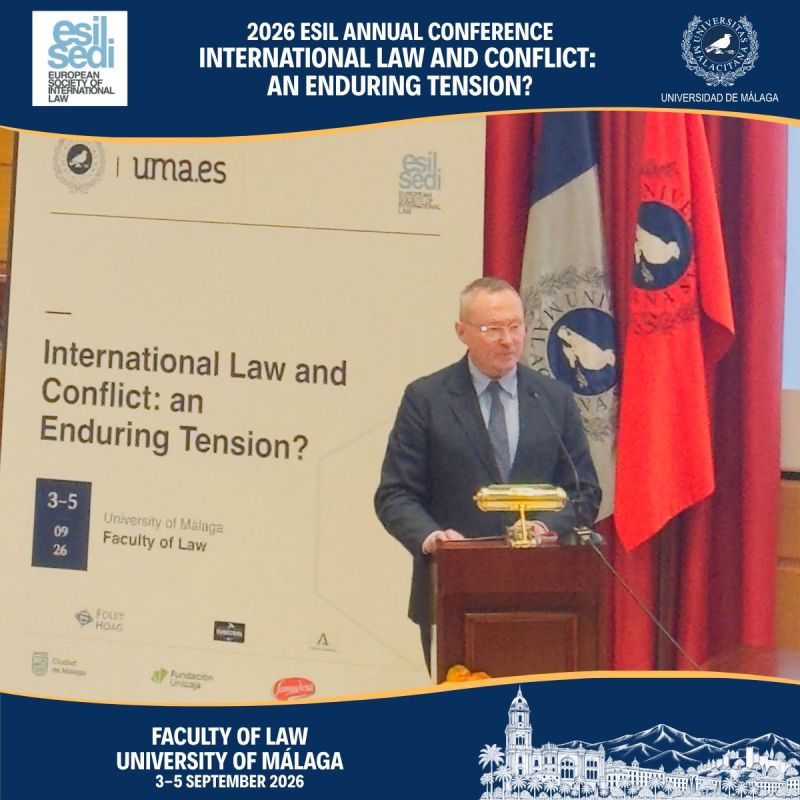


𝗛𝘂𝗺𝗮𝗻 𝗥𝗶𝗴𝗵𝘁𝘀 𝗮𝘀 𝗮 𝗥𝗼𝗮𝗱𝗺𝗮𝗽 𝗧𝗵𝗿𝗼𝘂𝗴𝗵 𝗚𝗹𝗼𝗯𝗮𝗹 𝗩𝗼𝗹𝗮𝘁𝗶𝗹𝗶𝘁𝘆 — 𝗥𝗲𝗳𝗹𝗲𝗰𝘁𝗶𝗼𝗻𝘀 𝗳𝗿𝗼𝗺 𝗘𝗦𝗜𝗟 𝟮𝟬𝟮𝟲
One of the highlights of the opening day of the European Society of International Law Annual Conference in Málaga was the keynote lecture delivered by Michael O’Flaherty, Commissioner for Human Rights of the Council of Europe: “International Human Rights Law: The Roadmap to Honour Human Dignity.”
A longer and more detailed version is available here: https://lnkd.in/eJsPxtTd/
Drawing on his experiences in Bosnia and Herzegovina, Sierra Leone, Northern Ireland, the establishment of the International Criminal Court, and the Council of Europe, O’Flaherty presented human rights law not as an abstract vocabulary of aspirations, but as an institutional architecture capable of preventing violations, saving lives, supporting peace, and transforming societies.
He situated that architecture within five mutually reinforcing sources of contemporary volatility: the continuing consequences of COVID-19; digitalisation and artificial intelligence; the climate crisis; extreme inequality; and pervasive violence—from Ukraine and Gaza to Sudan and the renewed risk of nuclear conflict.
Against this background, he defended human rights law as the “only credible roadmap” for honouring the dignity of everyone.
His discussion of migration and the Chișinău Declaration was particularly urgent. He called for public and legal discourse to remain rigorously evidence-based, defended the absolute principle of non-refoulement, reaffirmed the universality of human rights, and warned against weakening the independence of the European Court of Human Rights. Once a hierarchy of more and less “deserving” rights-holders is accepted, he asked, which unpopular group will be next?
His insistence that facts invoked to justify legal change must be impeccable resonated strongly with the framework I develop in my paper, “Epistemic Governance,” available on SSRN:
https://papers.ssrn.com/sol3/papers.cfm?abstract_id=6487038
The paper examines how law allocates epistemic authority: which evidence enters the legal record, who is recognized as an expert, whose knowledge becomes visible, and which claims are discounted or remain open to meaningful challenge. These questions recur in migration policy, judicial and administrative decision-making, artificial intelligence, climate and energy governance, and the treatment of Indigenous and local knowledge.
His warning that technology may substitute for human agency also resonated with questions explored in two chapters from Science, Technology, Policy and International Law (Routledge, 2024), which I published on“Science, Technology, Society and Law,” and “The Interlinkages Science–Technology–Law: Information and Communication Society, Knowledge-Based Economy and the Rule of Law.”
https://papers.ssrn.com/sol3/papers.cfm?abstract_id=4590213
https://papers.ssrn.com/sol3/papers.cfm?abstract_id=4590217
Those chapters examine how technological change reshapes knowledge, institutions, and the rule of law. In today’s algorithmically governed society, these questions have acquired even greater urgency: dignity must concern not only outcomes, but also who classifies, predicts, ranks, and decides—and whether affected individuals can understand, contest, and reshape those processes.
Among the questions I would have welcomed the opportunity to ask Michael O’Flaherty, Commissioner for Human Rights of the Council of Europe were:
• Who should govern the production and validation of the “impeccable” evidence on which legal reform is based, particularly when relevant data and models are controlled by governments or private technology companies?
• Does protecting human dignity in the age of AI require affirmative rights to explanation, meaningful human review, cognitive liberty, and effective contestation?
• How can human rights institutions respond to genuine experiences of alienation and disadvantage—conditions readily exploited by populism and disinformation—without accepting false causal narratives or bargaining away the rights of marginalized groups?
• How can we move from the formal recognition of universal rights to their effective enjoyment when individuals and communities lack the material, institutional, or epistemic capacity to exercise them?
O’Flaherty’s call to academics, universities, civil society, and human rights centres was equally important. Defending human rights requires protecting the independent institutions that produce knowledge, scrutinize power, challenge dominant narratives, and keep alternative futures imaginable.
The challenge is therefore not merely to preserve our human rights inheritance, but to build the institutional conditions necessary to deliver human rights better—and for everyone.
#ESIL #ESILAC2026 #HumanRights #InternationalLaw #HumanDignity #EpistemicGovernance #ArtificialIntelligence #AcademicFreedom #RuleOfLaw
Paolo Davide Farah, Paolo Farah
Related Scholarship by Paolo Davide Farah
Selected Bibliography
Books
- Artificial Intelligence, Governance and Sustainable Development: Peace, Justice and Strong Institutions, co-edited with Imad Antoine Ibrahim and Jon Truby, Routledge, 2026.https://www.routledge.com/Artificial-Intelligence-Governance-and-Sustainable-Development-Peace-Justice-and-Strong-Institutions/Ibrahim-Truby-Farah/p/book/9781032524047
- Science, Technology, Policy and International Law, co-edited with Justo Corti Varela, Routledge, 2024.https://www.routledge.com/Science-Technology-Policy-and-International-Law/Varela-Farah/p/book/9781032751139
- China’s Influence on Non-Trade Concerns in International Economic Law: Trade, Investment and Beyond, co-edited with Elena Cima, Routledge, 2016.https://www.routledge.com/Chinas-Influence-on-Non-Trade-Concerns-in-International-Economic-Law/Farah-Cima/p/book/9780367439897
- Globalization, Environmental Law, and Sustainable Development in the Global South: Challenges for Implementation, co-edited with Kirk W. Junker, Routledge, 2021.https://www.routledge.com/Globalization-Environmental-Law-and-Sustainable-Development-in-the-Global-South-Challenges-for-Implementation/Junker-Farah/p/book/9780367749262
Book Chapters and Related Contributions
- “Framing AI’s Role in Achieving SDG 16,” with Imad Antoine Ibrahim and Jon Truby, in Artificial Intelligence, Governance and Sustainable Development: Peace, Justice and Strong Institutions, Routledge, 2026.https://ssrn.com/abstract=5399415
- “The Intersections Among Science, Technology, Policy and Law: In Between Truth and Justice,” with Justo Corti Varela, in Science, Technology, Policy and International Law, Routledge, 2024.https://ssrn.com/abstract=4590214
- Science, Technology, Society and Law
- The Interlinkages Science–Technology–Law: Information and Communication Society, Knowledge-Based Economy and the Rule of Law
- “Water-Energy-Food Nexus in International Law: A Legal Analysis,” with Imad Antoine Ibrahim, in Handbook on the Water-Energy-Food Nexus, Edward Elgar Publishing, 2022, pp. 381–397.https://ssrn.com/abstract=4243774
Articles
- Five Years of China’s WTO Membership: EU and US Perspectives about China’s Compliance with Transparency Commitments and the Transitional Review Mechanism, 33 Legal Issues Econ. Integration 3, 263–304 (2006).
- When John Locke Meets Lao Tzu: The Relationship between Intellectual Property, Biodiversity and Indigenous Knowledge and the Implications for Food Security, 33 Duke Envtl. L. & Pol’y F. 297 (2024).
- Conflict between Intellectual Property Rights and Human Rights: A Case Study on Intangible Cultural Heritage, 94 Or. L. Rev. 125 (2015).
- The Implementation of the WTO Agreement on Trade-Related Aspects of Intellectual Property Rights (TRIPs) in China, 2 Tsinghua China L. Rev. 2, 317–51 (Spring 2010).
- China’s Water Environmental Management Towards Institutional Integration: A Review of Current Progress and Constraints vis-a-vis the European Experience, 113 J. Cleaner Prod. 285–98 (2016).
- Desirability of Commodification of Intangible Cultural Heritage: The Unsatisfying Role of IPRs, 11 Transnat’l Dispute Mgmt. 2, 2014.
- Global Governance and Intangible Cultural Heritage in the Information Society: At the Crossroads of IPRs and Innovation, in Daniele Archibugi & Andrea Filippetti (eds.), HANDBOOK OF GLOBAL SCIENCE, TECHNOLOGY, AND INNOVATION 462–79 (Oxford: Wiley Publisher 2015).
- Public Ownership and the WTO in a Post Covid-19 Era: From Trade Disputes To a ‘Social’ Function, 125 W. Va. L. Rev. 644 (2022).
- “Energy Trade and the WTO: Implications for Renewable Energy and the OPEC Cartel,” with Elena Cima, 16 Journal of International Economic Law 707–740 (2013).https://doi.org/10.1093/jiel/jgt024
- World Trade Organization, Renewable Energy Subsidies and the Case of Feed-in Tariffs: Time for Reform Toward Sustainable Development?, 27 Geo. Envtl. L. Rev. 515 (2015).
- Trade and Progress: The Case of China, 30 Colum. J. Asian L. 51 (2016).
- “Trade in Clean Energy Technologies: Sliding from Protection to Protectionism Through Obligations for Technology Transfer in Climate Change Law, or Vice Versa?,” with Anthi Koskina-Saridaki and Imad Antoine Ibrahim, 13 Journal of World Energy Law & Business 114–128 (2020).https://ssrn.com/abstract=3646993
- China’s Role and Contribution in the Global Governance of Climate Change: Institutional Adjustments for Carbon Tax Introduction, Collection and Management in China, 8 J. World Energy L. & Bus. 6, 581–99 (Dec. 2015).
- “China’s Energy Policies and Strategies for Climate Change and Energy Security,” with Haifeng Deng, 13 Journal of World Energy Law & Business 141–156 (2020).https://doi.org/10.1093/jwelb/jwaa018
- Evaluating China’s Environmental Management and Risks Avoidance Policies and Regulations on Offshore Methane Hydrate Extraction, 12 Sustainability 13, 5331 (2020).
- “A Comparison Between Shale Gas in China and Unconventional Fuel Development in the United States: Water, Environment and Sustainable Development,” with Riccardo Tremolada, 41 Brooklyn Journal of International Law 579–654 (2016).https://ssrn.com/abstract=2802157
- “Balancing Technological Innovation and Regulation: Safeguarding Societal Interests in the Age of AI,” JURIST, February 25, 2025.https://ssrn.com/abstract=5156010
- China’s Belt and Road Initiative and Its Impact on the Energy Independence of the European Union, Asian J. Law & Soc’y, 1 -30 (Cambridge Univ. Press 2025)
- China’s Path to Modernization and Legal Pluralism: Transplants and the Belt and Road Initiative, Asian J. Law & Soc’y, pp. 1 – 36 (Cambridge Univ. Press 2025)