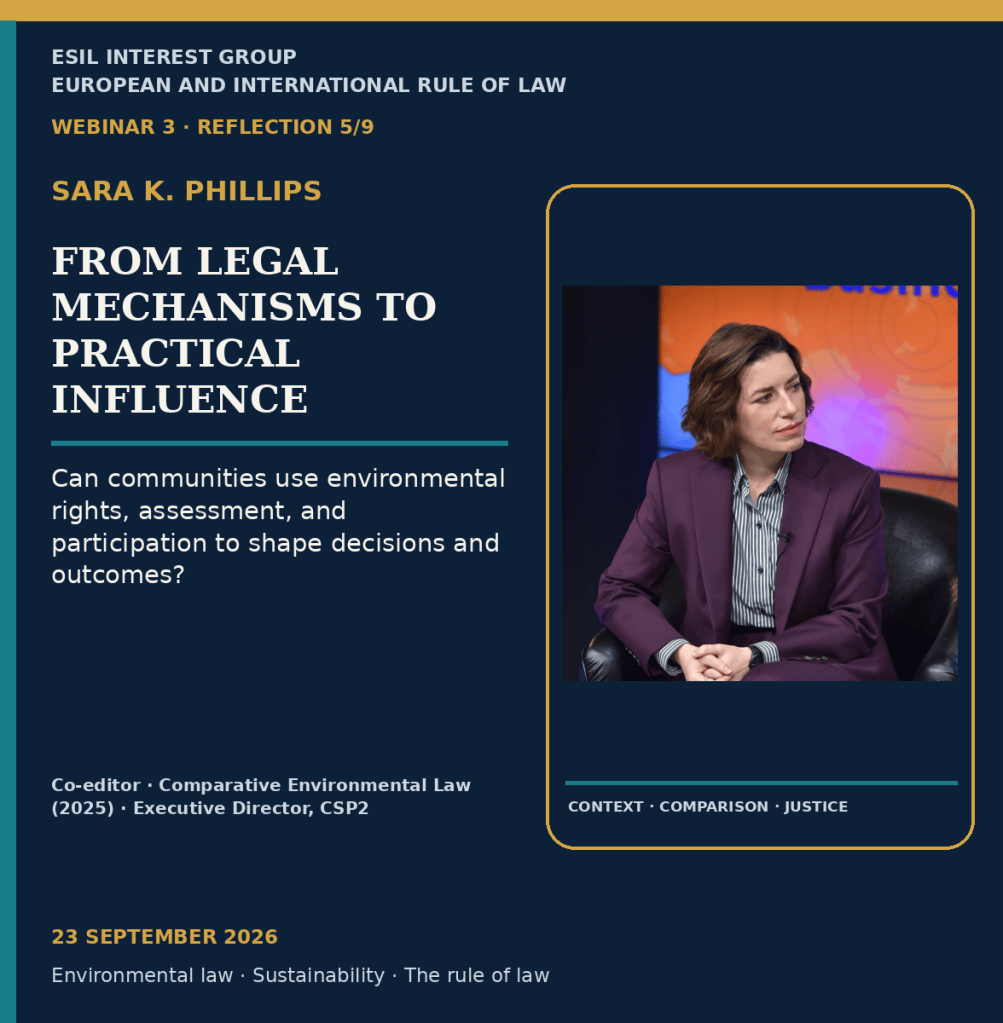

Sara K. Phillips: From Legal Mechanisms to Practical Influence in Environmental Governance – Reflections on ESIL Webinar 3 – Webinar 3 · Reflection 5/9
Sara K. Phillips’s contribution to the September 23, 2026 – European Society of International Law (ESIL) Interest Group on European and International Rule of Law Webinar, entitled From Environmental Law in Context to Comparative Environmental Governance: Justice, Sustainability, and the Rule of Law, asked what comparative environmental law can reveal about the practical operation of legal mechanisms. Presenting Comparative Environmental Law with Tseming Yang, she connected the volume to her interdisciplinary research and her work as Executive Director of the Center for Science in Public Participation.
Her perspective came from work with communities and Indigenous nations on mining-related issues. That practical setting sharpened the questions she brought to the discussion: who can use a legal mechanism, what authority does it carry, and can it influence decisions and outcomes?
Shared mechanisms, different effects
Environmental impact assessment offered an accessible starting point. Sara described its widespread adoption as an example of formal convergence while emphasizing that prevalence alone cannot establish effectiveness. A system may require an assessment process without requiring selection of an environmentally preferable option. Another system may give assessment a different substantive effect.
The comparison therefore needs to move from identifying the mechanism to investigating its operation. The relevant questions concern the obligations imposed on decision-makers, the status of the information produced, and the consequences of the process for a project.
Sara developed similar points through environmental human rights and public interest litigation. Related functions can be pursued through explicit environmental rights or through established rights such as life, health, or privacy. Different legal foundations matter for access, enforceability, institutional conduct, and remedies. Recognizing a functional relationship does not make the mechanisms interchangeable.
Mining and the interaction of institutions
Her own chapter on mining brought the wider governance system into view. A mining project can be governed through legislation, assessment procedures, human rights, contracts, voluntary standards, investment arrangements, and dispute-resolution mechanisms. Those sources may use similar terms while carrying different kinds of authority.
Transparency, consultation, consent, and accountability consequently need to be examined in operation. Can a community use a recognized right to influence project approval? Does disclosure lead to an institutional response? Can consultation alter a decision? How do contractual or investment protections affect the scope of public decision-making?
The answers depend on the interaction of mechanisms within a wider setting. A legal protection that appears strong on paper may have a different effect when another institution controls the relevant decision or when a competing arrangement limits the available response.
Comparison within jurisdictions
Sara’s response to the discussants widened the unit of comparison. Differences arise across countries, but they can also arise within a single jurisdiction. Formal law, administrative practice, cultural and community norms, corporate standards, and economic rationalities may coexist and compete.
This dimension of Sara’s intervention also connected with the broader framework of comparative environmental governance and legal pluralism that I had developed in preparing the webinar’s Speaker and Moderator Guide. As Chair, Moderator, and Discussant, I had raised questions about how different sources of normative authority interact, when institutional diversity reflects legitimate pluralism rather than exclusion, and whether formal opportunities for participation translate into meaningful influence over environmental decisions.
Sara’s contribution gave these questions a particularly valuable practical dimension through her examination of mining governance, illustrating how overlapping legal and normative arrangements affect the capacity of communities and Indigenous peoples to mobilize different forms of authority, assert their interests, and influence decisions that directly affect them.
This perspective avoids treating one jurisdiction as the unquestioned baseline. It also gives comparison a way to investigate internal differences rather than assuming that a national legal system operates as a uniform whole.
Empirical inquiry and meaningful participation
Sara proposed interdisciplinary and empirical approaches as a way to develop this contextual dimension. Environmental assessment presents opportunities to study knowledge, evaluation, participation, and decision-making at the project level.
The question is what affected communities can actually do. Can they shape the evidence considered? Can they help define the environmental problem? What power do they have within the decision process? Studying those matters can distinguish formal opportunities to participate from participation that carries practical influence.
Responding to my comments on epistemic governance, Sara connected these questions to the knowledge that institutions recognize and the power relations revealed by that recognition.
Her contribution made the connection especially concrete: information and participation need to be evaluated through their consequences for the people living with the decision.
An interdisciplinary agenda
In the closing round, Sara called for environmental law faculties to work across disciplines, including political science and the physical sciences. Students from different fields can build a shared understanding of environmental problems while contributing different forms of expertise.
As Chair, Moderator, and Discussant, I found her intervention valuable for connecting comparative methodology to institutional practice. The practical contribution of comparison is to clarify the function being sought, the conditions that make a mechanism effective, and the interactions that may support or undermine it.
Sara’s questions offer a demanding standard for environmental governance: examine whether rights, knowledge, and participation enable affected communities to shape the decisions that matter to them.
Event information and selected bibliography. Comparative Environmental Law. Center for Science in Public Participation.
Keywords/tags: Sara K. Phillips, CSP2, mining governance, public participation, Indigenous nations, environmental impact assessment, functional comparison, legal pluralism, empirical legal research, institutional accountability
This post forms part of the ESIL Interest Group on European and International Rule of Law Webinar Reflections series, which offers accounts of individual contributions and the wider intellectual exchanges generated by each event.
Explore the Complete Webinar 3 Reflections Series
ESIL Interest Group on European and International Rule of Law Webinar Series
Webinar 3 — From Environmental Law in Context to Comparative Environmental Governance: Justice, Sustainability, and the Rule of Law
September 23, 2026
This nine-part series documents the contributions and intellectual exchanges developed during Webinar 3, examining environmental justice, comparative environmental governance, legal education, sustainability, institutional accountability, and the rule of law.
Reflection 1/9 — Environmental Law, Justice, and Comparative Governance: Reflections on ESIL Webinar 3
[Link forthcoming]
Reflection 2/9 — Rebecca Bratspies: Teaching Environmental Law Through History, Justice, and Power
[Link forthcoming]
Reflection 3/9 — Carmen G. Gonzalez: Environmental Justice in Every Topic, Every Tool, and Every Statute
[Link forthcoming]
Reflection 4/9 — Tseming Yang: Comparative Environmental Law, Legal Cultures, and Learning Across Systems
[Link forthcoming]
Reflection 5/9 — Sara K. Phillips: From Legal Mechanisms to Practical Influence in Environmental Governance
[Link forthcoming]
Reflection 6/9 — Mekonnen Ayano: How Much Distance for Comparison, How Much Proximity for Justice?
[Link forthcoming]
Reflection 7/9 — Chinonso Tansi Anozie: Humanizing Environmental Law and Connecting Sustainability to Energy Justice
[Link forthcoming]
Reflection 8/9 — Paolo Davide Farah: From Comparative Environmental Law to Comparative Environmental Governance—Beyond Rules, Across Institutions and Contexts
[Link forthcoming]
Reflection 9/9 — Paolo Davide Farah: Who Decides What Counts as Knowledge? Environmental Justice and Epistemic Accountability
[Link forthcoming]
Webinar information, speakers, books, and selected bibliography:
https://paolofarah.wordpress.com/2026/09/05/european-society-of-international-law-esil-interest-group-on-european-and-international-rule-of-law-webinar-series-webinar-3-from-environmental-law-in-context-to-comparative-environme/
The ESIL Interest Group on European and International Rule of Law Webinar Reflections Series is conceived, coordinated, and edited by Professor Paolo Davide Farah, Chair of the Interest Group and Chair and Moderator of the Webinar Series. The reflections document and critically engage with the contributions of Rebecca Bratspies, Carmen G. Gonzalez, Tseming Yang, Sara K. Phillips, Mekonnen Ayano, Chinonso Tansi Anozie, and Paolo Davide Farah, recognizing their respective scholarly perspectives and the wider intellectual exchanges generated during the webinar. The series seeks to preserve, develop, and disseminate these contributions as part of an ongoing international scholarly dialogue. The reflections are editorial accounts of the discussions and do not necessarily represent the official positions of the Interest Group or the individual participants.
The recording is now available here:
Paolo Davide Farah, Paolo Farah