Two Papers, Two Panels, and a Common Question: Who Has the Authority to Define Knowledge, Law, and Our Collective Futures?
The full post is available at https://paolofarah.wordpress.com/2026/11/14/two-papers-two-panels-and-a-common-question-who-has-the-authority-to-define-knowledge-law-and-our-collective-futures/
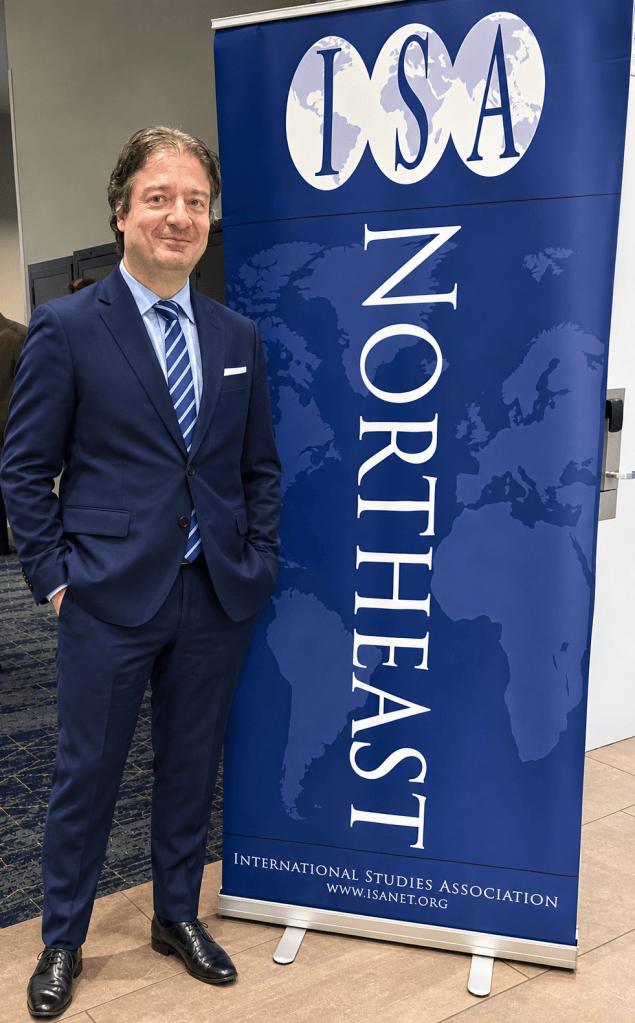
I had the pleasure of presenting two papers at the 2026 International Studies Association (ISA) Northeast Conference.
My first presentation, “Who Owns the Future? Intellectual Property, Artificial Intelligence, and the Governance of Knowledge,” was part of the panel Histories of Knowledge and Concepts.
My second presentation, “Indigenous Legal Orders and the Politics Beyond End Times: Pluralism, Resilience, and Alternative Futures,” was part of the panel The Polysemy of Legal Order.
Although addressing different subjects, both papers belong to my broader research agenda on epistemic governance, legal pluralism, international law, and the distribution of legal and political authority.
The conceptual and methodological frameworks of both new papers build upon my original research on Epistemic Governance, extending its central arguments into two distinct but interconnected areas of inquiry: artificial intelligence and intellectual property, on the one hand, and Indigenous legal orders and legal pluralism, on the other.
Available at : https://papers.ssrn.com/sol3/papers.cfm?abstract_id=6487038
The first examines how intellectual property and artificial intelligence shape the production, ownership, circulation, and control of knowledge.
The second explores how Indigenous legal orders challenge state-centered conceptions of sovereignty and offer alternative ways of understanding legal authority, environmental responsibility, and political futures.
Both ultimately raise a fundamental question: Who determines which forms of knowledge, authority, and governance are recognized as legitimate—and whose perspectives remain excluded?
I am particularly grateful to the panel chairs, fellow presenters, and participants for the thoughtful discussions, challenging questions, and constructive feedback.
I look forward to sharing further reflections on each paper and the conversations they generated.
Professor Paolo Davide Farah, University of Tulsa College of Law
#ISANortheast2026 #InternationalLaw #EpistemicGovernance #ArtificialIntelligence #IntellectualProperty #IndigenousRights #LegalPluralism #GlobalGovernance
Paolo Davide Farah, Paolo Farah